

Appel d'urgence sanitaire de l'OMS 2026
Resume — La crise humanitaire en Haïti s'est aggravée, atteignant une gravité sans précédent fin 2025. Ce document décrit les objectifs stratégiques et les besoins de financement de l'OMS pour faire face à l'urgence sanitaire en Haïti en 2026, en mettant l'accent sur les services d'urgence, la surveillance des maladies et la sécurité de la chaîne d'approvisionnement.
Constats Cles
- La crise humanitaire en Haïti s'est aggravée, atteignant une gravité sans précédent fin 2025.
- En octobre 2025, 1 412 199 Haïtiens (12 % de la population) sont déplacés à l'intérieur du pays.
- Le système de santé est au bord de l'effondrement, avec seulement 26 % des établissements de santé pour patients hospitalisés pleinement opérationnels à l'échelle nationale.
- La violence sexiste reste très répandue, avec 6 450 cas enregistrés entre janvier et août 2025.
- La transmission du choléra a persisté en 2025, avec près de 4 000 cas suspects au 8 novembre.
Description Complete
Ce document présente l'appel d'urgence sanitaire de l'Organisation mondiale de la santé (OMS) pour Haïti en 2026. Il souligne l'aggravation de la crise humanitaire en Haïti, exacerbée par la violence des gangs, l'effondrement institutionnel et les catastrophes naturelles. L'appel décrit les objectifs stratégiques de l'OMS pour 2026, qui comprennent la garantie de l'accès aux services de santé d'urgence et de soins primaires, le maintien de la surveillance des maladies et des mécanismes de réponse aux épidémies, et la sécurisation des opérations essentielles de la chaîne d'approvisionnement. Il détaille également l'évolution du rôle et de l'approche de l'OMS en Haïti, en mettant l'accent sur la durabilité, la localisation et l'efficacité face à la réduction du financement humanitaire et à l'escalade de la violence. Le document précise en outre les principales activités pour 2026, telles que le renforcement des établissements de santé, la sécurisation des médicaments essentiels et le déploiement d'équipes d'intervention rapide.
Texte Integral du Document
Texte extrait du document original pour l'indexation.
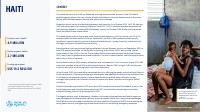
CONTEXT HAITI The humanitarian crisis in Haiti has deepened, reaching unprecedented severity by late 2025 due to escalating gang violence, the near collapse of state institutions and natural disasters such as Hurricane Melissa which caused extensive flooding and infrastructure damage. Rampant violence has led to massive displacement and insecurity. As of October 2025, 1 412 199 Haitians (12% of the population) are internally displaced. Since 2021, 701 614 Haitians have been deported from the Dominican Republic, including 226 668 between January and October 2025, further straining border health facilities and host communities. People in need - Health1 4.9 MILLION People targeted - Health1 2.7 MILLION Funding requirement US$ 19.2 MILLION 1 Figures represent health-specific People in Need and people targeted drawn from the Humanitarian Needs and Response Plan (HNRP) 2026 The health system is near collapse and under compounded pressures. In Port-au-Prince, only 37 of 100 inpatient health facilities remain functional. Nationwide, just 26% of 268 inpatient facilities are fully operational, severely restricting access to essential health services. Looting, insecurity and chronic fuel shortages continue to undermine service delivery. Armed violence continues to cause high casualties and injuries. Between January and September 2025, at least 6760 people were killed, including 2481 by lynching, and a further 50 621 were injured. Hôpital Universitaire La Paix (HUP) in Port-au-Prince treated 6365 trauma cases between January and October 2025, many linked to gunshot wounds and explosions. The lack of trauma centres, staff and supplies limits the country’s ability to respond. Gender-based violence (GBV) remains widespread and underreported. From January to August 2025, 6450 cases were recorded, of which 56% involved sexual violence. Women (79%) and girls (14%) are the main survivors, with most incidents reported in the Ouest department. In late October 2025, Hurricane Melissa worsened the crisis, affecting thousands across the Grand Sud and Ouest departments. Flooding destroyed agricultural lands, damaged health infrastructure and forced over 15 000 people into temporary shelters. Several health facilities reported water infiltration, power shortages and concerns over increased cholera risk due to poor water, sanitation and hygiene (WASH) conditions. Cholera transmission persisted in 2025, with nearly 4000 suspected cases as of November 8, mainly in the Ouest Department and internally displaced persons (IDP) sites. Mortality remains high and, without sustained funding, there is risk of resurgence in 2026. The ongoing security crisis, displacement, disasters, continued cholera epidemic and lack of resources have left large parts of the population without access to essential health care. Despite these challenges, PAHO/WHO continues to support the Ministry of Public Health and Population (MSPP) in maintaining life saving health services, strengthening disease surveillance and coordinating emergency responses. A young displaced mother and her children in an IDP site in the Metropolitan areas of Port au-Prince. Photo credit: PAHO/WHO WHO’s Health EmergencyAppeal 2026 1 WHO’S STRATEGIC OBJECTIVES 1. Ensure availability of and access to emergency, primary and life-saving health services: Prioritize the delivery of emergency and primary health services for the most vulnerable population groups, including pregnant women, children, IDPs, returnees and those injured due to violence. 2. Maintain and strengthen disease surveillance and outbreak response mechanisms: Enhance the capacity for timely detection and rapid response to disease outbreaks of epidemic potential such as cholera, malaria, diphtheria, measles or COVID-19. 3. Secure critical supply chain operations: Ensure a reliable supply of essential medicines and medical equipment amid security challenges. WHO’S CHANGING ROLE AND APPROACH: DELIVERING UNDER THE HUMANITARIAN RESET In 2026, PAHO/WHO will adapt its operational model in Haiti to meet the demands of a prolonged humanitarian crisis, emphasizing sustainability, localization and efficiency. As other actors progressively scale down or withdraw from health operations due to insecurity and funding constraints, PAHO/WHO will assume expanded responsibilities in life-saving health service delivery, emergency coordination and outbreak response. This includes maintaining national cholera surveillance, ensuring supply chain continuity for essential medicines and reagents and strengthening referral hospitals to provide emergency and obstetric care in underserved areas. At the same time, PAHO/WHO will continue to support the operational functions - such as direct community sensitization and field-level surveillance - of departmental health authorities and trusted local partners like Zanmi Lasante, thereby reinforcing national ownership and sustainability. Global trends, marked by reduced humanitarian funding, escalating violence and the localization agenda, require PAHO/WHO to operate more strategically, integrating humanitarian response within health system strengthening. The Organization will continue to support this through strengthened resource mobilization efforts toward nexus and development projects that will enable long-term sustainable actions to strengthen the national health system, working jointly with the MSPP and its technical units promoting co-coordination and joint accountability. In this context, PAHO/WHO will maintain its role as the direct implementing agency for critical health interventions while continuing to work closely with health authorities and local partners to enhance their capacity to deliver essential services and improve access to care. The organization will balance response operations with sustained technical support, ensuring the continuity of essential and life-saving health services amid crises and reinforcing the resilience of the Haitian health system. This approach aligns with the Humanitarian Reset principles, fostering a more effective, adaptive and nationally-anchored health response for Haiti’s most vulnerable populations. Malnutrition screening among displaced families, Port-au Prince, Haiti. Photo credit: PAHO/WHO WHO’sHealth EmergencyAppeal 2026 2 WHO 2026 RESPONSE STRATEGY In 2026, PAHO/WHO will continue to work in close partnership with the Ministry of Public Health and Population and its decentralized health directorates to strengthen national capacity for emergency response, disease surveillance and the delivery of essential health services. PAHO/WHO will provide technical support to integrate response activities into departmental operational plans, ensure institutional ownership and reinforce the leadership of the MSPP in coordination, policy development and implementation of health interventions at all levels. Collaboration with partners will remain central to PAHO/WHO’s approach. As co-lead of the Health Cluster alongside the MSPP, PAHO/WHO will continue to coordinate the humanitarian health response with United Nations agencies, non-governmental organizations, civil society and donors to ensure alignment with national priorities, avoid duplication and maximize collective impact. Through joint planning with key operational partners such as Zanmi Lasante, the United Nations Children’s Fund (UNICEF) and Médecins Sans Frontières (MSF), PAHO/WHO will sustain synergies between clinical care, community surveillance and WASH interventions in high-risk and hard-to-reach areas. The strategic focus for 2026 will centre on ensuring access to life- saving health and obstetric emergency care, maintaining and strengthening epidemic-prone disease surveillance and rapid response capacity and securing critical supply chain operations. Priority interventions will include reinforcing emergency care for vulnerable populations, guaranteeing the availability of essential medicines and medical supplies, deploying community health workers and surveillance teams in IDP sites and supporting rapid outbreak detection and response. In parallel, PAHO/WHO will continue to strengthen logistics and supply chain resilience by maintaining essential stockpiles, exploring alternative transport routes, and improving data systems for real-time decision-making. Through these actions, PAHO/WHO aims to enhance national health resilience, reduce mortality from preventable causes and ensure continuity of care for all, even in the face of chronic instability and continued exposure to natural hazards. OPERATIONAL PRESENCE PAHO/WHO’s workforce in Haiti comprises 106 national personnel, including consultants, and 24 international staff. They work across health emergency preparedness and response to disasters and epidemics, health systems and services, immunization, family health, health promotion and the life-course (including maternal health, gender-based violence, health equity, ethnicity, gender equality and cultural diversity), noncommunicable diseases (including mental health), communicable disease prevention and control, pharmaceutical supply management, communications and programme management. Of these, 10 assistant epidemiologists and 22 “labo-moto” nurses (motorbike-based nurses) are deployed across all 10 departments to support outbreak response. Given the current security situation and restrictions of access, PAHO/WHO also has set-up two field offices: one in the Nord department in Cap Haïtien, and one in the southern region in the Nippes department in Miragoâne, enabling the continued operations for PAHO personnel throughout the country. Additionally, PAHO/WHO’s operations in Haiti are directly supported by PAHO’s Regional Incident Management System Team (IMST), PAHO’s Emergency Operations Center in Washington DC and by PAHO’s Regional Strategic Reserve based in Panama. Vaccination of pregnant women against maternal and neonatal tetanus in the Nippes department. Photo credit: PAHO/WHO WHO’sHealth EmergencyAppeal 20263 KEY ACTIVITIES FOR 2026 o Maintain and strengthen capacities of health facilities and partners for emergency care delivery for vulnerable groups, including pregnant women, children, IDPs and those injured due to violence. o Secure essential medicines and medical supplies to manage urgent health needs. o Support health authorities to increase access to primary care for the population. o Deploy quick-response teams across the country, including “labo-moto” nurses to support sampling for epidemic prone diseases and community-based surveillance. o Ensure quality case managementfor cholera and other epidemic-prone diseases through targeted training and resource allocation. o Improve data reporting mechanisms to strengthen disease surveillance and inform public health responses nationwide. o Implement prompt vaccination campaigns and health interventions in high-risk areas, such as IDP camps, to prevent the spread of infectious diseases. o Ensure the continuous availability of medicines, medical supplies and laboratory reagents, including for the national transfusion centre and the national laboratory of public health. o Explore alternative delivery routes and logistics strategies to maintain uninterrupted health service provision throughout the country. I was wounded by a stray bullet in my left thigh. When I arrived at the hospital, they treated my leg and gave me medication to ease the pain. From the moment I got there, people stayed by my side, and the doctors never left me alone. A 23-year-old emergency care patient at the PAHO/WHO supported Hôpital Universitaire la Paix A diphtheria vaccination campaign in the North-East department. Photo credit: PAHO/WHO WHO’sHealth EmergencyAppeal 2026 4 KEY ACHIEVEMENTS IN 2025 In 2025, WHO has further strengthened health service delivery in Haiti by: o Delivering 46.5 metric tonnes of medicines and medical supplies to 41 health institutions nationwide between 1 January and 6 October 2025. o Distributing over 16.5 tonnes of medicines and medical and WASH supplies for the treatment of cholera to cholera treatment centres (CTCs) nationwide between 26 February and 29 September. o Supporting Hôpital Universitaire la Paix (HUP), providing free emergency care to 13 186 patients (including individuals injured by firearms) and performing 12 843 caesarean sections, with a 50% cost reduction for women in need, between January and October 2025. o Supporting the Ministry of Public Health and Population in its cholera response, resulting in 23 424 cholera cases receiving treatment in a CTC, 29 146 cholera cases being tested by laboratory and 10 455 cholera alerts being investigated between January and October 2025. o Treating 110 cases of severe acute malnutrition with complications in HUP’s nutritional stabilization unit, including 92 cases detected across 43 IDP sites, between January and September. o Supporting 226 survivors of gender-based violence (184 women and 42 girls under 18) with care at HUP. o Providing psychological support to 1698 women and girls in 30 IDP sites and referring them for medical care when needed. o Training 64 health professionals from HUP in breastfeeding promotion, reaching 67 000 people with breastfeeding awareness messages in 43 IDP sites, and sensitizing over 70 000 people on GBV- related issues across 30 IDP sites between February and September. Arrival of medical supplies at Toussaint Louverture International Airport, Port-au-Prince, Haiti. Photo credit: PAHO/WHO – David Lorens Mentor WHO’sHealth EmergencyAppeal 20265 IMPACT IN 2025 “I was assaulted by several people without my consent. I thought about taking my own life because I didn’t want what happened to become a source of shame for me or my children. The suicidal thoughts wouldn’t leave me, but when I finally received psychosocial support, I found real help, and with it, a glimmer of hope,” says F., 34, a survivor of sexual violence in Haiti. Her story reflects the growing toll of GBV amid escalating armed conflict and displacement. Since early 2024, Haiti has seen a sharp increase in sexual assaults, particularly in areas under gang control. Nearly 6500 GBV cases were reported in 2024, with 1250 additional cases recorded in just the first two months of 2025. More than 60% of these involve sexual violence, though experts believe the true figures are far higher due to fear, stigma and limited access to protection and care. SUPPORTING SURVIVORS: RESPONDING TO THE SURGE OF SEXUAL VIOLENCE IN HAITI F.34, a GBV survivor in the FLA IDP site of Port-au-Prince. Photo credit: PAHO/WHO – David Lorens Mentor In response, PAHO/WHO, in collaboration with the Ministry of Public Health and Population (MSPP) and local partners, is ensuring that survivors like F. receive lifesaving care and psychosocial support. Backed by the financial support of the Central Emergency Response Fund and the European Commission (ECHO), PAHO/WHO has strengthened GBV response services across displacement sites. Thirty-one psychologists and social workers have been trained and deployed to provide counselling, referrals and safe spaces for women and girls, and eight health facilities were equipped with post-rape care kits, gynaecological tables, sterile instruments and essential medicines to ensure survivors receive timely and compassionate medical treatment. Over 1698 people received GBV psychosocial support and case management, while 338 survivors have accessed GBV and sexual and reproductive health (SRH) medical assistance. By combining psychosocial care, medical response and community outreach, PAHO/WHO and its partners are helping survivors rebuild their lives with dignity, safety and hope. M.52, a GBV survivor in the FLA IDP site of Port-au-Prince. Photo credit: PAHO/WHO – David Lorens Mentor FOR MORE INFORMATION Julie Mauvernay | Resource Mobilization and Communications Lead a.i., Health Emergencies | AMRO (PAHO/WHO) | mauvernj@paho.org Giliane Magloire | Project Support Specialist, Health Emergencies | PAHO/WHO Haiti | magloireg@paho.org WHO’sHealth EmergencyAppeal 2026 6 WHO’S 2026 FUNDING REQUIREMENTS HAITI HUMANITARIAN CRISIS FUNDING REQUIREMENT BY RESPONSE PILLAR FUNDING REQUIREMENTS (US$ M) Collaborative surveillance 2.49 Laboratory systems, diagnostics and testing 0.58 Surveillance, case investigation and contact tracing 1.91 Community protection 3.68 IPC in the community 0.21 Risk communication and community engagement 0.53 Travel, trade, points of entry and gatherings 0.32 Vaccination 2.63 Safe and scalable care 8.09 Case management and therapeutics 3.89 Essential health systems and services 3.68 IPC within health care settings 0.53 Access to countermeasures 3.28 Operational support and logistics 3.28 Emergency leadership 1.63 Lead, coordinate, plan and monitor protracted response ops1.53 PSEAH in protracted emergency response operations 0.11 Total 19.17 A community health worker responding to a suspected cholera case in Pétion-Ville, Haiti. Photo credit: PAHO/WHO WHO’s Health EmergencyAppeal 2026 7 Confidential - Not for Public Consumption or Distribution