

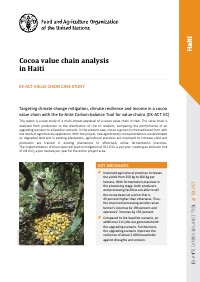
Analiz Chèn Valè Kakawo an Ayiti
Rezime — Rapò sa a prezante yon etid ka pwojè chèn valè kakawo an Ayiti a, li analize li depi nan pwodiksyon rive nan distribisyon an detay avèk zouti EX-ACT VC a. Etid la evalye mitigasyon klima a, adaptasyon ak rezilyans klima a, ak pèfòmans sosyo-ekonomik yo, li konpare yon senaryo amelyorasyon avèk yon senaryo referans.
Dekouve Enpotan
- Pratik agrikòl amelyore ogmante rannman soti nan 250 kg a 600 kg pa ekta.
- Pratik fèmantasyon ogmante pri pwa kakawo yo pa 45 pousan.
- Pwosesis amelyore ogmante revni kiltivatè yo pa 194 pousan ak revni operatè yo pa 156 pousan.
- Senaryo amelyorasyon an jenere 111 djòb adisyonèl.
- Senaryo amelyorasyon an amelyore rezilyans anviwon 2,000 fanmi kont sechrès ak erozyon.
Deskripsyon Konple
Etid ka sa a analize chèn valè kakawo an Ayiti a avèk zouti EX-ACT VC a, depi nan pwodiksyon rive nan distribisyon an detay. Li evalye mitigasyon klima a, adaptasyon, rezilyans, ak enpak sosyo-ekonomik yo. Etid la konpare yon senaryo referans, kote yo grandi kakawo tradisyonèlman avèk aplikasyon agroforestri ki ba, avèk yon senaryo amelyore ki enplike nouvo plantasyon kakawo agroforestri sou tè degrade, pratik agrikòl amelyore, ak fòmasyon nan pratik fèmantasyon. Senaryo amelyorasyon an mennen nan mitigasyon 552 tCO2-e pa ane, li kreye yon rezèvwa emisyon 0.8 tCO2-e pa ekta pa ane pou tout zòn pwojè a.
Teks Konple Dokiman an
Teks ki soti nan dokiman orijinal la pou endeksasyon.
Haiti Cocoa value chain analysis in Haiti EX-ACT VALUE CHAIN CASE STUDY Targeting climate change mitigation, climate resilience and income in a cocoa value chain with the Ex-Ante Carbon-balance Tool for value chains (EX-ACT VC) This report is a case study of a multi-impact appraisal of a cacao value chain in Haiti. The value chain is analysed from production to the distribution of rice to retailers, comparing the performance of an upgrading scenario to a baseline scenario. In the present case, cocoa is grown in the traditional form with low levels of agroforestry application. With the project, new agroforestry cocoa plantations are developed on degraded land and in existing plantations, agricultural practices are improved to increase yield and producers are trained in existing plantations to effectively utilize fermentation practices. The implementation of the project will lead to mitigation of 552 tCO2-e per year, creating an emission sink of 0.8 tCO2-e per hectare per year for the entire project area. KEY MESSAGES ◤ Improved agricultural practices increases the yields from 250 kg to 600 kg per hectare. With fermentation practices in the processing stage, both producers and processing facilities are able to sell the cocoa beans at a price that is 45 percent higher than otherwise. Thus, the improved processing activity raises farmer’s incomes by 194 percent and operators’ incomes by 156 percent. ◤ Compared to the baseline scenario, an additional 111 jobs are generated with the upgrading scenario. Furthermore, ©FAO/K. Boldt the upgrading scenario improves the resilience of about 2 000 households against droughts and erosion. Introduction This working document presents a case study of a multi-impact appraisal of the cocoa value chain project in Haiti. The value chain is analysed from production to the distribution of cocoa to retailers using the EX-ACT VC tool. EX-ACT VC is a tool derived from EX-ACT providing a multi-impact appraisal of food value chains in terms of climate mitigation, climate adaptation and resilience and socio-economic performances. This report includes a section on both the background of the cocoa value chain in Haiti and methodologies and guidance to use the tool. Objectives The main objectives of this case study are to test the tool, to verify whether the results are acceptable and to illustrate how it is possible to analyse a value chain by using EX-ACT VC. Moreover, it can help users to understand the multi-impact appraisal issued from a specific analysis, regardless of it being simplified. Data collection For this application on EX-ACT VC, data has been collected, used and derived from a feasibility study on a program called “Ak-kilma-tanyson” which supports both the reduction of vulnerability of different watersheds in Haiti and the adaptation of climate-smart agroforestry systems. Acknowledging the existence of several value chains, we only focus on the cocoa value chain appraisal and the reference terms that have been described specifically for this production. To complete the analysis, data from other sources have also been collected and used (in particular for processing and socio-economic analysis). Background Haiti is a small cocoa producer in terms of volume, producing around 5 000 tonnes of cocoa per year (on a global production of 4 million tonnes) as compared to 20 000 tonnes in 1960. With an average of 8 million USD (value of exported production per year for more than 5 years), cocoa production is the third most important export factor in Haiti. At least 130 000 people in Haiti directly depend on this value chain. The southern department in Haiti was historically a production zone which is no longer exploited. The old agroforestry systems of this area remain poorly managed. However, agro-ecological conditions suggest that this area is suitable for cocoa production. In 2011, cocoa was produced on a total of 18 000 hectares, with an average cultivation area per farm of only 3 000 square meters to 3 hectares. With an output of 300 kilograms per hectare, productivity is relatively low compared to the Dominican Republic where producers reach a yield of 3 000 tonnes per hectare, despite having similar agro-ecological conditions. Moreover, the type and the quality of cocoa both play an important role in terms of economic valuation. In the region of Grande Anse in Haiti, the majority of cocoa production is not fermented, but only dried. Without fermentation, cocoa cannot develop its distinct flavour that is needed in order to reach high-end consumer markets. However, the cocoa producers have the capacity to develop and place cocoa production on different markets, given the initial quality of their existing varieties. Currently, producers cannot target special consumers and don’t have access to more remunerative prices (45 percent increase for fermented cocoa). Therefore, local production in Haiti is widely under-exploited, providing the country with a great potential to expand this production in terms of produced volume, cultivated area and of cocoa product quality. Despite this low productivity and performance, cocoa represents more than 60 percent of total smallholder income in Haiti. It is thus an important source of income which can help to reduce the level of poverty in one of the poorest countries of the planet. Sixty percent of the countries’ population lives below the poverty line. The agricultural sector is the first source of revenue of the Haitian economy. Haiti is particularly affected by climate change, putting further pressure on the already highly vulnerable population. Developing sustainable value chains can therefore be a starting point to reduce ecological degradation (soil erosion, water management, etc.), increase agricultural productivity, contribute to improving smallholder income and generate new assets to cope with climate shocks. To improve the cocoa value chain in the southern department in Haiti, the following actions are planned to be undertaken: • pursue rehabilitation and plantation of cocoa; • train producers to undertake and manage fermentation processes in order to commercialize cocoa through value-addition to high-end markets; • build a stakeholder group and value production by certification. Within this case study, an ex-ante multi-impact appraisal is realized to estimate climate mitigation, climate resilience and socio-economic performance for both the current situation of the value chain and the upgrading scenario. Comparing both results will allow us to identify towhat extent the upgrading scenario can be a solution for the rural population of southern Haiti in terms of mitigation and adaptation to climate change. Methodologies and tool used EX-ACT VC tool EX-ACT VC is a tool derived from EX-ACT (EX-Ante Carbon-balance Tool), developed by FAO in 2009. EX-ACT VC is an Agriculture, Forestry and Other Land Use (AFOLU), processing and transportation framework of 8 Excel modules that provides co-benefits appraisals of crop-based value chains in developing countries on GHGs emissions, climate resilience and income. The EX-ACT VC aims at helping designing performant and sustainable value chains. The methodology provides both a quantified socio-economic appraisal of value chain both at micro and meso levels (by agent, by group and for the whole chain) and an environmental carbon-balance appraisal of the value chain impact, in terms of climate mitigation, adaptation and value chain resilience: ◤ The impact on climate mitigation is reflected through quantitative indicators, derived directly from the EX-ACT tool. These indicators are used to obtain and analyse the mitigation impacts in terms of tonnes of carbon dioxide equivalents (tCO2-e) of the project. The carbon footprint of the product is calculated for the whole value chain and at different stages, in order to analyse the environmental performance of the chain. The equivalent economic return is also determined and could be an important aspect to be considered when attempting, for example, to access payments for environmental services. ◤ Value chain resilience is assessed using simple quantitative but also qualitative indicators. Adaptation indicators measure the reduction of vulnerability of people, livelihoods and ecosystems to climate change. ◤ The socio-economic impact of the value chain is assessed in terms of value-added, income and employment generation using a socio-economic appraisal component of the value chain. Developing a sustainable cocoa value chain The project aims at developing new agroforestry plantations to improve existing cocoa plantations and train producers to effectively use fermentation practices for a period of 5 years in the region of Grande Anse within the southern department of Haiti. In the baseline scenario, it is assumed that cocoa plantations would be grown in the same way as in the current situation, i.e. cocoa is grown traditionally and the application of agroforestry remains low. Three activities take place in the upgraded production scenario, which are accounted for in the EX-ACT VC tool as follows: (1) Land use change, (2) Agricultural practices and (3) Processing. Module: Land use change The first activity is the development of new agroforestry cocoa plantations on degraded land that has been abandoned in the southern department of Haiti. This land provides the suitable agro- ecological conditions for the development of cocoa production. In the non-forest land use change section, 100 ha of new cocoa plantation can be added in the area transformed from degraded land – initial use, to Perennial/ Tree Crop – final land use for the upgrading scenario. Figure 1. Land use change module – Non forest land use change section Module: Agricultural practices A complementary activity to this upgrading scenario is the improvement of existing cocoa plantations that are less productive compared to cocoa plantations with the same agro-ecological conditions as the Dominican Republic. The improvement takes place on an area of six hundred hectares and consequently increases the yields from 250 kg to 600 kg per hectare. As you can see below, the cultivation of perennials on degraded land of the upgrading project (Land Use Change module) is automatically accounted for in this module. Figure 2. Agricultural practices module – Perennial systems section Module: Productions input No mechanization is observed on cocoa plantations, meaning that there is no energy consumption. This can mainly be explained by the small size of agricultural plots (on average between 0.3 and 3 hectares). The improvement hence requires more labour force to manage fertility, to trim trees and to add inputs. The access and efficient use of fertilizers is an important factor in the improvement of cocoa plantations. For the Haiti project, the following inputs were applied: manure, chemical fertilizer and herbicides. Figure 3. Production inputs module – Fertilizer and pesticides consumption section Module: Processing As soon as the farmers have harvested the cocoa pods from the tree, some of the most crucial work begins to make fine, high-grade chocolate. This second step is crucial for the upgrading scenario and hence also for value addition. The beans must be carefully fermented to bring out the very best flavours. This requires additional labour force and an increased use of wooden boxes. It is important that the fermentation process happens as quickly as possible, since the beans begin to germinate as soon as the fruit has been picked. The fermentation requires wooden pallets representing 50 kg per tonne of fermented cocoa. This replaces the conventional use of plastic to dry beans (representing 3 kg per tonne of cocoa). Jute bags are used afterwards to pack the fermented beans and to transport them to the wholesaler. The Jute bags’ weight is equivalent to 2 kg per tonne of cocoa production. With good fermentation management, a significant decrease of loss of production from 5 to 3 percent is expected to be observed. Module: Transportation The boxes used for cocoa fermentation are located in the local cooperative, where the beans are mixed with beans from other local farms during and after fermentation. The cooperative is on average 10 km away from the 2 100 cocoa-producing farms. Targeting the European market with high-end chocolate, cocoa is then transported from processing facilities to the closest harbour by truck. From the harbour, the cocoa is exported to Europe by international water containers. Once the cocoa reaches Europe, it is distributed to wholesalers and retailers mostly by truck. The cocoa beans do not need any specific type of conditioning once they are fermented. Figure 4. Transport module – Type of transportation section Module: Socio-economic analysis This part of the analysis sets the focus on climate resilience and socio-economic performance benefits to the population in Haiti. Therefore, socio-economic performance of European wholesalers and retailers will not be analysed in this case study. Including both operators would significantly increase the level of complexity, as a variety of different operators and transformations would have to be taken into account. The upgrading project scenario, this is to say the production of fermented cocoa beans, allows producers to target a new international market with more remunerative prices. There is a 45 percent increase in prices of fermented cocoa beans as compared to conventional cocoa beans. The tool allows users to include this additional remuneration at the different levels of the value chain in Haiti. Hence, both producers and processing facilities (local cooperatives) sell the produced cocoa beans with a price increase of 45 percent. Cost of input and consumable supplies are calculated using prices in local currency per tonne of cocoa. The different quantities in tonnes of cocoa can be drawn from the previous modules. An example of the socio-economic data that has to be integrated for the production phase can be found below. As described above, labour force increases within the upgraded value chain have to be accounted for in the different sections of the economic analysis module in man-day per hectare or per tonne of production. For instance, an increase from 28 to 53 man-days per hectare is assumed for the production part within the upgrading project scenario. In the module, prices are in local currency and remain the same in both situations. In other words, the official exchange rate of one USD to the local currency must be specified. Figure 5. Economic analysis – Production section Module: Climate resilience The climate resilience module is a qualitative appraisal of the coping ability of the upgraded cocoa value chain to natural shocks. This includes, among others, the buffer capacity of households in terms of food security, the resilience and self-organisation of households and the market resilience and adaption capacity of the value chain. A set of questions has to be answered, by inserting values between 0 and 4, 4 meaning a high (and 0 a low) buffer capacity of the value chain to natural shocks. An assumption for every sub-index was made in this case. Figure 6. Economic analysis – Production section Results When clicking on the VC results, the user can review the multi-impact appraisal realized in this analysis. Climate mitigation dimension Both situations create a carbon sink due to current perennial plantations. However, improving and expanding agroforestry cocoa plantations creates a higher sink. Indeed, the upgrading scenario mitigates 552 tCO2-e per year, or in other words it creates an emission sink of 0.8 tCO2-e per hectare per year for the entire project area. The carbon footprint of the value chain is currently low, but even lower within the upgrading project scenario, corresponding to a decrease of 0.7 tCO2-e per tonne of product. In the detailed carbon footprint shown below, the processing of cocoa beans in the upgrading scenario leads to a slight increase of GHG emissions per tonne of product. This can be attributed to the use of new wooden boxes for fermentation, while the cocoa processing in the baseline scenario only requires plastic bags. However, this slight increase in GHG emissions of the processing of cocoa in the upgrading scenario is largely offset by the decrease in emissions from the production. Assuming a price of 10 USD per tCO2-e, the upgrading project scenario leads to additional earnings of 8 USD per hectare per year. Figure 7. Detailed carbon footprint Value chain resilience In terms of quantitative appraisal of the value chain resilience induced by upgrading the cocoa value chain, it is to highlight that the previous agroforestry system already generated benefits in terms of landslide and flood resilience. However, the new cocoa plantations on previously degraded land increases the total area in hectares with increased soil carbon. The upgrading scenario hence further improves the resilience of about 2 000 households against droughts and erosion. Figure 8. Climate resilience, quantitative appraisal In terms of qualitative appraisal, the results show that there is only a moderate improvement of global climate resilience with the upgraded value chain. Indeed, the buffer capacity of the cocoa production as shown in Figure 6 is indicated as “low”. Socio-economic performances of the value chain The socio-economic analysis only corresponds to the value chain in Haiti, from the production stages to the delivery of the cocoa beans to the harbour for export. The aggregated socio-economic performance shows an important increase in terms of value-added and gross production value within the upgrading project scenario. The detailed results are derived from the socio-economic performances module and show that this value-added is mainly generated at processing level, with the fermentation of the cocoa beans. Indeed, fermentation raises cocoa prices by 45 percent and this corresponds to more than half of the total value-added in the upgrading scenario. Both farmers and operators are better off in the upgrading scenario and the income is distributed more equally. The improved processing activity raises farmers’ incomes by 194 percent (from 71 USD to 209 USD) and operators’ incomes by 156 percent (from 1 351 USD to 3 464 USD). Figure 9. Aggregated socio-economic performances Both scenarios create additional employment, mainly occurring in the production sectors of rural areas. Yet, compared to the baseline scenario, an additional 111 jobs are generated with the upgrading scenario. EX-ANTE CARBON-BALANCE TOOL [EX-ACT] The EX-Ante Carbon-balance Tool (EX-ACT) is an appraisal system developed by FAO providing estimates of the impact of agriculture and forestry development projects, programmes and policies on the carbon-balance. The tool helps project designers estimate and prioritize project activities with high benefits in terms of economic and climate change mitigation, and it helps decision-makers to decide on the right course to mitigate climate change in agriculture and forestry and to enhance environmental services. EX-ANTE CARBON-BALANCE VALUE CHAIN TOOL [EX-ACT VC] EX-ACT VC is a tool derived from EX-ACT (EX-Ante Carbon-balance Tool), developed by FAO in 2009. EX-ACT VC is an AFOLU, processing and transportation framework of 8 Excel modules that provides co-benefits appraisal of crop-based value chain in developing countries on GHGs emissions, climate resilience and income. The EX-ACT VC aims at helping designing performant and sustainable value chains. The methodology provides both a quantified socio-economic appraisal of value chain both at micro and meso levels (by agent, by group and for the whole chain) and an environmental carbon-balance appraisal of the value chain impact, in terms of climate mitigation, adaptation and value chain resilience. CONTACTS www.fao.org/tc/exact Laure-Sophie Schiettecatte – lauresophie.schiettecatte@fao.org This appraisal was elaborated by Louis Bockel, Policy Support Officer, Agricultural Development Economics Division, FAO, Orane Debrune, Consultant, Agricultural Development Economics Division, FAO and Laure-Sophie Schiettecatte, Senior Consultant, Agricultural Development Economics Division, FAO. The authors thank the World Bank for the materials provided and for the support granted for the project analysis. CA5398EN/1/07.19 © FAO, 2019 Some rights reserved. This work is available under a CC BY-NC-SA 3.0 IGO licence