

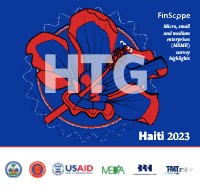
FinScope MSME Haiti 2023: Micro, Small and Medium Enterprises Survey Highlights
Summary — A comprehensive national survey of over 5,000 MSMEs in Haiti conducted in 2022-2023 to assess their size, scope, and financial inclusion levels. The study reveals that MSMEs represent 10% of Haiti's adult population and are predominantly informal with limited access to formal financial services.
Key Findings
- Only 11% of MSMEs are formally registered or licensed, indicating extremely high informality levels.
- Women represent 67% of MSME owners, with their businesses predominantly being micro-enterprises in the trade sector.
- MSMEs employ over 1.1 million people, representing a significant portion of Haiti's workforce.
- 65% of MSMEs are located in urban areas, with concentration in Artibonite, Ouest, and Sud departments.
- Nearly half (49%) of MSMEs are established or mature businesses operating for six years or more.
Full Description
The FinScope MSME Haiti 2023 survey represents the first comprehensive national study of micro, small, and medium enterprises in Haiti, conducted by FinMark Trust in partnership with local and international stakeholders. The study surveyed over 5,000 business owners across all departments to establish a baseline understanding of the MSME sector's contribution to Haiti's economy.
The survey reveals that approximately 660,845 adults own MSMEs, representing 10% of Haiti's adult population, with these businesses employing over 1.1 million people. The sector is characterized by high levels of informality, with only 11% of businesses being formally registered or licensed. Women represent 67% of MSME owners, though their businesses are predominantly micro-enterprises operating in the trade sector.
Geographically, most MSMEs are concentrated in the Artibonite, Ouest, and Sud departments, with 65% located in urban areas. The businesses span four main sectors: services (66%), trade (18%), agriculture (9%), and industrial activities (7%). Nearly half of all MSMEs are established or mature businesses, having operated for six years or more.
The study identifies significant challenges facing the sector, including limited access to formal financial services, governance issues, and the need for digital transformation. The research aims to inform evidence-based policy decisions and provide a foundation for monitoring the sector's development and financial inclusion progress over time.
Full Document Text
Extracted text from the original document for search indexing.
HTG Micro, small and medium enterprises (MSME) survey highlights Haiti 2023 20 years of making work for the poor OVERVIEW Partnering for MSME development FinScope MSME Haiti was designed to involve a range of stakeholders engaging in a comprehensive consultation process. This enriches the survey and ensures appropriateness and stakeholder buy in. The Bank of the Republic of Haiti HTG The cover symbol Through the evidence-based FinScope Survey, we hope to effect real change at country level and see the impact of financial inclusion on broader chaired the reference group (RG) which comprised of Mennonite Economic Development Associates (MEDA) and Diagnostic & Development Group SA (DDG) with expert technical assistance and project management from FinMark Trust (FMT). The survey was funded by the Bank of the Republic of Haiti and United States Agency for International Development (USAID) through the ATTEINDRE project implemented by MEDA. I national growth and development. The cover graphic features a flower synonymous to Haiti. The flower symbolizes growth and development while the circle represents inclusive growth. Each flower is an example of the successful growth in a unique environment. By combining the flower with the currency symbol of Haiti we represent the characteristics of the country, linking financial inclusion with successful growth. MINISTRY OF ECONOMY AND FINANCE AND BANK OF REPUBLIC OF HAITI – INTRODUCTORY WORDS The Ministry of Economy and Finance (MEF) and the Bank of the Republic of Haiti (BRH) are delighted to announce the publication of the national survey report on Micro, Small, and Medium Enterprises (MSMEs) titled FinScope MSME Haiti 2023. This essential work was conducted under the direction of the Coordination and Monitoring Committee for the National Financial Inclusion Strategy (CSSNIF). This initiative was co-financed by the United States Agency for International Development (USAID) and the Government of Haiti. It was spearheaded by the Central Bank of Haiti (BRH) and Mennonite Economic Development Associates (MEDA), the implementor of the USAID-funded ATTEINDRE project. The study was conducted by FinMark Trust, an international firm, in partnership with Diagnostic & Development Group (DDG), a Haitian firm. We would like to emphasize that this project results from a dynamic collaboration among various national actors brought together in a steering committee that includes representatives from key ministries and public and private institutions, such as the Ministry of Commerce and Industry (MCI) through the Investment Facilitation Center (CFI), the Ministry of Economy and Finance through the General Directorate of Taxes (DGI), the Haitian Institute of Statistics and Informatics (IHSI), the Bank of the Republic of Haiti, the U.S. Agency for International Development (USAID), Mennonite Economic Development Associates (MEDA), Quisqueya University, the Center for Applied Planning and Economics Techniques (CTPEA), the Industrial Development Fund (FDI), Alternative Insurance Company (AIC), Digicel, the Haitian Alliance for Inclusive Finance (AHFI), Groupe Croissance, the Chamber of Commerce and Industry of Haiti (CCIH), and the American Chamber of Commerce in Haiti (AMCHAM Haiti). The FinScope MSME study provides an in-depth analysis of the profile and situation of Micro, Small, and Medium Enterprises (MSMEs) in Haiti. Through quantitative and qualitative data collected from over 5,000 formal and informal businesses, it it sheds light on recent dynamics, challenges to overcome, and opportunities to seize. These findings aim to inform development strategies, guide investment decisions, and and strengthen the framework for supporting MSMEs. In most developing countries or globally, micro, small, and medium enterprises (MSMEs) represent a significant share of employment. In both developed and developing countries, these enterprises contribute two-thirds of total employment (World Bank, 2019). In developing countries in particular, small businesses can be a crucial driver of social inclusion, notably by enabling women to participate in economic activities. II MINISTRY OF ECONOMY AND FINANCE AND BANK OF REPUBLIC OF HAITI – INTRODUCTORY WORDS The vast majority of micro, small, and medium enterprises share certain characteristics, the main ones being labor-intensive production methods and the small size of the business in terms of turnover and employee numbers. In most countries, small and medium enterprises (SMEs) refer to companies employing between ten (10) and 250 people. Businesses employing fewer than ten people are generally called "micro enterprises" (WTO, 2016). In Haiti, although no official definition is adopted, most micro-enterprises are usually considered part of the informal sector. In 1998, the informal sector accounted for 90% of Haiti's labor force (Lumarque, 1998). In 2023, it represented over 70% (Bernardin, 2023), showing its overwhelming dominance in the country's economic landscape. Furthermore, private employment in Haiti is mainly informal, with more than 90% of the workforce engaged in jobs outside the formal sector's regulatory oversight. In May 1999, it comprised over 85% of all non-agricultural jobs according to a publication by the Haitian Institute of Statistics and Informatics (IHSI), Economic Establishments by Sector – May 1999. In March 2008, the Professional Association of Banks (APB) defined SMEs in Haiti as businesses III with between ten (10) and 100 employees, an annual turnover between five (5) and 50 million HTG, and assets of up to a maximum of 50 million HTG. Given the informal sector's significance in the Haitian economy, certain criteria should be included in an MSME definition: • The company’s workforce, indicating the number of jobs created • The company’s assets • The turnover Specific Definitions: • A micro-enterprise is a formal or informal business that employs up to five (5) people and has an annual turnover not exceeding 2.5 million gourdes. • A small enterprise is a formal or informal business that employs between five (5) and 20 people, with a turnover or balance exceeding 2.5 million gourdes but not exceeding 20 million gourdes. • A medium enterprise is a formal business employing between 20 and 100 people with a turnover not exceeding 50 million gourdes. MINISTRY OF ECONOMY AND FINANCE AND BANK OF REPUBLIC OF HAITI – INTRODUCTORY WORDS Business Category Annual Turnover (HTG) Number of Employees Micro enterprise Less than 2.5 million 1 to 5 Small enterprise 2.5 to 20 million 5 to 20 Medium enterprise 20 to 50 million 20 to 100 General Definition: A business is considered an MSME if it meets the following two criteria: a workforce between 1 and 100 employees and an annual turnover of less than 50 million gourdes. MSMEs, often a source of innovation and diversity in our country, are a fundamental pillar of our economy. They represent a significant share of employment and gross domestic product (GDP). Thanks to their agility, they can quickly respond to fluctuations in our context. However, MSMEs face significant challenges such as governance issues, access to financing, limitations in financial education, increased competition, and the need for digital transformation. Moreover, it is crucial to consider gender disparities that affect women entrepreneurs’ access to resources and opportunities. In this context, data collection is essential to foster financial inclusion, ensuring that businesses led by both women and men have equitable access to the necessary tools for success. We firmly believe that supporting this sector is crucial for strategic decision-making to stimulate economic growth, encourage innovation, and promote socio economic inclusion. By implementing suitable policies and creating an enabling environment, we can allow MSMEs to innovate and thrive, thus contributing to building a more resilient and inclusive economy. We believe that this report will serve as a reference tool for policymakers, financial sector actors, technical institutions, and all national economic agents. May its findings inspire and strengthen your commitment to MSMEs, the true engines of our economy. Together, let us build a prosperous future where these businesses thrive and energize our economy! IV MINISTRY OF ECONOMY AND FINANCE AND BANK OF REPUBLIC OF HAITI – INTRODUCTORY WORDS M. Alfred Fils Metellus Minister of Economy and Finance (MEF) V M. Ronald Gabriel Governor of the Bank of the Republic of Haiti (BRH) Port-au-Prince, October 7, 2024 Introduction The MSME sector is recognized as a significant contributor to economic growth, development and mass employment. With this knowledge, the crucial role of MSMEs in the national economy anchors on the roles of government, the business community and the public at large to harness and optimize the sector’s development. The lack of recent, holistic and reliable information about the MSME sector was identified to be a significant barrier from past consumer surveys. It is in this pursuit that the Bank of the Republic of Haiti initiated the first FinScope survey to set a baseline of both sector developments and financial inclusion. Methodology The FinScope MSME Survey Haiti 2022 was conducted with a sample of 5310 adult business owners who were selected from their businesses and at household level across the country. The sampling frame and data weighting was done by a sampling expert in consultation with FMT and had the following characteristics: • Business owners are 15 years or older • Business owners consider themselves to be business owners/generating an income through small business activities • Businesses employ less than 251 employees • National, regional and urban/rural representative sample OVERVIEW Survey objectives • To assess the size and scope of micro, small, and medium enterprises (MSMEs) in Haiti • To describe the levels and landscape of access to financial products and services (both formal and informal) • To identify the most binding constraints to MSMEs development and growth with a focus on access to markets • To support evidence-based policy and provide reliable baseline for monitoring and evaluation of initiatives and contribution to critical studies on the sector • To segment the MSME sector into market segments and identify the needs of different segments to stimulate related product innovation • To set a baseline of both sector developments and financial inclusion in Haiti using the FinScope MSME Haiti 2023 as a benchmark and to provide an assessment of changes and factors in the future (including possible impacts of future interventions) VI DEPARTMENTS OF HAITI Distribution of MSMEs by departments • Majority of the MSME businesses are located in Artibonite, Ouest and Sud departments. Nord-Ouest Artibonite Ouest Sud Grand'Anse Nord-Est 23 21 7 7 21 Nord Artibonite Nord-Est Centre Nord 6 Nord-Ouest 6 Sud-Est 6 Grand'Anse Ouest Nippes Sud Sud-Est Nippes Centre 5 4 660 845 MSME owners Employing 1 122 557 Employees* Full + Part time + Seasonal SIZE AND SCOPE OF THE MSME SECTOR Note exchange rate used was as of June 2023 1HTG = 0.0077$ Owning 710 337 MSMEs Estimated turnover (Annual) HTG 485,228,348,875.26 (3 736 258 286,34 USD) 1 SIZE AND SCOPE OF THE MSME SECTOR Business owners 15 years or older 89% % of individual 250 employees or less 7 million 10% (660 845) Estimated % of adult population that owns MSMEs entrepreneurs ESTIMATED ADULT POPULATION OF HAITI 2 710 337 Number of MSMEs they own 11% % of businesses with employees 1 122 557 Number of employees 11% % of MSME owners with registered/licensed businesses DEFINING MSMES FOR THIS SURVEY Business definition by the number of employees MICRO-ENTERPRISE SMALL ENTERPRISE MEDIUM ENTERPRISE Other definitions of MSMEs Turnover less than 0.5 M HTG Turnover between 0.5 – 2 M HTG 71.15% Turnover more than 2 M HTG Using number of employees MCI Using turnover MCI Micro business No. of businesses: 505 405 23.90% Small business No. of businesses: 169 771 4.95% Medium business No. of businesses: 35 162 DGI Development and Microfinance Agency It should be noted that a definition based on the number of employees (micro enterprise: 1 employee, small enterprise: 2-4 employees, and medium-sized enterprise: more than 4 employees) would give a similar distribution of MSMEs. *The proposed definition makes it possible to compare MSMEs in Haiti with other economies of similar size. *The steering committee of the National Strategy for Financial Inclusion will work on the implementation steps and make any necessary adjustments. 3 BUSINESS SECTOR VIEW • MSMEs operate predominantly in the trade and agriculture sector. 66% Trade wholesale retail, accommodation, real estate activities. Agriculture 18% 9% 7% Industrial mining, manufacturing, construction, gas supply, agricultural processing. Service personal services, education, financial and insurance, professional services. BUSINESS SECTOR SPLIT (%) 4 Agricultural Service Trade Industrial Agricultural 4% 16% 21% 13% 11% 13% 30% 33% 33% MSMES BY SECTOR FEMALE MALE 50% • About 7% of women-owned businesses are formal, majority of these are in the trade sector. 15-24 YEARS 25-35 YEARS Service Trade Industrial 26% 7% 34% 11% 52% 46% 5 SIZE AND SCOPE OF THE MSME SECTOR Business life cycle by business age (years) • Segmenting MSMEs by age is the simplest way to differentiate businesses that are in the process of establishing and formalizing their processes. • Age is another dimension that can be used as a requirement for funding and business support especially businesses that have survived beyond the 3 years of existence. BUSINESS AGE 7% 17% 27% 21% 28% LESS THAN A YEAR START UP 0 - 2 years GROWTH 3 - 5 years ESTABLISHED 6 - 10 years MATURE >10 years Almost half (49%) of MSMEs in Haiti are established or mature ranging from six years or older. 6 15-24 YEARS 25-35 YEARS BUSINESS LIFE CYCLE BY YOUTH AND GENDER • The proportion of youth business owners tends to decline as the firm ages. 30% 24% 26%28% 28% • More youth owners in start ups. 21% 11% 12% 6% 14% LESS THAN A YEAR FEMALE MALE START UP 0 - 2 years 18% 16% GROWTH 3 - 5 years 28% 25% ESTABLISHED 6 - 10 years 24% 19% MATURE >10 years 29% 26% 8% 6% LESS THAN A YEAR START UP 0 - 2 years GROWTH 3 - 5 years ESTABLISHED 6 - 10 years MATURE >10 years 7 89% Mostly individual entrepreneurs 67% Are females (largely micro—87%) 65% Located in urban areas 8 50% Motivation to start the business is mainly needs driven (opportunity and to take care of family) MSME owner • The most prominent insight is the level of informality as only 11% of all MSMEs are legally recognized. • Informality has a lot of implications on many fronts, which will be discussed in later results. 60% Degree (under/postgrad) Diploma High school Primary school No schooling SIZE AND SCOPE OF THE MSME SECTOR 12% 24% 24% 37% 3% Majority have secondary education and above LEVEL OF EDUCATION (%) 35% Young business owners (below 35 years) 15 - 24 years 25 - 35 years 36 - 45 years 46 - 60 years 61 years and older AGE (%) HTG 1–9,999 10,000–19,999 20,000–29,999 5% 30% 29% 26% 10% 19% 11% 29% 60%Earn less than HTG 30,000 per month from 30,000–39,999 40,000–49,999 50,000–59,999 7% 4% 4% their businessesMONTHLY PERSONAL 60,000–69,999 70,000–99,999 100,000–239,000 240,000 or more 2% 5% 5% 4% INCOME OF BUSINESS OWNERS 9 LEGAL AND COMPLIANCE 11% GDP contribution USD 4.2 billion Formal MSME sector (125 027 businesses) 7% MSMEs registered and 10% licenced Informal GDP contribution US3.2 billion 89% Informal MSME sector (1 016 641 businesses) 10 89% of businesses are not registered/ licensed. As low as 11% of businesses COMPLIANCE AND BUSINESS FORMALITY majority being informal. 11% are formally registered, the 7% 4% 3% COMPLIANT WITH: 1% 1% 0.41% 0.39% 0.28% Business is too small Do not know Do not have money to register 24% 18% 16% CITY HALL MCI DGI MAST MSPP CFI MJSP MPCE Too complicated Do not know how 13% 9% Don’t know Complying with the law No benefits Access to finance Avoid harassment from authorities Access to government 7% 5% 3% 2% 42% 39% MAIN BENEFITS No benefit Do not have time Registration is being processed Refused to answer Tried but did not succeed Avoiding tax 6% 5% 4% 3% 2% 1% assistance Avoid fines Other MALE FEMALE 15-24 YEARS 1% 1% 7% 9% OF BEING A REGISTERED BUSINESS (%) 17% REASONS FOR NOT BEING REGISTERED (%) • It is clear that MSME owners do not see or understand the benefits of formalizing their businesses. 25-35 YEARS BUSINESS REGISTRATION (%) 11% 11 BUSINESS RECORDS AND ACCOUNTING PACKAGES 8% Yes 92% No 7% 1% 1%0.16% Accountant does it • Generally, the records are kept through Keep records in my head RECORDS (%) Manual system Computerised BUSINESS KEEPS FINANCIAL METHOD OF KEEPING FINANCIAL RECORDS (%) Business records kept by MSMEs a manual system while 1% do keep computerized records. Total sales made Expenses Income after expenses Revenue/sales before expenses Cost of sales Stock Debts/debtors Number of customers 12 4% 4% 3% 3% 3% 2% 5% 5% FINANCIAL RECORDS KEPT (%) Cash Direct debit Pay in kind Cheque Bank transfer 0 - 10% 2% 1% 1% 0.4% HOW CUSTOMERS PAY (%) MSME CHARACTERISTICS 99% 89% Cash is king!! Considering the MSME sector is predominantly informal, cash is still the preferred medium of transactions. 5% 11% - 25% 26% - 50% 51% - 75% Yes 9% 1% 1% PORTION OF CASH PAYMENTS BANKED (%) Shareholding and ownership 19% 95% No Yes No WRITTEN 81% BUSINESS HAS PARTNERS/SHAREHOLDERS (%) PARTNERS/SHAREHOLDERS’ AGREEMENT (%) 13 BUSINESS SUPPORT AND EMPOWERMENT 73% are aware of an organization giving assistance or advice to MSMEs 42% reported that they need skills AWARENESS OF SUPPORT ORGANISATIONS MSMES THAT NEED EMPLOYEES WITH SKILL AND EDUCATION 81% of those aware of an organization giving business support used their service • Therefore, such support is required to transform these MSMEs to realize their potential USAGE OF SUPPORT ORGANIZATIONS IS HIGH Loan funding Business management Training on business promotion Budget and forecasting Productivity improvement Debt management Business start-up Customer relations Technical training (services, merchandises) 46% 8% 8% 6% 6% 6% 5% 4% 24% Legislation Computer training Digital operations training Preparing business plan 14 3% 2% 1% 1% REQUIRED SUPPORT NEEDED (%) Sourcing money Cash flow Being owed money/debtors Financial records Not enough customers Finding business 4% 2% 2% 1% 1% START UP CAPACITY TO GROW AND CHALLENGES 43% • Access to finance would continue being a challenge as the majority of MSMEs are informal and with no financial records. Addressing premises/space Natural disasters Savings Informal saving group Family and friends 1% 7% CHALLENGES (%) 12% 36% informality becomes an urgent priority. • Owners generally rely on their savings and informal savings to start the business, Money from other business Personal loan Other money A relative from diaspora Sold assets Inheritance Less than 50,000 HTG HTG 50,000 - 99,999 HTG 100,000 - 149,999 HTG 150,000 - 199,999 HTG 200,000 - 249,999 HTG 250,000 - 299,999 HTG 300,000 or more 4% 3% 3% 2% 2% 1% 5% 2% 2% 1% 3% SOURCES OF FUNDING TO START A BUSINESS (%) 13% AMOUNT NEEDED TO START (%) mostly needed less than HTG 50,000 to start their businesses. 65% 15 ACCESS TO MARKETS Who do MSMEs conduct trade with? 0.2% Trade with larger 1% businesses 97% Have private customers Trade with government 2% Where MSMEs trade from Street/pavement Residential premises Shopping/trading mall Farm/small holding Business park/premises Stall/table in a designated area MSME 9% 7% 6% 4% Trade with other MSMEs 33% 31% • Most MSMEs are running their operations from the street / pavement Door to door/visits customers Oce block/park 16 3% 1% PLACE OF BUSINESS OPERATIONS (%) while others from residential premises. Electricity Toilets outside Well water Toilets inside Storeroom/storage facility Running water from outside Running water from inside Waste storage space 8% 7% 7% 1% 1% 0.2% 4% 3% ACCESS TO AMENITIES BUSINESS HAS ACCESS TO THESE AMENITIES (%) 36% 64% 93% 7% 94% 6% CELL PHONE SOLAR PANEL CALCULATOR 96% 4% 99% 1% 94% 6% USE OF COMMUNICATION AND OTHER DEVICES (%) Use Do not Use GENERATOR COMPUTER/ LAPTOP INVERTER 17 IMPACT OF COVID-19 ON BUSINESSES 60%of MSMEs have had losses attributed to Covid-19, as 53% of owners reported that the revenue of their businesses declined. Signigicant losses Some small losses Not a ected Might close down GENERAL IMPACT OF COVID-19 (%) Reduced Same as before 8% 3% 14% 53% 27% 46% Stopped operations Increased IMPACT ON REVENUE/SALES (%) 18 5% 2% 53% Signigicant losses Some small losses Not a ected Might close down Only time will tell IMPACT OF SOCIO-POLITICAL CRISIS AND INSECURITY ON MSMEs of MSMEs have had losses attributed to the socio-political unrest, and business owners identified threats towards their businesses and personal safety. 15% 38% 5% 2% 31% IMPACT OF SOCIO-POLITICAL INSECURITY (%) Very high threat High threat Moderate threat Low threat Very low threat Don’t know 7% 4% 36% 33% 19% 21% 15%18% 18%20% 5% 4% Threat level on business Threat level on owner THREAT LEVEL ON BUSINESS VS. OWNER (%) 19 Financial inclusion - Framework Total business owner (BO) population = Minimum age defined by the age at which individuals can enter into a legal financial transaction in their own capacity FINANCIALLY INCLUDED BOs who have/use financial products and/or services for business purposes – formal and/or informal FORMALLY SERVED BOs who have/use formal financial products and/or services provided by a formal financial institution (bank and/or non-bank) BANKED BOs who have/use financial products and/or services provided by a commercial bank regulated by the central bank (BRH) 20 FINANCIALLY EXCLUDED BOs who do not have/use any financial products and/or services – if borrowing, they rely only on friend/family; and if saving, they save at home INFORMALLY SERVED BOs who have/use financial products and/or services which are not regulated, e.g. farmer associations, saving clubs/groups, private money lenders SERVED BY OTHER FORMAL FINANCIAL INSTITUTIONS BOs who have/use financial products and/or services provided by regulated non-bank formal financial institutions, e.g. insurance companies FINANCIAL INCLUSION Financial inclusion - Haiti MSME owners Total business owner (BO) population 100% (660 845) FINANCIALLY INCLUDED 70% (464 998) FORMALLY SERVED 25% (167 660) BANKED 14% (90 214) FINANCIALLY EXCLUDED 30% ( 195 847) INFORMALLY SERVED 58% (382 513) SERVED BY OTHER FORMAL (NON-BANK) FINANCIAL INSTITUTIONS 15% (99 357) ‘Formal’ is a category classifying products or services as regulated or supervised by a formal institution or any other formal regulator/agency. This is also synonymous to ‘other formal’ or ‘other formal (non-bank)’ to differentiate it from the banked which are mostly commercial and development banks. 21 FINANCIAL INCLUSION Overall levels of financial inclusion, overlaps and MSME Access Strand Overalls with overlaps Formally served Banked Other formal (non-bank) Informal Excluded 25% 14% 15% 58% 30% • >70% of business owners are financially included. • Half of the business owners use formal financial products or services— one in four business owners (24%) have/use commercial bank products/ services and 47% use other formal (non-bank)products/services. • High uptake (58%) of informal financial products among business owners. • 30% of business owners do not use any formal or informal financial products though they may borrow from family and friends or save at home. Access Strand 2023 22 30% 45% 11% 14% Banked Informal Other formal (non-bank) Excluded only Overlaps 5.6% 1.8% 5.1% FINANCIAL INCLUSION “Business owners generally use a combination of financial products and services to meet their financial needs”. • Only 6% of business owners rely exclusively on banking services. Banked Other formal • Around 14% use a combination of 1.5% 4.7% 45% (non-bank) 6.6% formal and informal mechanisms to manage their financial needs, thus indicating that their needs are not fully met by the formal sector alone. • 45% of the small business owners Informal only 29.6% Excluded ONLY rely on informal mechanisms such as savings groups and loan sharks. 23 ACCESS STRANDS Financial inclusion by Department Nord Centre Nord-Ouest Grand'Anse Ouest Artibonite Nord-Est Sud Sud-Est Nippes 18% 9% 45% 28% 17% 9% 33% 41% 17% 13% 47% 23% 16% 19% 46% 19% 16% 11% 46% 27% 13% 14% 50% 23% 13% 5% 56% 26% 13% 9% 33% 45% 7% 14% 55% 24% 1% 14% 36% 49% Financial inclusion by area Urban Rural 24 24% 9% 45% 22% 8% 13% 46% 33% Banked Informal Other formal (non-bank) Excluded only Male Female 15-24 years 25-35 years 36-45 years 46-60 years 61 and older ACCESS STRANDS Financial inclusion by MSME owner’s gender 22% 12% 38% 28% 10% 12% 48% 30% Financial inclusion by MSME owner’s age (focus on the youth) 8% 10% 38% 44% 16% 12% 46% 26% 17% 13% 47% 23% 11% 11% 49% 29% 6% 10% 33% 51% Banked Informal Other formal 25 (non-bank) Excluded only ACCESS STRANDS26 Access Strand by country comparison 26% 30% 20% 24% 3% 2% 55% 40% 13% 11% 7% 69% 35% 20% 4% 41% 15% 4% 1% 80% 30% 45% 11% 14% Banked Informal Other formal (non-bank) Excluded only Malawi 2019 Zimbabwe 2022 Eswatini 2017 Lesotho 2016 South Africa 2020 Haiti 2023 Less than a year 1 - 2 years 3 - 5 years 6 -10 years More than 10 years Industry Service Trade Agriculture ACCESS STRANDS Financial inclusion by business life cycle 35% 5% 47% 13% 30% 11% 44% 15% 26% 14% 46% 14% 28% 11% 47% 14% 31% 13% 43% 13% Financial inclusion by sector 25% 13% 35% 27% 28% 9% 45% 18% 27% 13% 48% 12% 41% 11% 43% 5% Banked Informal Other formal 27 (non-bank) Excluded only LANDSCAPE PRODUCTS Savings Strand Savings at bank Savings in other formal (non-bank) Savings in informal sector Not saving 6% 8% 55% 36% Savings are largely driven by savings group. • About 63% of business owners are saving. • Only 6% of business owners have/use formal savings products from commercial banks and 8% have savings from other formal non-bank institutions. • Majority of the business owners save informally (57%), largely driven by savings group. • 37% of business owners do not save. 28 Savings at bank 3% 12% LANDSCAPE PRODUCTS Savings by gender Savings in other formal (non-bank) Savings in informal sector Not saving Savings at bank Savings in other formal (non-bank) Savings in informal sector 8% 8% 3% 8% 7% 8% 35% 37% 43% 50% 57% 56% Male Female Savings by age groups (youth) 15-24 years 25-35 years Not saving 33% 48% 29 LANDSCAPE PRODUCTS Savings Strand by business life cycle Less than a year 1 - 2 years 3 - 5 years 6 -10 years More than 10 years 44% 4% 48% 4% 33% 7% 52% 8% 34% 9% 51% 6% 36% 6% 51% 7% 36% 10% 49% 5% Savings Strand by sector Industry Service Trade Agriculture 34% 8% 47% 11% 33% 7% 51% 9% 34% 9% 53% 4% 46% 8% 43% 3% Savings Strand by region Urban Rural 30 10% 8% 51% 31% 4% 8% 49% 39% Savings at bank Savings at Savings at Other formal (non-bank) Not saving informal sector Business expansion Day-to-day business needs For the future Mitigation of natural disaster risks Acquisition of more businesses Family education Mitigation of socio-political crisis 6% 1% LANDSCAPE PRODUCTS Saving Strand drivers to saving and digitized informal savings 29% 29% 25% 24% 4% DRIVERS FOR SAVING (%) 31 LANDSCAPE PRODUCTS Credit Strand Credit from bank Credit from other formal (non-bank) Credit from informal sources Not borrowing 5% 5% 13% Only 17% of business • The proportion of business owners who have loans from formal institutions is similar for both banking institutions and other formal non-bank institutions at 5%. • About 13% of business owners borrowed from informal credit mechanisms. 83% of MSMEs are currently not 17% owners have borrowed in the past 12 months. 83% borrowing with the main barriers being lack of qualification, fear of debt and having no need to borrow. Credit by age groups Credit from bank Credit from other formal (non-bank) Credit from informal sources Not borrowing 32 4% 7% 4% 7% 10% 16% 78% 15-24 years 25-35 years 88% Trade Service Agriculture Industry 80% 14% 6% 85% 10% 5% 85% 11% 4% 89% 7% 4% LANDSCAPE PRODUCTS Credit Strand by sector Credit at bank Do not borrow Credit at other formal (non-bank) Credit at informal mechanisms • MSMEs in the trade sector are more able to access credit than other sectors even though this is informal credit. Growing my business Day-to-day business needs Start my business To buy machinery 20% 9% 2% 1% Personal reasons I am scared Do not need to Business is slow so I am afraid to borrow I do not believe in borrowing money Borrowed in the past and paid back I do not qualify 1% 3% 6% DRIVERS FOR USING CREDIT (%) 18% 17% 13% 9% BARRIERS TO CREDIT (%) My earnings change from month to month I tried but was turned down I do not have collateral/security 2% 2% 2% 33 LANDSCAPE PRODUCTS Insurance and risk management PERSONAL RISK 3% Yes INSURANCE (%) TYPES OF PERSONAL INSURANCE (%) 97% Personal Risk 1.4% No • A lowly 3% of MSMEs have insurance but its mostly covering the owner and not business risks per se! Insurance uptake by sector Health Portable Risk Other Business 1% 0.62% 0.27% 0.25% Industry Service Trade Agriculture 34 94% 6% 97% 3% 97% 3% 99% 1% Insured Other formal (non-bank) Of those borrowing money (17%), saving money (64%), mostly rely on informal savings groups/sabotaj. Only 3% have insurance —mostly covering personal risks. Opportunity to convert personal accounts to business accounts – to clearly dierentiate the two entities. USE OF PERSONAL FINANCIAL ACCOUNTS IN RUNNING A BUSINESS 95% Personal Accounts = 95% of the banked businesses. 35 KEY TAKE-OUTS Total MSME sector estimated at 660 thousand businesses employing 1,122 million people: • MSMEs contribute an estimated HTG485 billion to GDP. • Artibonite (23%) and Ouest (21%) departments respectively have significant number of MSMEs. • 67% are women-owned businesses. • 35% are youth-owned businesses (15 – 35 years). Business formalization—only 11% of the MSMEs are formal, informal MSMEs are devoid of opportunities from government and financial sector. Covid-19 affected 60% of MSMEs—reported losses due to Covid-19. Surviving Socio-Political unrests—about 53% of MSMEs reported losses due to the civil unrests. • Exacerbated due to MSMEs relying on walk-in clients (97%) for business. • Inability to utilize digital platforms also a limitation. 36 Financial Inclusion related: • 14% of the MSMEs are banked. • 15% are formally served by other formal (non bank) institutions. • 58% are utilizing informal mechanisms. • 30% are financially excluded. Majority are cash-dependent (99%)—with some pockets of opportunities as 89% of MSMEs bank portions of cash payments (0-10% of all cash payments received). Credit and Savings are mostly from the informal savings groups. • Informal credit is accessed by 13% of MSMEs. • Informal savings are accessed by 55% of MSMEs. Insurance is almost non-existent with 3% of MSMEs insured. Differentiation between personal and business accounts—95% of banked accounts are in name of owner. 1. Formalization of MSMEs is critical— is not just about the fiscus, but about understanding the size of the sector for appropriate government support (e.g. Covid-19 support), proper documentation to access services and financial support, close the information asymmetry. 2. Digitization of payments towards a cash-lite economy—cash has its vulnerabilities, concerted efforts to create a digital ecosystem would assist MSMEs to benefit from its efficiencies and advantages thus enabling them to scale and grow. 3. Access and usage of financial services—access to formal financial services is a clear limitation in Haitian MSME sector, simultaneously understanding which informal mechanisms MSMEs rely on is invaluable. 4. Enhancing business resilience post Covid-19 and Socio-Political Unrest—beyond prevailing challenges, MSMEs will need support and training to develop their entities. KEY FOCUS AREAS 5. MSME definition and categorization is important—setting a common standard to what MSMEs are is an important task. 6. Value proposition for financial service providers via data analytics— with the wealth of data on MSMEs, financial service providers should be incentivized to serve the MSME sector by highlighting the value proposition for them. 7. Differentiation between personal and business accounts—efforts to transform, differentiate legal and personal entities are key to present data showcasing business transactions, documents and performance. 37 38 Haïti Tanzania Malawi FinScope MSME Survey Zambia South Africa Mozambique Zimbabwe Eswatini Lesotho Comprehensive study focusing on individual entrepreneurs, and owners of micro-, small- and medium enterprises (MSMEs) and their financial services needs. Completed Banque de la Republique d'Haiti ( BRH) Address: Angle des rues Pavée et du Quai Port-au-Prince, Haiti Tel: +509 2290 0777 Ministère du Commerce et de l'Industrie (MCI) Address: 64, Rue Legitime Port-au-Prince, Haiti Tel: +509 29 43 4488 Ministère de l'Économie et des Finances (MEF) Address: 5, Ave Charles Summer Port-au-Prince, Haiti Tel: +509 25 58 665 USAID Atteindre (Attain) Project Implemented by MEDA atteindre@meda.org Tel: +509.2940.7070 Tel: +27 67 594 9291 Dr Kingstone Mutsonziwa Finmak.org.za Tel: +27 67 594 9291 kingstonem@finmark.org.za www.finmark.org.za Mr Abel Motsomi /+509 2290 0012 info@brh.ht www.brh.ht www.mci.gouv.ht www.mef.gouv.ht Finmak.org.za Tel: +27 67 594 9291 abelm@finmark.org.za www.finmark.org.za www.finmark.org.za