

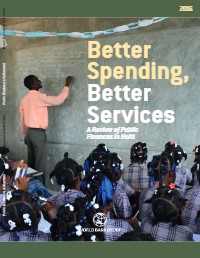
Une Revue des Finances Publiques en Haïti: Meilleures Dépenses, Meilleurs Services
Resume — Ce rapport de la Banque mondiale analyse le système de gestion des finances publiques et les modèles de dépenses d'Haïti. Il vise à identifier des moyens d'améliorer l'efficacité des dépenses gouvernementales pour offrir de meilleurs services publics.
Constats Cles
- Les systèmes de gestion des finances publiques en Haïti nécessitent un renforcement pour améliorer l'efficacité des dépenses.
- Une meilleure coordination entre les agences gouvernementales est essentielle pour une prestation de services efficace.
- Le renforcement des capacités et la formation sont cruciaux pour des améliorations durables dans la gestion financière.
- La fragmentation des données fiscales pose des défis pour une gestion budgétaire et une surveillance efficaces.
Description Complete
Ce rapport complet de la Banque mondiale examine le système de gestion des finances publiques d'Haïti dans le but d'améliorer l'efficacité des dépenses et la prestation de services. L'analyse couvre plusieurs secteurs, notamment la santé, l'éducation et la protection sociale, évaluant comment les ressources gouvernementales sont allouées et utilisées. Le rapport souligne l'importance de meilleures pratiques de gestion financière pour améliorer la qualité et l'accessibilité des services publics pour les citoyens haïtiens. L'étude a été menée grâce à une collaboration extensive avec les institutions gouvernementales haïtiennes, notamment le Ministère de l'Économie et des Finances, le Ministère de l'Éducation, le Ministère de la Planification et de la Coopération Externe, le Ministère de la Santé Publique et de la Population, et d'autres agences clés. Le rapport intègre également des éléments de renforcement des capacités, avec des ateliers de formation fournis aux homologues haïtiens sur divers outils et techniques analytiques utilisés dans l'analyse des dépenses publiques.
Texte Integral du Document
Texte extrait du document original pour l'indexation.
Public Disclosure Authorized 2016 Better Spending, Public Disclosure Authorized Better Services Public Disclosure Authorized A Review of Public Finances in Haiti Public Disclosure Authorized 2016 BETTER SPENDING, BETTER SERVICES Better Spending, Better Services A Review of Public Finances in Haiti Standard Disclaimer: This volume is a product of the staff of the International Bank for Reconstruction and Development/ The World Bank. The findings, interpretations, and conclusions expressed in this paper do not necessarily reflect the views of the Executive Directors of The World Bank or the governments they represent. The World Bank does not guarantee the accuracy of the data included in this work. The boundaries, colors, denominations, and other information shown on any map in this work do not imply any judgment on the part of The World Bank concerning the legal status of any territory or the endorsement or acceptance of such boundaries. Copyright Statement: The material in this publication is copyrighted. Copying and/or transmitting portions or all of this work without permission may be a violation of applicable law. The International Bank for Reconstruction and Development/ The World Bank encourages dissemination of its work and will normally grant permission to reproduce portions of the work promptly. For permission to photocopy or reprint any part of this work, please send a request with complete information to the Copyright Clearance Center, Inc., 222 Rosewood Drive, Danvers, MA 01923, USA, telephone 978-750- 8400, fax 978-750-4470, http://www.copyright.com/. All other queries on rights and licenses, including subsidiary rights, should be addressed to the Office of the Publisher, The World Bank, 1818 H Street NW, Washington, DC 20433, USA, fax 202-522-2422, e-mail pubrights@worldbank.org. Photo cover Credit: Isabelle Schaefer / World Bank BETTER SPENDING, BETTER SERVICES Acronyms and Abbreviations AFD Agence Française de Développement (French agency for development) AIDS Acquired Immunodeficiency Syndrome ARI Acute Respiratory Infection ASC Agent de Santé Communautaire (community health worker) BM Banque Mondiale BMPAD Bureau de Monétisation des Programmes d’Aide au Développement (Monetization Office of Development Assistance Programs) BRH Banque de la République d’Haïti (Haiti Central Bank) BSEIPH Bureau du Secrétaire d’Etat à l’Intégration des Personnes Handicapées (Office of the Secretary of State for Integration of Persons with Disabilities) CAL Centre de Santé avec Lit (health centre with bed) CAS Caisse d’Assistance Sociale (Social Assistance Fund) CDB Caribbean Development Bank CHE Catastrophic Health Expenditure CIDA Canadian International Development Agency CNMP Commission Nationale des Marchés Publics (National Procurement Commission) CONATEL Conseil National de Télécommunication (National Telecommunication Regulator) CSAFP Conseil Supérieur de l’Administration et de la Fonction Publique CSCCA Cour Supérieure des Comptes et du Contentieux Administratif (Supreme Court of Accounts and Contentious Administrative Proceedings) CSL Centre de Santé sans Lit (health centre without bed) DAB Directorate of Administration and Budget DAO Dossier d’Appel d’Offres (Bidding Document) DASIP Direction de l’Analyse et du Suivi des Investissements Publics (Public Investment Analysis and Monitoring Unit) iii DDP Document Définitif du Projet (Final Project Document) DEA Data Envelopment Analysis DEC Direction d’Evaluation et de Contrôle (Evaluation and Control Directorate) DGB Direction Générale du Budget (Budget Directorate) DTDCP Direction du Trésor, Dette, et Comptabilité Publique (Treasury Directorate) DHS Demographic and Health Survey DIP Direction de l’Investissement Public (Directorate of Public Investment) DPC Direction de la Pension Civile (Directorate for Public Pensions) DPES Direction de la Programmation Economique et Sociale (Economic and Social Programming Directorate) DSE Direction du Suivi et de l’Evaluation (Directorate of Monitoring & Evaluation) ECVMAS Enquête sur les Conditions de Vie des Ménages après le Séisme (survey on the living conditions of households after the earthquake – household survey) EMMUS Haiti Mortality, Morbidity, and Service Utilization Survey (DHS in English) EPPLS Entreprise Publique de Production de Logement Social (Public Enterprise for the Promotion of Social Housing) EPSSS Evaluation de la Prestation des Services de Soins de Santé (Service Provision Assessment) EPT Education Pour Tous (Education For All) EU European Union FAES Fonds d’Assistance Economique et Social (Economic and Social Assistance Fund) FER Fonds d’Entretien Routier (Road Maintenance Fund) FIOP Fiche d’Identification et d’Opération des Projets (Identification and Project Operation File) FNE Fonds National de l’Education (National Education Fund) FY Fiscal Year GDP Gross Domestic Product GL General Ledger GoH Government of Haiti GPRSP Growth and Poverty Reduction Strategy Paper GSP Groupe Santé Plus (Health group – private company) HCR Hôpital Communautaire de Référence (Community Referral Hospital) HIMO Travaux à Haute Intensité de Main d’Oeuvre (Labor-intensive public works) HIS Health Information System HIV Human Immunodeficiency Virus HRMIS Human Resources Management Information System HTG Haitian Gourdes IADB Inter-American Development Bank IBERS Institut du Bien-Etre Social et de Recherches (Institute of Social Welfare and Research) IBRD International Bank for Reconstruction and Development iv BETTER SPENDING, BETTER SERVICES IDA International Development Association IDB Inter-American Development Bank IGF Inspection Générale des Finances (Inspectorate General of Finances) IHE Institut Haïtien de l’Enfance (Haitian Institute of Childhood) IHSI Institut Haïtien de Statistique et d’Informatique (Haitian Statistics Agency) IMF International Monetary Fund IMR Infant Mortality Rate INTOSAI International Organization of Supreme Audit Institutions KF Kore Fanmi (Family Support – Community Social Worker Initiative) LdF Loi de Finances MARNDR Ministère de l’Agriculture, des Ressources Naturelles et du Développement Rural (Ministry of Agriculture, Natural Resources and Rural Development) MAST Ministère des Affaires Sociales et du Travail (Ministry of Social Affairs and Labor) MCFDF Ministère de la Condition Féminine et des Droits des Femmes (Ministry for Women and Women’s Rights) MDG Millennium Development Goals MEF Ministère de l’Economie et des Finances (Ministry of Economy and Finance) MENFP Ministère de l’Education Nationale et de la Formation Professionnelle (Ministry of National Education and Vocational Training) MICT Ministère de l’Intérieure et des Collectivités Territoriales (Ministry of Interior and Local Government) MIS Management Information Systems MMR Maternal Mortality Ratio MNCH Maternal, Neonatal, and Child Health MoP Ministry of Planning MPCE Ministère du Plan et de la Coopération Extérieure (Ministry of Planning and External Cooperation) MSPP Ministère de la Santé Publique et de la Population (Ministry of Public Health and Population) MTPTC Ministère des Travaux Publics, Transports et Communications (Ministry of Public Works, Transport, and Communication) NGO Non Governmental Organization NHA National Health Account OFATMA Office d’Assurance Accidents du Travail, Maladie et Maternité (Office of Insurance for Work Accidents, Illness and Maternity) OMRH Office des Ressources Humaines (Office of Human Ressources) ONA Office National d’Assurance Vieillesse (National Office for Old Age Insurance ) ONART Office National de l’Artisanat (National Handicrafts Office) ONM Office National de la Migration (National Migration Office) PAARP Plan d’Action pour l’Accélération de la Réduction de Pauvreté (Plan for Accelerating the Reduction of Extreme Poverty) v PaP Port-au-Prince PARDH Plan d’Action pour le Relèvement et le Développement d’Haïti (Action Plan for Haitian National Recovery and Development) PDS Plan Directeur de Santé (Health Master Plan) PEFA Public Expenditure and Financial Accountability PFM Public Financial Management PIMS Public Investment Management System PIP Programme d’Investissement Public (Public Investment Program) PMS Paquet Minimum de Santé (Minimum Package of Services) PNCS Programme National de Cantines Scolaires (National School Canteen Program) PNS Politique Nationale de Santé (National Health Policy) PSDH Plan Stratégique de Développement d’Haïti (Strategic Plan for the Development of Haiti) PSUGO Programme de Scolarisation Universelle Gratuite et Obligatoire (Free and Compulsory Universal Schooling Program) PTI Plan Triennal d’Investissement (Triennial Investment Plan) RBF Results-Based Financing SAI Supreme Audit Institution SDI Schéma Directeur Informatique (IT Master Plan) SIGMP Système Informatisé de Gestion des Marchés Publics (IT System for Procurement Management) SP Social Protection SSN Social Safety Net SYSCOMPTE Système de gestion des Comptes Courants (Accounting System for Specific Budget Items) SYSDEP Système Informatisé de gestion des Dépenses Publiques (Public Expenditure Management System) SYSPIP Système Informatisé de gestion du Programme d’Investissement Public (Public Investment Management System) TB Tuberculosis THE Total Health Expenditure U5MR Under-five Mortality Rate UAS Unité d’Arrondissement de Santé (District Health Unit) UCE Unité de Contrôle d’Exécution UEP Unité d’Etude et de Programmation (Programming and Analysis Unit) ULCC Unité de Lutte Contre la Corruption (Anti-Corruption Unit) UN United Nations UNCITRAL United Nations Commission on International Trade Law UNDP United Nations Development Program UNICEF United Nations Children’s Fund UPM Unité de Passation de Marché (Procurement Unit) vi BETTER SPENDING, BETTER SERVICES USAID United States Agency for International Development WB World Bank WFP World Food Program WHO World Health Organization WHS World Health Survey vii viii BETTER SPENDING, BETTER SERVICES Acknowledgement We would like to thank the members of the Haiti Country Team, as well as all the partners and stakeholders in Haiti who have contributed to the preparation of this document in a strong collaborative process. We are very grateful for the generosity exhibited in providing us with substantive inputs, knowledge and advice. The Team was led by Raju Jan Singh (Program Leader, LCC8C) and the table below identifies the full list of team members who have contributed their time, effort and expertise, and their affiliations. We wish to thank for their helpful suggestions and insights our peer reviewers: Margaret Grosh (Practice Manager, GSPDR), Sebastian James (Senior Investment Policy Officer, GTCDR), Roland Kpodar (Senior Economist, IMF), David Cal McWilliam (Senior Economist, GMFDR), Patrick Ramanantoanina (Senior Operations Officer, GEDDR), and Anand Rajaram (Practice Leader, GGODR). Mary Barton-Dock (Special Envoy for Haiti, LCC8C) and Miria Pigato (Practice Manager, GMFDR) advised the Team throughout the stages of the process. The Team is also extremely grateful for the cooperation of the Haitian authorities and for the invaluable contributions of senior officials and governmental agencies. We acknowledge in particular the following institutions: the Ministry of Economy and Finance, the Ministry of Education, the Ministry of Planning and External Cooperation, the Ministry of Public Health and Population, the Ministry of Social Affairs, and the Prime Minister’s Office, as well as the Central Bank of Haiti (BRH). The Team wishes to thank all the participants of the numerous workshops where preliminary results have been presented and discussed, in particular Mme Laleau, Head of the Economic Studies (Ministry of Economy and Finance) and Berny Duvalsaint, Secretary of the PER Steering Committee. The Team gratefully acknowledges also the support from donors present in Haiti: AFD, Brazil, Canada, European Union, IADB, IMF, Mexico, USAID, UNDP, and UNICEF. A strong emphasis has been put throughout the preparation of this report on training and capacity building. Special attention has been put on ensuring as much as possible that the various analytical tools and technics used in this document be transferred to our Haitian counterparts, and many of the quantitative work was carried out jointly with Haitian teams. In this regard, the Team would like to thank particularly all the Haitian participants who attended our various workshops on the Tariff Reform Impact Simulation Tool (TRIST), the subsidy simulation toolkit (SUBSIM), and BOOST, as well as Ibrahim El ghandour (GGODR), Olivier Jammes (Consultant, ix GEDDR), and Paulo Verme (Senior Economist, GPVDR) for running these trainings. The Team is also grateful to a number of colleagues who provided insights, comments and support in the course of the report preparation. They include Lucy Basset (Social Protection Specialist, GSPDR), Malaika Becoulet (Consultant, GTIDR), Ludmilla Buteau (Consultant, GHNDR), Pierre Bonneau (Program Leader, LCC8C), Daniel Boyce (Practice Manager, GGODR), Michelle Keane (Lead County Officer, LCC8C), Donald Mphande (Lead Financial Management Specialist, GCFDR), Deo Ndikumana (Senior Country Officer, LCC8C), Prosper Nindorera (Senior Procurement Specialist, GGODR), Maki Noda (Consultant, GSPDR), Elizabeth Ruppert Bulmer (Lead Economist, GCJDR), Paolo Verme (Senior Economist, GPVDR), and Kanae Watanabe (Country Officer, LCC8C). HAITI PER TEAM Global Practice/Cross-cutting Area Data in Haiti is particularly challenging. This study built on the recently-completed Poverty Assessment, carried out jointly by the World Bank and the ONPES. The expansion in donor assistance and the availability of concessional financing over the past decade has compounded, however, the fragmentation of fiscal data. In this regard, the Team would like to thank the Gates Foundation financing the BOOST Initiative in Haiti, as well as Massimo Mastruzzi (Senior Economist, GGODR) and Leif Jensen (Senior Public Sector Specialist, GGODR) for assisting the Team in this process. Our work on fuel price subsidies would not have been possible without the financial support of the Energy Sector Management Assistance Program (ESMAP), and the help of Sameer Shukla (Senior Energy Specialist, GEEES) and Rohit Khanna (Practice Manager, GEEES). Team Members Communication Christelle Chapoy, Berdine Edmond Education Melissa Adelman, Juan Baron, Eva Junyen, Axelle Latortue Energy & Extractives Frederic Verdol Governance Emeline Bredy, Mamadou Deme, Ibrahim El ghandour, Eduardo Estrada, Rubens Lacerd, Andy MacDonald, Fabienne Mroczka, Renas Sidahmed, Gerard Verger Haiti CMU Gabrielle Dujour, Nellie Sew Kwan Kan, David Lighton, Raju Jan Singh, Paula White Health, Nutrition & Population Eleonora Cavagnero; Marion Cros; Sunil Rajkumar Macro Economics & Fiscal Management Kassia Antoine, Calvin Djiofack, Evans Jadotte, Naoko Kojo, Jan Loeprick, Julie Lohi, Sandra Milord, Erik von Uexkull, Konstantin Wacker Poverty Facundo Cuevas, Federica Marzo, Aude-Sophie Rodella, Thiago Scot Social Protection Carine Clert, Victoria Strokova, Frieda Vandeninden Social, Urban, Rural and Resilience Michel Matera, Rafael Van der Borght x BETTER SPENDING, BETTER SERVICES xi Emmanuel Wilkinton fait ses devoirs de sciences à Delmas 32 , Haïti. Emmanuel est l’un des bénéficiaires ayant accès à l’électricité jusqu’à 23 heures et peut maintenant étudier facilement chaque soir. Photo : Dominic Chavez / Banque Mondiale xii BETTER SPENDING, BETTER SERVICES Contents Acronyms and Abbreviations .........................................................................iii Acknowledgement .............................................................................................ix Executive Summary ............................................................................................xxv CHAPTER 1 Country Profile..........................................................................1 A. Haiti Has Opportunities …. ....................................................................................... 1 B. … Hampered by Political Instability and Natural Disasters .................................. 2 C. … As Well as Weak Structural Policies and Institutions........................................ 2 CHAPTER 2 Living With Tighter Budget Constraints .........................9 A. Macroeconomic Stability Has Been Maintained …................................................ 9 B. … With Greater Revenue Mobilization and a Surge in Aid................................... 10 C. … Allowing Higher Public Spending........................................................................ 12 D. … Despite Widening Deficits, Debt is Expected to Remain Sustainable …........ 13 E. … But Financing Constraints Are Becoming Tighter ............................................ 17 F. … While Natural Disasters Would Call for Larger Fiscal Buffers......................... 17 CHAPTER 3 Protecting Priority Spending................................................19 A. Haiti Has a Vision Calling for Higher Human and Physical Capital …............... 19 B. … Reflected in the Rise in Public Investment … .................................................... 24 C. … And Greater Priority Given to Social Sectors …................................................ 26 xiii D. … But Haiti’s Inclusiveness Remains Limited.......................................................... 29 CHAPTER 4 TOWARDS GREATER AND MORE EQUITABLE REVENUE MOBILIZATION........................................................31 A. Despite Some Increase, Revenue Mobilization Remains Low and Regressive… 31 B. … With Exemptions and Ill-Designed Tax Brackets Eroding Direct Taxes….... 34 C. … And Indirect Taxes Hampered by Weak Revenue Administration and Unclear Exemptions ............................................................................................. 40 D. … But Could Be Bolstered By a Simple VAT........................................................... 42 E. … And Taxes on International Trade Could Be Streamlined................................ 44 CHAPTER 5 GETTING A GREATER GROWTH DIVIDEND FROM PUBLIC INVESTMENT...........................................................................51 A. High Public Investment Doesn’t Translate into Faster Growth in Haiti…........... 51 B. … Because of an Overly Elaborate and Rarely Respected Regulatory Framework ................................................................................................ 56 C. … Little Strategic Guidance to Select Projects......................................................... 57 D. … A Budgeting Process That is Not Followed ......................................................... 60 E. … Weak Procurement…............................................................................................. 63 F. … Fragmented Project Execution and Administration…...................................... 65 G. … Limited Physical and Financial Monitoring…................................................... 69 H. … And a Lack of Ex-post Evaluation (Project Auditing and Evaluation)............ 72 CHAPTER 6 Increasing Sustainability and Improving Further Health Outcomes ..............................................................................75 A. Although Low, Health Indicators Have Improved …............................................. 75 B. … But Disparities Remain …..................................................................................... 79 C. … With Relatively High Health Spending Financed by Donors........................... 81 D. … Access to Health Is Limited Especially For the Poor ….................................... 83 E. … And Public Spending Is Not Geared to Better Services..................................... 85 CHAPTER 7 KEEPING CHILDREN IN SCHOOL AND IMPROVING EDUCATION OUTCOMES..............................................99 A. Despite Progress, Education Outcomes are Low …................................................ 99 B. … Driven by a Greater Education Supply from the Non-Public Sector … ......... 103 xiv BETTER SPENDING, BETTER SERVICES C. … While Public Spending Has Been Recently Rising … ....................................... 104 D. … Its Composition Is Not Conducive to Better Services ….................................. 107 E. … With Cost Remaining a Main Obstacle to Access….......................................... 109 F. … And Disparities across Regions and Poor Services............................................ 110 CHAPTER 8 TOWARDS A MORE EFFECTIVE AND BETTER TARGETED SOCIAL PROTECTION SYSTEM......................113 A. Growing Investments in Social Safety Nets.............................................................. 113 B. … Needed By A Vulnerable Population ….............................................................. 117 C. … But Too Fragmented … ......................................................................................... 120 D. … Too Small …............................................................................................................ 122 E. … Not Well Targeted ….............................................................................................. 127 F. … And of Limited Impact .......................................................................................... 131 CHAPTER 9 PREVENTING A RETURN OF FUEL SUBSIDIES ...................135 A. Fuel Price Subsidies Implied a Heavy Burden on the Budget…............................ 135 B. … Are Regressive…..................................................................................................... 138 C. … And Could Return.................................................................................................. 146 Concluding Observations ................................................................................149 References.............................................................................................................153 xv List of Annexes Annex 1 : PIM Process Flowcharts ................................................................................ 166 Annex 2 : Correlates with Enrollment........................................................................... 171 Annex 3 : Correlates with Overage Status..................................................................... 172 Annex 4 : EDE PEP Programs: A Glossary................................................................... 173 Annex 5 : Price Structure for Petroleum Products (2010/2011)................................ 175 List of Boxes Box 2.1 : Electricité d’Haiti.............................................................................................. 15 Box 2.2 : Petrocaribe and Haiti....................................................................................... 16 Box 3.1 : Benchmarking the Drivers of Shared Prosperity: An Application to Haiti................................................................................... 22 Box 3.2 : Fiscal Data Challenges..................................................................................... 27 Box 4.1 : International Experience with Tax Incentives.............................................. 35 Box 4.2 : Removing Nuisance Taxes............................................................................... 37 Box 4.3 : The CATT Methodology for Benchmarking Customs Performance ........ 42 Box 4.4 : The World Bank’s Tariff Reform Impact Simulation Tool (TRIST)........... 48 Box 5.1 : Common Features of PIM in Donor-Dependent Countries...................... 54 Box 5.2 : Haiti Legislative Framework........................................................................... 56 Box 5.3 : The Share of Recurrent Expenditures in Investment Projects.................... 61 Box 5.4 : INTOSAI Conditions Supporting Corruption............................................. 65 Box 5.5 : Project Completion.......................................................................................... 74 Box 6.1 : Health Care Provision in Haiti ....................................................................... 86 Box 6.2 : Definitions of Operating Budget Terms........................................................ 88 Box 6.3 : Definition of Technical Efficiency.................................................................. 94 Box 6.4 : More Health for Every Dollar: Results-Based Financing............................ 96 Box 6.5 : The Right Incentives Lead to Measurable Results in Rwanda .................... 97 Box 7.1 : Education Provision in Haiti .......................................................................... 105 Box 8.1 : Methodology Note on Social Protection Spending ..................................... 125 Box 9.1 : The Transport Sector in Haiti ......................................................................... 143 xvi BETTER SPENDING, BETTER SERVICES List of Figures Figure 1.1 : Annual GDP Growth vs. Change in Government, 1971-2013 (percent)................................................................................. 3 Figure 1.2 : Annual GDP Growth vs. Occurrence of Natural Disaster, 1971-2013 (percent)................................................................................. 3 Figure 1.3 : Obstacles to Growth.................................................................................. 4 Figure 1.4 : Change in Governance Indicators, 2004-13 .......................................... 6 Figure 1.5 : Logistic Performance Index, 2014........................................................... 7 Figure 1.6 : Port Tariffs Estimated Cost Per TEU*, 2009 (in US Dollar)................ 7 Figure 1.7 : Electric Power Consumption, 2011 ........................................................ 8 Figure 2.1 : Inflation, 2004-14 ...................................................................................... 10 Figure 2.2 : Gross International Reserves, 2004-14 (Millions of US Dollars)........ 10 Figure 2.3 : Fiscal Revenues, 2004-13 (In Percentage of GDP)............................... 12 Figure 2.4 : General Government – Total Revenues, 2000-12 (In Percentage of GDP)............................................................................ 12 Figure 2.5 : Public Expenditures by Source of Financing, 2001-13 (In Percentage of GDP)............................................................................ 13 Figure 2.6 : General Government Expenditure - International Comparison 2004-13................................................................................ 13 Figure 2.7 : Central Government Fiscal Balance, ...................................................... 14 Figure 2.8 : Current Account Balance, 2004-14 (Percentage of GDP).................... 14 Figure 2.9 : Haiti – Stock of Debt from Petrocaribe, 2009-14 (In Percentage of GDP)............................................................................ 14 Figure 2.10: External Debt (PV), 2014-35 (Percentage of Exports G&S + Remittances)........................................ 14 Figure 2.11: International Aid, 2008-25 (In Percentage of GDP)............................. 17 Figure 2.12: Government Deposits, 2009-14 (In Percentage of GDP)..................... 17 Figure 2.13: Petrocaribe Financing, 2008-17 (Millions of US Dollars) ................... 18 Figure 3.1 : Extreme Poverty Simulations................................................................... 20 Figure 3.2 : Economic Magnitude of Estimated Parameters.................................... 21 Figure 3.3 : Life Expectancy at Birth, 2010 (Years).................................................... 23 Figure 3.4 : Cabinet Changes, 2003 (10 Years Average)............................................ 23 Figure 3.5 : Income Effects of Closing the Gap (In Percentage of the Gap)........... 23 xvii Figure 3.6 : Current Expenditure, 2005-14 (In Percentage of GDP)....................... 26 Figure 3.7 : Operating and Capital Expenses, 2005-14 (In Percentage of GDP)... 26 Figure 3.8 : Changes in Sectoral Composition –........................................................ 28 Figure 3.9 : Project Activities Financed by Petrocaribe Funds, 2008-13, (USD Millions).......................................................................................... 28 Figure 3.10: Project Activities Financed by Petrocaribe Fund, 2008-13, (Percentage of Total) ................................................................................ 29 Figure 3.11: Donors Financing, 2010-12 (Percentage of Total)................................ 29 Figure 3.12: International Comparison - Social Spending, 2013 or latest (In Percentage of GDP)............................................................................ 30 Figure 4.1 : Fiscal Revenue, 2009-13 (In Percent of GDP)....................................... 32 Figure 4.2 : Tax-to-GDP Ratio ..................................................................................... 33 Figure 4.3 : Ratio Direct To Indirect Taxation, 2009 or 2011................................... 34 Figure 4.4 : Corporate (left) and Personal (right) Income Tax Rates in Regional Comparison (Percent)......................................................... 35 Figure 4.5 : Income Tax Rate Thresholds In Regional Comparison (Per Capita GDP)...................................................................................... 38 Figure 4.6 : Hypothetical Income Tax Revenue Collection Based on 2012 Household Survey Results....................................................................... 39 Figure 4.7 : Hypothetical Effect of Changes in Income Tax Brackets on Revenue Collection............................................................................. 40 Figure 4.8 : Results of Haiti Customs Assessment: Distance from.......................... 41 Figure 4.9 : Tax Revenue Collection around the Introduction of VAT................... 43 Figure 4.10: Applied Protection from Tariffs and Inspection Fees for Four Reform Scenarios...................................................................... 48 Figure 5.1 : Capital Investment (a) and (b)................................................................. 52 Figure 5.2 : Public Management Efficiency Index ..................................................... 53 Figure 5.3 : Public Investment Management Index – PIM (0=Lowest, 4=Highest) ............................................................................ 53 Figure 5.4 : Four Stages of the Project Life Cycle....................................................... 55 Figure 5.5 : Required Process for Adding New Projects to the PIP ........................ 59 Figure 5.6 : Illustrates the Budget Formulation Process for the Preparation of the Investment Budget. ........................................... 62 Figure 5.7 : Contracting Methods, 2012-13................................................................ 63 xviii BETTER SPENDING, BETTER SERVICES Figure 5.8 : Complexity in Procurement Processes................................................... 66 Figure 5.9 : PIP Project Execution Processes............................................................. 67 Figure 5.10: Treasury funded Public Investment....................................................... 70 Figure 5.11: Cash Flows National Treasury Funded Projects 2012-13 .................... 71 Figure 5.12: Monitoring and Evaluation on Projects, in PIP, 2011-13 (in Number of Projects)........................................................................... 73 Figure 6.1 : Maternal Mortality, 2013 (Per 100,000 live birth)................................. 76 Figure 6.2 : Under-5 Child Mortality, 2013 (Per 1,000 live births).......................... 76 Figure 6.3 : Health Service Utilization (In Percent of Population).......................... 77 Figure 6.4 : Changes in Under-5 Child Mortality Rates, 1990-2013 (per 1,000 live births)............................................................................... 78 Figure 6.5 : Maternal Mortality Ratio, 1990-2013 (Per 100,000 live births)........... 78 Figure 6.6 : Changes in Life Expectancy at Birth,...................................................... 78 Figure 6.7 : Health Service Utilization, 1994-2012 (In Percent of Population).... 78 Figure 6.8 : Change in Infant Mortality, 2006-12 (Percentage Points).................... 79 Figure 6.9 : Change in Under-5 Child Mortality, 2006-12 (Percentage Points)..... 79 Figure 6.10: Change in Stunting Rate, 2006-12 (Percentage Points)........................ 79 Figure 6.11: Change in Diarrhea Prevalence Rate, 2006-12 (Percentage Points)... 79 Figure 6.12: Child Health Outcome Indicators, 2012 (Per 1,000 Live Births)........ 81 Figure 6.13: Health Expenditure Per Capita, 2012 (Current US$)........................... 82 Figure 6.14: Health Expenditure Per Capita PPP, 1995-2012 (Constant 2005 US$)................................................................................ 82 Figure 6.15: Public Health Expenditure, 2012 (Percent of GDP)............................. 82 Figure 6.16: Public Health Spending, 2000-12 (Percent of Government Expenditure).................................................. 82 Figure 6.17: Health Expenditure, 2005-10, (Percentage of Total) ............................ 82 Figure 6.18: Health Expenditure, 2011-12 (Percentage of Total) ............................. 82 Figure 6.19: Health Expenditure by Source, 2004-2013 ............................................ 83 Figure 6.20: Barriers to Health Care Access for Women Aged 15-49, 2012 or 2013 (Percentage of Total)......................................................... 84 Figure 6.21: Enrollment of Populations in Risk-Pooling........................................... 84 Figure 6.22: Incidence of Catastrophic Health Expenditures at............................... 85 Figure 6.23: Salaries, Excl. Domestic Investment Budget.......................................... 89 xix Figure 6.24: Investment Budget from Public Funds, 2012-13 (Percentage of Total) ................................................................................ 89 Figure 6.25: Utilization of the Different Types of Structures by Area, 2013 ........... 89 Figure 6.26: Density of Medical Personnel, 2013 (Per 10,000 Inhabitants) ........... 91 Figure 6.27: Density of Inpatient Beds, 2013............................................................... 91 Figure 6.28: Density of Medical Personnel by Department – Private for-Profit Sector Excluded ........................................................................................ 91 Figure 6.29: Number of Beds, exc. Private For-Profit (Per 10,000 Inhabitants)..... 91 Figure 6.30: Density of (a) Medical (b) Paramedical Personnel, and (c) Community Agents by Location, ........................................................... 91 Figure 6.31: Technical Efficiency Score, 45 First-Level.............................................. 93 Figure 6.32: Consultations Per Doctor and Nurse, exc. Private For-Profit Sector, 2013 (Daily Numbers)................................................................. 94 Figure 6.33: Consultations per Medical Staff .............................................................. 94 Figure 6.34: International Comparisons-Share of Administrative Personnel In Total Number of Primary Health Facilities (Percentage Total)..... 95 Figure 7.1 : Share of 3-25 Year Olds Currently........................................................... 100 Figure 7.2 : Haiti’s Literacy Rate Is Between LIC and LAC Averages...................... 100 Figure 7.3 : Figures (a) and (b) - Gross and Net Enrollment Ratios, 2001-12 ....... 101 Figure 7.4 : Youth Enrolled in School by Age and..................................................... 104 Figure 7.5 : Number of Primary Schools, 1930-2011 (Number of Schools).......... 105 Figure 7.6 : Donor Financing for Education Sector, 2010-13 .................................. 105 Figure 7.7 : MENFP Annual Budget Funded by Domestic Resources, 2005-13....................................................................................................... 106 Figure 7.8 : Student Beneficiaries by Department, 2013........................................... 107 Figure 7.9 : Public Expenditures on Education.......................................................... 108 Figure 7.10: Education Budget, 2014 (domestic resources only, percentage of total)................................................................................... 108 Figure 7.11: Education Expenditures by Type, 2012 .................................................. 109 Figure 8.1 : EDE-PEP SSN Financing, By Source, 2013 (Percentage of Total)...... 116 Figure 8.2 : Programs Under EDE PEP....................................................................... 116 Figure 8.3 : Chronic Poverty, Multidimensional Deprivation and Transient Poverty, 2012 (Percent of Total).............................................................. 118 Figure 8.4 : Poverty Headcount by Age Group, 2012 (In Percent).......................... 120 xx BETTER SPENDING, BETTER SERVICES Figure 8.5 : Key Risks, the Life Cycle, and Social Protection in Haiti..................... 121 Figure 8.6 : Public Expenditure on Social Protection, 2013 (Percentage of GDP) ................................................................................ 124 Figure 8.7 : Social Safety Net Spending – International Comparison, 2013 or latest (Percent of GDP).............................................................. 126 Figure 8.8 : Distribution of Social Protection Benefits (Benefit Incidence), 2012......................................................................... 128 Figure 8.9 : Access to Social Security by Income Group, 2012 (Percentage of Total) ................................................................................ 129 Figure 8.10: Coverage of Social Assistance Programs and Distribution of Beneficiaries.......................................................................................... 130 Figure 8.11: Coverage of Social Assistance Programs by Age Group, 2012, ........... 131 Figure 8.12: EDE PEP Coverage (FAES-Executed) by Region and Program Type, 2013.......................................................................... 132 Figure 8.13: Numbers of Meals Distributed, Kantin Mobile, 2013 (Percentage of Total Population)............................................................ 132 Figure 8.14: Benefit Amounts and Contribution to Consumption of Beneficiaries.......................................................................................... 132 Figure 9.1 : Evolution of Domestic Price and International Prices of Oil Products, 2004-14.......................................................................... 136 Figure 9.2 : Oil Subsidies Costs, 2010-13.................................................................... 137 Figure 9.3 : Total Post-Tax Costs of Petroleum Subsidies, 2011 (Percentage of GDP) ................................................................................ 137 Figure 9.4 : Total Post-Tax Costs of Petroleum Subsidies, 2011 (In percent of General Revenues)........................................................... 137 Figure 9.5 : Oil Subsidies and Public Spending Allocation, 2010-12...................... 138 Figure 9.6 : Expenditure on Petroleum Products Per Decile, 2012 (Percentage of Budget)............................................................................. 139 Figure 9.7 : Fuel Subsidies Received By Group, 2012 (Percentage of Total) .......... 140 Figure 9.8 : Composition of Expenditure by Groups, by Decile, 2012 ................... 140 Figure 9.9 : Expenditures by Groups, 2012................................................................. 140 Figure 9.10: Welfare Loss by Direct Effect (Percentage)............................................ 141 Figure 9.11: Intensity In Oil Products By Sector ........................................................ 142 Figure 9.12: Effect of Prices from the IO Table ........................................................... 142 Figure 9.13: Contribution to Inflation.......................................................................... 142 xxi Figure 9.14: Welfare Loss by Decile (Percent)............................................................ 145 Figure 9.15: Main Source of Lighting, 2012 (percent Households)......................... 145 Figure 9.16: Households Using Kerosene As Main Source of Lighting, 2012 (Percent)........................................................................................... 145 Figure 9.17: Total Loss of Welfare by Decile................................................................ 146 Figure 9.18: Welfare Losses by Urban/Rural Areas.................................................... 146 List of Tables Table 1.1 : Frequency and Impact of Natural Disasters, 1971-2014 ......................... 3 Table 2.1 : Macroeconomic Indicators .......................................................................... 11 Table 2.2 : Fiscal Revenues - International Comparison (In Percentage of GDP) ............................................................................... 12 Table 3.1 : Fiscal Indicators (In Percent of GDP)....................................................... 25 Table 4.1 : Customs Duties and Inspection Fees (2013)............................................. 45 Table 4.2 : TRIST Simulations on Four Scenarios of Tariff Reform ......................... 47 Table 5.1 : Set of Projects Reviewed by Ministerial Affiliations................................ 55 Table 5.2 : Procurement Thresholds for State institutions (in millions of Haitian Gourdes) ............................................................... 64 Table 5.3 : Summary of Applications Relating to the Expenditures and Investment Chain.................................................................................. 71 Table 6.1 : Maternal and Children Health Coverage by Income Group, 2005-6 and 2012 (In Percent of Population)............................................. 80 Table 6.2. Participation Incidence by Income Groups, 2013 (in Percent of Beneficiaries)........................................................................ 85 Table 6.3 : Technical Efficiency In Haiti And Other Low-Income Countries.......... 93 Table 7.1 : Late Starts, Repetition, and Drop out Contribute to Low System Efficiency............................................................................. 102 Table 7.2 : National Exam Passing Rates, 2012-13 (In Percent)................................ 103 Table 7.3 : Characteristics of Primary Schools by Department, 2010-11 (In Percent).................................................................................... 110 Table 8.1 : Social Insurance: Institutions and Programs in Haiti, December 2014............................................................................................. 122 xxii BETTER SPENDING, BETTER SERVICES Table 8.2 : EDE PEP Fragmentation: Institutions and Programs by October 2014 ........................................................................................... 123 Table 8.3 : EDE PEP Executed Spending (Actual) in 2013 ........................................ 126 Table 8.4 : Key Donors’ Contributions (Estimates) - Social Protection................... 127 Table 8.5 : Alignment of EDE PEP Programs with Risks and Vulnerabilities Across the Life Cycle.................................................................................... 133 Table 9.1 : Distribution of Oil Subsidies by Fuel Product, 2009-13 (Billion Gourdes).......................................................................................... 137 Table 9.2 : Average Yearly Expenditure on Fuels (HTG) ........................................... 139 Table 9.3 : Fuel Subsidies Received By Income Decile (Percentage of Total).......... 140 Table 9.4 : Subsidies (Million Gourdes) Given Different Scenarios for Oil Prices................................................................................................. 147 xxiii xxiv Objectives BETTER SPENDING, BETTER SERVICES Executive Summary GDP per capita fell by 0.7 percent per year on average between 1971 and 2013. As a result, Haiti 1. Haiti has a vision to become an emerging economy by 2030. Haiti has comparative advantages, including its proximity and access to major markets; a young labor force and a dynamic diaspora; and substantial geographic, historical, and cultural assets. Areas of economic opportunity for Haiti include agribusiness, light manufacturing and tourism. Recognizing these opportunities, the Government of Haiti issued in May 2012 a Strategic Development Plan (PSDH), aiming at building a new modern, diversified, resilient, competitive and inclusive economy, respectful of its environment and in which people’s basic needs are met. Achieving this objective would require ambitious double digit growth rates, a significant break from the past, possibly based on an expansion of agriculture, construction, manufacturing, and tourism. 2. Haiti’s growth performance in the last four decades has been overall disappointing, however, and poverty remains endemic. A history of vested interests, political instability, and natural disasters, as well as poor governance, inadequate infrastructure and limited skills, have prevented the country to realize up to now its aspirations, trapping it in a low equilibrium. is the poorest country in the Latin America and Caribbean (LAC) region and among the poorest in the world. The overall poverty headcount amounts to about 59 percent and extreme poverty to 24 percent in 2012, indicating that almost 6.3 million Haitians cannot meet their basic needs and 2.5 million cannot even cover their food needs. Furthermore, with a Gini coefficient at 0.6, Haiti has the highest income inequality in the region and one of the highest in the world. 3. Haiti experienced a return of donor assistance and greater access to concessional financing over the past decade. Haiti has long been characterized by its very low fiscal revenue mobilization, seriously constraining its ability to carry out needed developmental spending (infrastructure, health, education). A lot of basic services are provided in Haiti by non-State actors. Following greater political stability and particularly the 2010 earthquake, the budget has benefitted from exceptional donor assistance with external grants increasing from 2 percent of GDP in 2004 to 8.1 percent in 2013, peaking at 12.1 percent of GDP in 2010. Meanwhile, in addition to benefiting from the HIPC and the xxv MDRI initiatives, Haiti received additional debt cancellation in the aftermath of the earthquake, reducing its total external debt to 8.9 percent of GDP in 2011 and providing borrowing space that the country used for concessional financing from Venezuela. 4. These resources allowed Haiti to finance a strong expansion in capital spending. Greater donor assistance and the availability of concessional financing have allowed an expansion in capital spending, a substantial shift in the country’s priorities as reflected by the growing share of public investment: it represented in 2014 more than half of total public spending compared to a third in 2005. In line with higher own fiscal revenue, current expenditure has also been on the rise, increasing from just below 10 percent of GDP in 2005 to about 13 percent GDP in 2014, driven by a higher wage bill: wages in relation to GDP rose significantly from 2005 to 2014 (from 3.5 to about 6 percent of GDP). 5. Priority spending in Haiti has also increased. The fragmented fiscal data available would suggest that these additional resources have been channeled to the reconstruction and social sectors, consistent with the decline in poverty and improvements in human development indicators (such as in education) observed over the same period. Overall, the share of resources allocated to social sectors seems to have expanded from an average of about 16 percent of total public spending for the period 2007 to 2010 to about 28 percent of total public spending after the earthquake, for the period 2010 to 2012. In addition, 22 percent of donor assistance on average is estimated to have gone towards social sectors over the period of 2010 to 2012. 6. The composition of public spending may, however, not be conducive to better services. Part of the growing wage bill reflects, however, increases in support, administrative or security staff, and not in staff directly delivering social services. Furthermore, operating costs more specifically (e.g. equipment, utilities) have not kept up with rising public investment, remaining broadly unchanged over the past decade. Without the needed resources to operate the newly built investments and equipment, it is questionable whether the new facilities could be maintained or deliver the expected growth dividends. 7. Furthermore, despite the recent increase in soc