

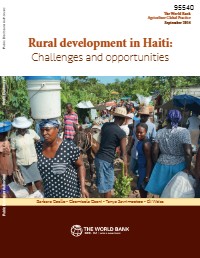
Rural development in Haiti: Challenges and opportunities
Summary — This World Bank report examines rural development challenges in Haiti, where 70.7% of rural households are poor and agriculture dominates economic activity. The analysis identifies barriers to rural development and recommends promoting livelihood diversification and improving rural market performance.
Key Findings
- 7% of rural households are poor and 53.9% are extremely poor, with average education of 2.8 years for household heads.
- Agriculture dominates with 78% of households involved, while 46% participate in nonfarm activities overall.
- Diversifying agricultural production activities correlates with higher productivity and reduces vulnerability to shocks.
- Remittances are positively associated with higher incomes, increased agricultural productivity, and improved food security.
- Female-headed households have reduced access to farming inputs, explaining observed gender gaps in agricultural productivity.
Full Description
This comprehensive World Bank report analyzes rural development challenges in Haiti, where approximately 50% of the 10 million population lives in rural areas. The study reveals that 70.7% of rural households are poor and 53.9% are extremely poor, with education levels averaging only 2.8 years for household heads.
The report draws on 2012 household-level data (ECVMAS) to examine linkages between rural economic activity, food insecurity, and poverty. Agriculture dominates rural economic activity with 78% of households involved, though 25% of agricultural households supplement income through nonfarm activities. Overall nonfarm activity participation reaches 46% of rural households.
The analysis identifies two priority intervention areas: promoting diversification of livelihood sources among rural households and improving performance of rural markets for inputs and outputs. Key findings show that agricultural diversification correlates with higher productivity, remittances positively associate with improved outcomes, and nonfarm activities provide pathways to escape poverty.
Recommendations include promoting agricultural production diversification, helping poor households access nonfarm employment opportunities, encouraging productive investment of remittances, investing in soil and water management technologies, strengthening private sector input distribution systems, and improving rural household access to output markets through better infrastructure and market information systems.
Full Document Text
Extracted text from the original document for search indexing.
95540 Public Disclosure Authorized The World Bank Agriculture Global Practice September 2014 Rural development in Haiti: Challenges and opportunities Public Disclosure Authorized Public Disclosure Authorized Public Disclosure Authorized Barbara Coello • Gbemisola Oseni • Tanya Savrimootoo • Eli Weiss Rural development in Haiti: Challenges and opportunities The World Bank Agriculture Global Practice September 2014 Barbara Coello Gbemisola Oseni Tanya Savrimootoo Eli Weiss Standard Disclaimer This volume is a product of staff of the International Bank for Reconstruction and Development/ The World Bank. The findings, interpretations, and conclusions expressed in this paper do not necessarily reflect the views of the Executive Directors of The World Bank or the governments they represent. The World Bank does not guarantee the accuracy of the data included in this work. The boundaries, colors, denominations, and other information shown on any map in this work do not imply any judgment on the part of The World Bank concerning the legal status of any territory or the endorsement or acceptance of such boundaries. Copyright Statement The material in this publication is copyrighted. Copying and/or transmitting portions or all of this work without permission may be a violation of applicable law. The International Bank for Reconstruction and Development/ The World Bank encourages dissemination of its work and will normally grant permission to reproduce portions of the work promptly. For permission to photocopy or reprint any part of this work, please send a request with complete information to the Copyright Clearance Center, Inc., 222 Rosewood Drive, Danvers, MA 01923, USA, telephone 978-750-8400, fax 978-750- 4470, http://www.copyright.com/. All other queries on rights and licenses, including subsidiary rights, should be addressed to the Office of the Publisher, The World Bank, 1818 H Street NW, Washington, DC 20433, USA, fax 202-522-2422, e-mail pubrights@worldbank.org Photo credit: Eli Weiss, World Bank, 2013 Acknowledgement The authors would like to thank Federica Marzo, Diego Arias and Michael Morris for their guidance and advice during the elaboration of this paper. Contents Excecutive Summary ...................................................................................................iv 1. Introduction and Background................................................................................1 2. Data Sources.............................................................................................................4 3. Profile of Rural Households....................................................................................6 3.1. Characteristics of Rural Households................................................................7 3.2. Economic Activities of Rural Households.......................................................12 3.2.1 Agriculture.................................................................................................16 3.2.2 Nonfarm Activities...................................................................................22 3.2.3 Other Income and Remittances..............................................................25 4. Determinants of Rural Income Generating Activities.........................................28 5. Determinants of Market Access.............................................................................34 6. Determinants of Participation in Nonfarm Activities.........................................38 7. Determinants of Poverty and Food Insecurity .....................................................42 8. Key Findings and Recommendations....................................................................46 8.1. Promoting Diversification of Livelihoods Sources among Rural Households....................................................................47 8.1.1 Findings .....................................................................................................47 8.1.2 Recommendations....................................................................................48 8.2. Improving the Performance of Rural Markets for Inputs and Outputs.......................................................................................50 8.2.1 Findings .....................................................................................................50 8.2.2 Recommendations....................................................................................50 9. References.................................................................................................................54 Appendix.......................................................................................................................58 Executive Summary Haiti is one of the least developed countries in the world and has faced many challenges in its development process due to its vulnerability to natural disasters and fragility. The frequent natural disasters are particularly devastating because they directly affect the large share of the population that lives in rural areas and depends on agriculture as a primary livelihood source. Approximately 50 percent of Haiti’s population of 10 million currently reside in rural areas, and according to recent figures about 70.7 and 53.9 percent of rural households are poor (income of less than $1.98 per day) or extremely poor (income of less than $1.00 per day). Haiti’s rural population remains one of the most food insecure in the world. Ecological challenges, rapid population growth, and high import dependency, combined with the devastating effects of the 2010 earthquake, have exacerbated an already dire food insecurity situation, and revitalization of the agricultural sector has become a foremost priority of the Haitian government. The nonfarm sector in Haiti is also important for the rural economy and contributes to improved livelihoods of rural households. The objective of this report is to examine the linkages between rural economic activity, food insecurity and poverty in Haiti as a means of determining the barriers to rural development. The analysis draws on a newly available set of household level living standards measurement data collected in 2012 (ECVMAS). About 70.7 percent of all rural households are poor, and education levels are low with an average of 2.8 years of education for the household head. Agriculture dominates economic activity (78 percent of all households are involved in agricultural activities), although almost 25 percent of the agricultural households supplement their agricultural income by engaging also in some type of nonfarm activity. Overall nonfarm activity participation (including households that engage in agricultural activities and households that do not) is reported at 46 percent. Nonfarm activities can be related to agriculture upstream (input supply) or downstream (value-adding and processing), or they can be unrelated to the sector (retailing). This report identifies the main factors of production that correlate with increased productivity in the agricultural sector and examines the determinants of nonfarm participation, poverty and food security within rural Haiti. Key Findings and Recommendations The information and analysis presented in this report point to two priority areas for rural development interventions in Haiti: (i) promoting diversification of livelihoods sources among rural households, and (ii) improving the performance of rural markets for inputs and outputs. Focusing on these areas could increase agricultural productivity, boost rural incomes, improve food security, thereby potentially reducing constraints to rural development. iv I. Promoting Diversification of Livelihoods Sources among Rural Households Findings • Diversifying agricultural production activities is correlated with higher productivity and could reduce vulnerability to shocks. • Remittances are positively associated with higher incomes, increased agricultural productivity, and improved food security, but the causal relationships are difficult to discern. • Nonfarm activities in rural areas seem to provide a pathway to escape from poverty and food insecurity. • Female headed households have reduced access to farming inputs, which could explain the observed gender gap in input use and agricultural productivity. In the nonfarm enterprise sector, female headed households similarly have reduced access to inputs and use lower quantities of inputs. Recommendations • Promote diversification of agricultural production activities as a way to increase income and improve food security. Activities that could be undertaken to promote diversification include educational campaigns to increase awareness of the benefits of diversification, research to identify crops and livestock species suited for particular locations or production environments, extension activities to disseminate locally appropriate management methods, and programs to improve the availability and accessibility of key inputs. Nevertheless, farmers might also be able to expand productivity / increase income on a single crop, if they select to invest in crops that provide higher profits. • Help poor rural households take advantage of non-farm employment opportunities as a way of generating additional revenue and managing risk. Special consideration should be given to interventions that will help the poorest households overcome entry barriers (lack of key assets and access to basic services, and distance to markets and labor), including not only interventions designed to improve the quality of the rural labor force (e.g., basic education, vocational training), but also interventions designed to generate increased rural non-farm employment opportunities (e.g., programs to encourage expansion of rural enterprises, support to rural financial institutions). • Encourage poor rural households to invest remittances in improving the productivity of their agricultural activities. Poor rural households receiving remittances often use those remittances to purchase food, and as a result they miss an opportunity to build the base of productive assets needed to generate an enhanced stream of income over the longer term. Interventions are needed to encourage poor rural households invest a portion of the remittances they may receive in productive assets that can ensure a longer term stream of future income. v • Invest in soil and water management technologies to improve the productivity of the natural resource base on which agriculture depends. Over the longer term, the welfare of rural households in Haiti will depend crucially on the quality of the natural resource base on which agriculture depends. Efforts are needed to compensate for decades of mismanagement, with the goal of reversing land degradation, restoring soil fertility, re-establishing vegetative cover, and conserving and protecting increasingly scarce water resources. A place to begin would be through the promotion of more environmentally friendly agricultural production practices, combined with introduction of regulations to restrict the uncontrolled exploitation of common-pool resources especially including trees. These could be complemented in time with schemes to promote payments for environmental services (PES), which led to good results in some countries and could provide opportunities for rural households to generate additional income by preserving the environment. II. Improving the Performance of Rural Markets for Inputs and Outputs Findings • Agricultural productivity in Haiti is severely constrained by the limited availability and high cost of purchased inputs. • For many rural households, incentives to invest in improved agricultural productivity are undermined by lack of access to reliable markets for outputs. Recommendations • Strengthen private sector-led input distribution systems to help ensure timely availability of improved inputs. a. For seeds, modern varieties hold the potential to deliver significant yield increases in virtually all of the major staples. Seed production and marketing are by nature commercial activities, but newly established private seed companies face many obstacles and may require public support during an initial phase. This support should come in two forms: (i) public investments that lower R&D costs of private companies (e.g., investments in public plant breeding research and public production of foundation seed), and (ii) enactment of policies that favor the emergence of a pluralistic and competitive seed industry. b. For fertilizer, stimulating the development of an efficient, profitable, and competitive fertilizer industry would require a two-pronged approach to strengthen demand for fertilizer on the one hand and improve the supply of fertilizer on the other. Possible interventions include measures that would improve the ability of farmers to access credit needed to purchase fertilizer, as well as scale up the use of fertilizer vouchers to make fertilizer more affordable vi to the poorest farmers. It is important that these programs be time-bound, however, to ensure that subsidies can be phased out as the quantities used of fertilizer increase and commercial distribution becomes profitable. Efforts to strengthen demand for fertilizer must be accompanied by parallel efforts to improve supply. Fertilizer market development efforts should be aimed at creating viable private production and distribution systems. As with seed, public support may be needed during an initial phase to allow emerging private fertilizer companies to become established and expand their operations to a commercially viable scale, but this support should be time-bound. Haiti lacks the raw materials needed to produce fertilizer, so the domestic fertilizer industry will rely for the foreseeable future on imported components. The government should promote private investment in the industry, but it should avoid directly participating in importing and distributing fertilizer. • Improve access of rural households to output markets. Many rural households in Haiti have little incentive to invest in expanding their agricultural enterprises because of the difficulty of selling surplus production. Efforts are needed to reduce the transactions costs incurred by rural households in identifying and accessing remunerative markets for outputs. An initial set of interventions could focus on different types of mobile phone- and internet-based market information systems that speed flows of market information and help connect buyers and sellers. Such efforts will have to be complemented with investments in infrastructure— especially rural roads—that can allow households located in remote areas to access inputs and evacuate outputs quickly and at lower cost. • Exploit immediate opportunities to match supply and demand. Development of efficient markets for agricultural commodities in Haiti will take time. In the short run, however, opportunities exist to link selected producers with remunerative markets, such as food aid programs, school feeding initiatives, and other institutional feeding schemes that can systematically source products from local producers. One promising approach that has been used successfully in many other countries to tackle this multi-pronged agenda is the Productive Alliances model that links producer groups to markets. • Strengthen food safety through regulations and implementing institutions. As Haiti’s food system transitions from its current subsistence orientation to become more market-oriented, food quality and safety will become increasingly important for public health and competitiveness. A comprehensive food safety strategy covering the entire supply chain “from farm to fork” would help to ensure that investments in improving food quality and nutritional content are sustained over time. Such a strategy should raise awareness about food safety and nutrition issues, provide production and market incentives, and develop the appropriate policy and institutional framework needed to ensure the availability of the necessary infrastructure and supporting services. vii Introduction and Background 1 1. Haiti, one of the poorest countries in the world, faces many development challenges due to its fragile resource base, vulnerability to natural disasters, and political instability. The economic challenges Haiti faces today are similar in many respects to those highlighted 15 years ago in the 1999 World Bank Haiti Poverty Assessment. The 1999 report indicated that among the two-thirds of the population classified as rural, as many as 80 percent lived in poverty, including more than 65 percent who lived in extreme poverty. Haiti also suffered from high rates of child malnutrition and low educational achievements1 (World Bank 1998). Today, very little has changed: about 502 percent of the Haitian population of almost 10 million people resides in rural areas where development indicators are lagging and poverty is more widespread. The most recent figures3 indicate that about 70.7 percent of rural households fall into the “poor” category (based on the moderate poverty line of $1.98 per day), and about 53.9 percent fall into the “extreme poor” category (based on a poverty line of $1.00 per day4). The main economic activities of rural households also remain relatively unchanged. Although households in rural Rural development in Haiti: Challenges and opportunities Haiti engage in multiple income generating activities, as in many developing countries, the agriculture sector employs more than 705 percent of the rural population and contributes about 28 percent to GDP (World Bank 2008). As is becoming more common in many developing countries, households in rural areas often diversify outside agriculture, and the importance of the nonfarm sector continues to grow (Barrett et al. 2001). This is also the case in Haiti, where about 45 percent of rural households engage in the nonfarm sector. 2. Haiti’s rural population remains extremely poor and food insecure. In rural Haiti, 7 out of 10 people live in poverty, a rate that is higher than the rate found in any other country in the region (World Bank Data). While countries such as Honduras, Guatemala, Nicaragua, and Bolivia also experience rural poverty rates over 50 percent, most other Latin American and Caribbean countries experience rates below 50 percent. In comparison, the rate of rural poverty stands at about 56 percent in Malawi and Mozambique and at about 30 percent in Ethiopia. The high levels of rural poverty in Haiti are reflected in widespread food insecurity: about 36 percent of the rural population suffers from food insecurity. According to the Global Food Security Index, Haiti ranks near the bottom of the table in food 1 Adult literacy rates were at about 55 percent and 35 percent of children under 5 suffered from malnutrition. 2 In contrast the 2003 census showed that about 60 percent of the population was classified as rural (WB 2005) 3 See Chapter 1: Poverty profile and trends, Haiti Poverty Assessment 2014 4 Both the moderate and extreme poverty rates are based on exchange rate of 41.58 HTG to the US dollar (2012). 5 Except when indicated, all statistics are from the Enquête sur les Conditions de Vie de Ménage Après le Séisme (ECVMAS 1), conducted in 2012-2013 by the National Bureau of Statistics of Haiti, l’Institut Haïtien de Statistique et d’Informatique (IHSI), see paragraph 5 below for more details 1 security6 (The Economist, 2014). It ranks dead last within the Latin American region, and it is one of the worst performers even when compared to other low income countries such as Niger, Bangladesh, and Uganda. 3. The agriculture sector in Haiti is adversely affected by high rates of population growth and harsh environmental conditions. Agriculture remains the mainstay of the rural economy in Haiti. The main food crops are rice, maize, bananas, yams, cassava, green beans, and millet, while important export crops include coffee and mangoes. Production is highly dependent on unreliable rainfall, as fewer than 1 percent of farmers use irrigation (Jadotte 2007). Most farmers have poor access to tools, machinery, and purchased inputs including improved seeds and fertilizer. Many have difficulty connecting to markets due to transportation constraints and poor infrastructure (WB 2005). In a country that is already densely populated, steady population growth continues to put pressure on the natural resource base, and farm sizes have declined over time and become less productive (WB 2005). To compound matters, Haiti’s exposure to frequent hurricanes and tropical storms, combined with high rates of soil erosion that have reduced soil fertility and adversely affected crop output, cause annual productivity losses in agriculture ranging from 0.5 to 1.2 percent (WB 2005). Extensive deforestation7 in many parts of the country has worsened the erosion problem and led to the loss of enormous quantities of fertile topsoil (Verner 2008; WB 2005). 4.Haiti is highly dependent on international markets for its food security, importing more than 50 percent of its food including 80 percent of the Introduction and Background main staple, rice (USAID 2014, WB 2014 and figure A1). The 2008 global food price crisis caused food prices in Haiti to spike sharply. Higher food prices were particularly harmful to the poor, more than 50 percent of whose expenses are dedicated to food. Food supply shortages are believed to have caused irreversible effects on human health, even though these effects are difficult to quantify. The 2008 experience highlighted the dependence of Haiti on food imports and its vulnerability to fluctuations in international prices.8 The 2008 food price crisis was followed by a series of severe storms in 2008 and widespread devastation to the nation’s capital caused by the earthquake in 2010. The large quantities of emergency food aid that were imported in response to these crises had unintended negative impacts on Haitian agriculture, as food prices fell precipitously in local markets. These events discouraged investment in Haitian farming,9 but at the same time they also led to some urban-to 6 Haiti ranks 103 out of 109 countries included in the index. The index considers three dimensions: affordability, availability, quality and safety. 7Haiti forest cover less than 2 percent of the country (Country profile, Library of congress federal research division) 8Former President Bill Clinton apologize in the Senate Foreign Relations Committee about the consequences of US rice subsidies inducing a loss of capacity for Haitian farmers to continue producing rice (March 10, 2010) 9John Holmes (U.N. humanitarian chief) in The Associated Press and former Director-General of UN Food and Agriculture Organization (FAO) Jacques Diouf 2 rural migration as people abandoned Port-au-Prince. This confluence of reduced food supply and increased rural demand created an incentive for the government to attribute increased importance to rural development as a national development objective (Shamsie 2012). Today, rebuilding the nation’s agricultural production base ranks among the top priorities of the government10 (Arias et al., 2013). Promoting development of the rural nonfarm sector is also considered important, as an expanding nonfarm sector could absorb surplus unproductive labor as it exits from the agricultural sector, slowing rural-to urban migration while at the same time creating opportunities to increase household income (Lewis 1954 and Verner 2008). 5. The Ministry of Agricultural Resources and Rural Development (MARNDR) has implemented important agriculture policy reforms. In 2010, the Government implemented a short- to medium-term strategy and investment plan for the period 2013-16. The plan identifies four main objectives for the agricultural sector: (i) modernize the ministry of agriculture to enable better governance; (ii) increase agricultural productivity to improve food security Rural development in Haiti: Challenges and opportunities and increase revenue; (iii) develop agricultural value chains, with particular emphasis on increasing exports; and (vi) adopt and promote ecological agriculture to preserve natural resources. Other major agricultural policy reforms have started to changed the way direct support to farmers is handled. For the first time, subsidies to agricultural inputs are being provided through voucher schemes, which are less distortionary than traditional subsidies applied across the board to input prices. The use of vouchers has encouraged increased participation by the private sector in the provision of inputs, allowing for a general positive spillover effect on non-beneficiaries. Finally, ongoing efforts have been made in strengthening the capacity of key institutions charged with the provision of agricultural public goods and services, in particular in the areas of animal and plant health, but also in the areas of research and development (R&D) and extension. 10 The objectives of the National Plan of Agricultural Investments (2011-2016) includes (a) increasing the productivity and competitiveness of the agricultural sector, (b) increase by 25 percent the contribution of agriculture productivity to national food availability, (c) Reduce by 50 percent the number of individuals in food insecurity, (d) Increase agricultural income for at least 500,000 households, (e) Increase resilience of the population to natural hazard. 3 Data Sources 2 4 6. This report on the linkages between rural economic activities, food security, and poverty in Haiti takes advantage of a new and unique data set11. The analysis presented below is based on data from the first wave of the panel survey, Enquête sur les Conditions de Vie de Ménage Après le Séisme (ECVMAS 1), conducted in 2012-13 by the National Bureau of Statistics of Haiti, l’Institut Haïtien de Statistique et d’Informatique (IHSI) in collaboration with the World Bank and the French research institution, Développement, Institutions et Mondialisation (DIAL). The survey follows the typical Living Standards Measurement Study (LSMS) framework. The survey sample was designed to be representative at the national, departmental and rural/urban levels. The full ECVMAS sample includes 4,960 households, both urban and rural, drawn from 500 enumeration areas. For the purpose of this chapter, the analysis has been restricted to the rural sub-sample, which includes 2,296 households from 287 enumeration areas. 7. One of the main objectives of ECVMAS 1 is to capture key socio-demographic and socio-economic characteristics of the population. ECVMAS 1 contains Rural development in Haiti: Challenges and opportunities comprehensive data on employment and unemployment, agricultural and non-agricultural economic activities of the household, primary and secondary economic activities of the individuals, housing conditions, consumption spending, migration, shocks as well as coping mechanisms. The ECVMAS data enables a closer look at crop, livestock and other agricultural activities of the 80 percent of rural households engaged in agriculture. Detailed information was also gathered on the nonfarm sector, focusing on areas such as industry of activity, size of enterprise, ownership, and destination of products.12 8. The availability of such comprehensive data on post-earthquake Haiti allows us to gauge with greater accuracy the current living conditions and socio-economic profiles of rural Haiti and to help determine some of the potential barriers to rural development. Section 2 presents a detailed profile of rural households in Haiti and their food security status. Section 3 examines the economic activities of rural household both in the farm and nonfarm sectors. Section 4 presents analysis on the determinants of rural income generating activities in Haiti and explores the role of remittances. The analysis also examines the factors that matter for poverty and food security of rural household in general and agricultural households in particular. Section 5 concludes by summarizing key findings and policy implications. 11 The analysis in this report is carried out within the availability of data collected in the first wave of the ECVMAS survey. 12 The ECVMAS has some limitation on the quality and accuracy of the data, which would have been useful for this study, such as data on soil, productivity, access to irrigation, credit or localization. 5 Profile of Rural Households 3 6 9. This section presents descriptive statistics on rural households in Haiti, reports on the economic activities of these households, and examines the correlates to poverty. For present purposes, Haiti’s 10 departments are grouped into four regions:13 Nord, Sud, Transversale, and Ouest. 3.1Characteristics of Rural Households 10. Rural households in Haiti suffer from higher rates of poverty than urban households, for example those found in the Port-au-Prince (PAP) region. Using a poverty line of $1.98/day, 70.7 percent14 of all rural households are categorized as poor (Figure 2.1). The rural poverty rate ranges from a low of 59.8 percent in Ouest region to a high of 82.8 percent in Nord region. These variations are likely due in part to the regions’ respective physical proximities to urban centers such as PAP, the Ouest being the closest and the Nord the most remote. About 53 percent of the rural population lives in extreme poverty, surviving on less than $1.00/day. The rate of extreme rural poverty is highest in Rural development in Haiti: Challenges and opportunities Nord region, where over 67 of the population lives in extreme poverty. Female headed households experience marginally higher rates of extreme poverty and food insecurity than male-headed households. 11. Education levels are low in rural Haiti, with an average of 2.8 years of education for the household head. Education levels are slightly higher in Ouest region compared with the other regions, where household heads have 3.5 years of education on average and about 51 percent are literate (Table A1). This is not unexpected as the Ouest region has the highest share of non-poor rural households. Education levels reflect a gender gap: male household heads report more years of schooling compared to female household heads (3.4 vs 1.9). 13 Haiti is divided into 10 departments: Artibonite, Centre, Grand’Anse, Nippes, Nord, Nord-Est, Nord-Ouest, Ouest, Sud-Est, and Sud. The department with the highest share of rural households is Sud-Est with 85.1 percent of households classified as rural. This is followed by the Nippes department with 82.2 percent rural households, the Centre department with 80.6 percent, the Sud department with 78.5, and the Grand’Anse department with 77.8 percent rural. The Ouest department, home to the nation’s capital Port-au-Prince,has the lowest share of rural households by far with just 20.6 percent of households classified as rural. Although, Ouest has the lowest share of rural households, due to its high population it has the highest number of rural households. The departments are grouped in 4 regions as follows: 1. Nord: Nord, Nord-Est and Nord-Ouest; 2. Sud: Grand’Anse, Nippes and Sud; 3.Transversale: Artibonite and Centre and 4. Ouest: Ouest and Sud-Est. The 5th region, Aire Metropolitaine, is not relevant to rural analysis and therefore not represented in this chapter. 14 The poverty rate of 70.7 percent is based on the rural sub-sample used in the analysis in this chapter. 7 Region Gender of head All Rural Nord Sud Transversale Ouest Female Headed Male Headed Figure 2.1: Poverty and Food Insecurity Status of Rural Households 0 10 20 30 40 50 60 70 80 90 Poverty Extreme Poverty Food Insecurity 12. In rural Haiti, the very high of economic dependency ratio15 found in rural Profile of Rural Households Haiti (94.3 percent) translates to an almost 1:1 person pressure on the productive population. While the dependency ratio provides some insight into the household composition, it can be misleading. In the case of Haiti especially, the dependency ratio as conventionally defined does not necessarily reflect the labor dynamics of rural households, where individuals past the age of retirement (65 years) often continue to engage in economic activities. In Haiti, 58 percent of individuals past the age of 65 still contribute actively to the household economy. Households with high dependency ratios are frequently poor, which is supported by the data from Ouest region, which has the lowest dependency ratio (87.6 percent) (Table A1). 15 The dependency ratio is defined as the number of individuals outside the working age group of 15-64 divided by the number of individuals in the working age group. The dependency ratio is different from the ‘economic dependency ratio,’ which takes into account the entire working population regardless of age. 8 Table 2.1a.: Household Characteristics (Percentage unless otherwise noted) All Rural Household Head is male 61.5 Age of household head 49.4 Household Head Edu (years) 2.8 Household Head is literate 45.9 Household head in committed relationship 65.5 Household size 4.9 Number of children under 5yrs old 0.6 Dependency Ratio1 94.3 Per capita Annual Consumption (HTG)2 30695.5 Observations 2261 Rural development in Haiti: Challenges and opportunities 1. Dependency ratio is based on 2154 hhs, since 107 hhs reported no adults of working age. 2. The computed annual consumption is based on Oct 2012 prices and is also geographically deflated. 13. Rural households in Haiti have poor access to infrastructure, such as electricity, safe water sources, and adequate waste disposal systems (Table 2.1b). Although most rural households own their dwelling, the dwellings tend to be constructed using inferior materials, and many are considered precarious16. Access to electricity in rural Haiti is very limited, with the highest levels of home electrification (22.2 percent) occurring in Ouest region. The region with the greatest access to clean water needed for drinking and for use in household activities such as cooking and cleaning is the Ouest, with about 65.3 percent and 41.3 percent of households reporting access to safe water sources for these two categories. Low penetration of key infrastructure in rural Haiti is a direct constraint on the country’s ability to reach its Millennium Development Goals. 14. Non-poor households are better educated, smaller in size, and characterized by lower dependency ratios. Among households classified as non-poor, per capita annual consumption expenditures (HTG 62,319) are more than three times higher than per capita annual consumption expenditures in poor households (HTG 17,624) (Table 2.2a). A greater proportion of non-poor households (40.9 percent) reported experiencing earthquake-related damage to their dwellings than poor households (33 percent), which could be due to the closer proximity of many non-poor households to the hard-hit urban centers. Poor households tend to live in lower quality dwellings, with less access to infrastructure and public services (Table 2.2b). 16 Dwellings are defined as precarious if the structure is made from cheap materials such as homes with thatch roofs, mud walls, palm leave doors and usually with minimal open air cooking facilities, or if it is assembled from discarded construction materials, in tents or temporary shelters. 9 Table 2.1b.: Housing Characteristics (Percentages unless otherwise noted All Rural Ownership of dwelling 84.3 Dwelling is considered precarious 18.0 Number of rooms 2.7 Walls are mostly made of bricks/stone or cement 49.0 Roof is mainly cement 5.6 Flooring is mainly cement or ceramic/mosaic 46.0 Main source of cooking fuel is wood 81.8 Main source of lighting is electricity 12.1 Main drinking water source is from a protected or safe source1 56.9 No toilet system (nature) 36.5 Observations 2261 The safe source includes any treated water source or naturally safe such as artesian wells. Table 2.2a.: Household Characteristics by Poverty Status (Percentages unless otherwise noted) All Rural Non Poor Poor Difference ttest4 Household Head is male 61.5 60.4 61.9 1.5 Age of household head 49.4 48.8 49.7 0.9 Household Head Edu (years) 2.8 4.5 2.1 -2.4*** Household Head is literate 45.9 60.7 39.8 -20.8*** Household head in committed relationship 65.5 55.0 69.8 14.7*** Household size 4.9 3.5 5.5 2.0*** Number of children under 5yrs old 0.6 0.3 0.8 0.5*** Dependency Ratio1 94.3 58.5 108.8 50.3*** Per capita Annual Consumption (HTG)2 30,695 62,272 17,621 -44,651.6*** House was damaged in earthquake 35.4 40.9 33.0 -7.9*** Observations3 2261 707 1554 Profile of Rural Households 1. Dependency ratio is based on 2154 hhs. 107 hhs reported no adults of working age. 2. The computed annual consumption is based on Oct 2012 prices and is also geographically deflated. 3. The number of observations of poor and non-poor is unweighted 4. Note: Significance levels are *** p<0.01, ** p<0.05, * p<0.1 10 Table 2.2b.: Housing Characteristics by Poverty Status (percentages unless otherwise noted) All Rural Non Poor Poor Difference ttest3 Ownership of dwelling 84.3 77.3 87.1 9.8*** Dwelling is considered precarious 18.0 13.4 19.9 6.5*** Number of rooms 2.7 2.8 2.6 -0.2** Walls are mostly made of bricks/stone or cement 49.0 63.7 42.8 -20.9*** Roof is mainly cement 5.6 13.6 2.3 -11.2*** Flooring is mainly cement or ceramic/mosaic 46.0 67.8 36.9 -30.9*** Main source of cooking fuel is wood 81.8 60.9 90.4 29.5*** Main source of lighting is electricity 12.1 25.1 6.7 -18.4*** Main drinking water source is from a protected or safe source1 56.9 69.6 51.7 -17.9*** No toilet system (nature) 36.5 21.1 42.9 21.8*** Observations2 2261 707 1554 Rural development in Haiti: Challenges and opportunities 1. The safe source includes any treated water source or naturally safe such as artesian wells. 2. The number of observations of poor and non-poor is unweighted 3. Note: *** p<0.01, ** p<0.05, * p<0.1 15. Food insecurity is more pronounced among the poorest of the poor. The lowest consumption quintile experiences the highest levels of food insecurity, suggesting that the poor are caught in a food security trap. If this is the case, any intervention that helps households trapped at the bottom of the distribution to move closer to the poverty line (while still being poor) could translate to considerable increases in food security. Using both the objective measure (FAO index)17 and the self-reported measures of food security, we observe wider gaps between households in the lowest quintile and in the 20-40 quintile than between the other quintiles (Table 2.3). Furthermore, the share of food insecure households decreases along the consumption quintile using either measure (Table A8). As expected, we also find that within the food secure rural population, non-poor households enjoy a higher food security index score than poor households (Table 2.4) 17 The FAO dietary diversity score (HDDS) is constructed by grouping food consumption in questionnaire into 16 food groups designated by FAO guidelines. The 16 food groups (cereals, white roots and tubers, vitamin A rich fruit, flesh meat etc.) are then aggregated into 12 dietary groups. Each household ends up with a HDDS score between 0-12. The cut-off point chosen was 8 whereby a household is considered food insecure with a HDDS score of 8 or lower. 11 Table 2.3. Food Security Index Food Security Index (FAO) Score1 Food Security Index (Self-Reported)2 Mean Score % % All rural 8.9 35.7 32.6 Consumption quintiles Lowest 7.4 68.9 54.1 20-40% 8.5 43.7 38.0 40-60% 9.2 33.1 30.9 60-80% 9.4 24.5 22.7 Highest 9.9 13.5 20.6 1. FAO security Index is based on Household Dietary Diversity Index score ranging between 0-12, (see Swindale and Ohri-Vachaspati, 2005). The cutoff point chosen was 8, based on Crush et al. (2012) findings on link between food security and FAO hdds score. 2. The self-reported food security score takes on a 0-1 value based on 3 questions about consumption (no access to food, spent a day without eating or went to bed hungry). Household were classified as food insecure if they suffered at least one of the three conditions listed above for at least 10days within the last 4 weeks. Table 2.4. Food Security Score Food Security Index (FAO) Score Poor Non-poor T-Test Food Secure 9.9 10.4 -0.5*** Food Insecure 6.8 6.6 0.3 Profile of Rural Households 3.2Economic Activities of Rural Households 16. About 54 percent of households in rural Haiti engage in farm activities only, while 22 percent of households engage in nonfarm activities only.18 Even though agriculture is the dominant activity in rural Haiti, with about 78 percent of households engaging in agricultural activities, there is some degree of diversification, as almost 25 percent of agricultural households also 18 Farm only category is defined as households where all economically active members are engaged in a farm activity. This includes households where all members are only engaged in agricultural wage activities. The nonfarm only category refers to households where all economically active members are engaged in nonfarm activities whether household enterprise or nonfarm wage/salary. Both Farm and Nonfarm category refers to households where economically active members are engaged in a combination of farm and nonfarm activities. Some examples of nonfarm activity include selling pre-made products such as shoes, soap and packaged food such as rice and candy. 12 engage in at least one nonfarm activity (Figure 2.2). Overall, 46 percent of rural households engage in the nonfarm sector, which can be related to agriculture on the upstream (input suppliers) or on the downstream (value-adding and processing) or be separate to the sector (such as small retail). Figure 2.2: Participation of Rural Households in Farm and Nonfarm Activities 24% 22% 54% Farm only Nonfarm only Both farm and Nonfarm 17. Participation in nonfarm activities is highest in Ouest region (Table A2a), Rural development in Haiti: Challenges and opportunities where 32.4 percent of all households are involved in nonfarm activities. This is not surprising, given that Ouest region has the highest education levels and literacy rates, which are important factors for participation in nonfarm activities. Ouest region is also located close to the capital, PAP, so many more households have better access to infrastructure such as electricity and safe water sources, which are especially relevant for nonfarm activity. 18. Female-headed households are twice as likely to be engaged in a nonfarm household enterprise only (Table A2a). A much higher proportion of female headed households is engaged in nonfarm household enterprises only, compared to male-headed households (31.7 percent compared to 16.4 percent). Female headed households also make up over 51 percent of nonfarm enterprises only, highlighting the economic role of this sector for female-headed households (Figure 2.3). Figure 2.3: Economic Activities, by Gender of Household Head 100 90 80 70 60 50 40 30 20 10 0 Farm Only Non farm Only Both Farm and Non farm Female Male 13 19. Households that depend on agriculture are poorer than households that depend on nonfarm activities. Among agricultural19 households, a much higher proportion (80.6 percent) are poor compared with households involved in nonfarm activities only (54.7 percent) (Figure 2.4 and Table A2b). Gender differences in poverty are also higher among households engaged in agricultural activities only. Diversification of livelihood into the nonfarm sector appears to be beneficial to rural households in Haiti, as we find a positive correlation between participation in the nonfarm sector and lower levels of poverty. Households with both farm and nonfarm income sources are less likely to be poor than those engaged in farming alone. Figure 2.4: Economic Activities, by Poverty Level 100 90 80 70 60 50 40 30 20 10 0 Profile of Rural Households Non Poor Poor Farm Only Non farm Only Both Farm and Non farm 20. The majority of the employed in rural Haiti (90 percent) are engaged in a household-owned economic activity. Most of these individuals work on a household farm or in a household-run non-farm enterprise, either as the owner or as an unpaid worker. Income from these activities is generally taken as household income. Wage employment is limited in rural Haiti, with only a small percentage of individuals (10 percent) employed as wage laborers (Figure 2.5). 19 Agriculture households are defined as households that have crop, livestock, and/or agriculture wage activity. Some of these households also have nonfarm activities. 14 Figure 2.5: Participation of Individuals, by Type of Employment 37% 10% Wage earner Self-employed 53% Unpaid Labor 21. Within farm-only20 households, the share of self-employed individuals and the share of unpaid household labor are roughly equal. By comparison, in the nonfarm sector the shares of self-employed individuals and wage earners are much higher than the shares of unpaid household labor. The majority of the individuals in the sample of farm-only households are self-employed, with female-headed households having a higher share of self-employed Rural development in Haiti: Challenges and opportunities individuals compared with Male-headed households (Table A3). Regionally, self-employment is the most common type of work in all four regions. Figure 2.6: Employment by Farm and Nonfarm Participation 100 90 80 70 60 50 40 30 20 10 0 Farm Only Non farm Only Both Farm and Non farm Self-employed Unpaid Labor Wage earner 22. The agricultural sector employs the largest percentage (70 percent) of individuals in rural Haiti (Table 2.5). The trade sector trails far behind, employing only 17 percent of the population. Transversale region has the highest share of individuals engaged in agricultural employment. Female-headed households participate more in trade activities than Male-headed households, with participation rates of 20.9 percent and 14.7 percent, respectively. Female headed households make up less than 35 percent of workforce. About 65 percent of female-headed households have at least one person working in agriculture, 20 Farm only category includes all rural households that engage only in agricultural economic activities. 15 a figure that is only slightly lower than the equivalent figure in male-headed households (see Table 2.5 below). Table 2.5: Industry of employment Agriculture Industry Trade Transport Education Other All rural 70.8 3.6 16.7 1.5 2.0 5.4 Gender of Head Female 64.7 4.9 20.9 1.4 2.1 6.0 Male 73.6 3.0 14.7 1.5 2.0 5.2 Poverty Status Poor 75.2 3.5 13.6 0.9 1.4 5.4 Non-poor 57.4 4.0 26.2 3.1 3.8 5.5 Food Security Food Insecure 75.0 3.9 12.6 1.4 1.2 6.0 Food Secure 68.8 3.5 18.7 1.5 2.4 5.2 3.2.1 Agriculture Factors of production Profile of Rural Households 23. Agricultural households in Haiti tend to cultivate relatively small areas, with average landholdings of 1.3 ha (Table 2.6)21. This is similar to Sub Saharan African countries such as Burundi, Rwanda, and Malawi, where over 80 percent of landholdings also tend to be smaller than 1.5ha. Female headed households cultivate slightly smaller plots compared with male-headed households. Female-headed households are also less likely to lease in and lease out land compared with male-headed households. The areas leased in or leased out by households are small relative to the size of owned landholdings (see appendix Table A4). Many farmers engage in practices designed to improve soil fertility, as evidenced by the substantial share of households that regularly leave some land fallow. The cost of cultivating infertile land may also be high relative to the benefits, making it rational to leave infertile land fallow. 21 Available survey data does not allow us to identify rural community land practices specific to Haiti such as any potential pooling of resources and land among farmers for better water access. 16 Table 2.6: Land Acquisition (Percentages unless otherwise noted) All rural Female Male T-Test Poor Non-Poor T-Test Own Land 89.7 89.8 89.6 -0.2 90.1 88.3 1.7 Land size (Owned, ha) 1.0 0.9 1.1 0.1* 0.9 1.2 -0.3 Leased in land 31.7 23.3 35.4 12.1*** 30.2 36.6 -6.4* Leased out land 16.4 12.8 17.9 5.1** 14.9 21.0 -6.1** Left land fallow 34.5 31.4 35.9 0.0 34.7 33.9 0.9 Land Size (cultivated, ha ) 1.3 1.2 1.4 0.2* 1.2 1.6 -0.4** Note: *** p<0.01, ** p<0.05, * p<0.1 Table 2.7. Agriculture Inputs (Percentages unless otherwise noted) All rural Female Male ttest Poor Non-Poor ttest Labor input Used non-household labor 67.3 59.4 70.7 11.3*** 65.1 74.3 -9.3** Non hh labor (number) 5.7 5.0 6.1 1.1 5.1 7.7 -2.5** Value of non hh labor (HTG) 2068.7 1414.8 2355.2 940.4** 1663.5 3347.7 -1,684.1*** Hh labor (number, incl. owner) 2.6 2.4 2.6 0.2 2.7 2.2 0.5*** Non labor input Fert