

Haiti Poverty & Equity Brief (2024-10)
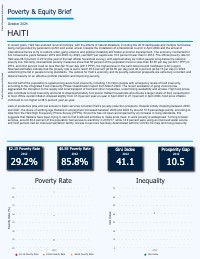
Summary — Haiti faces severe poverty with 58.5% of the population living below the national poverty line in 2012, worsened by economic contraction, gang violence, and food insecurity. Poverty rates are projected to increase further by 2024 due to ongoing instability.
Key Findings
- Haiti has the highest poverty rates in Latin America and Caribbean with 58.5% living below national poverty line in 2012.
- Economy contracted for five consecutive years (2019-2023) with real GDP per capita 10.3% lower than 2012 levels by 2023.
- Half the population faces acute food insecurity with 1.6 million at emergency levels.
- Rural poverty (74.4%) significantly higher than urban poverty (40.1%).
- Access to basic services remains limited: 40.4% electricity, 74.9% improved water, 54.8% improved sanitation.
Full Description
Haiti has endured multiple shocks in recent years, including natural disasters like the 2010 earthquake and hurricanes, compounded by persistent conflict and social unrest. Despite political transitions and international intervention attempts, gang violence and instability continue to hinder economic development. The economy contracted for five consecutive years between 2019 and 2023, with real GDP per capita falling 10.3% below 2012 levels by 2023.
Poverty remains widespread, with 58.5% of the population living below the national poverty line according to the last official survey in 2012. International poverty measures show 58% living on less than $3.65 per day and 29.2% on less than $2.15 per day - the highest rates in Latin America and the Caribbean. Nowcast estimates predict poverty will reach 65.6% (at $3.65/day) and 36.4% (at $2.15/day) by 2024.
Food insecurity affects half the population, with 1.6 million experiencing emergency levels. Gang violence has disrupted food supply chains, while food price inflation reached 38.5% year-on-year in April 2024. Rural populations face higher poverty rates (74.4%) compared to urban areas (40.1%), and education levels strongly correlate with poverty rates.
Access to basic services remains limited, with only 40.4% having electricity access, 74.9% using improved water sources, and 54.8% having improved sanitation facilities as of 2016/17. Employment has increased but without corresponding improvements in living standards, indicating widespread in-work poverty and people struggling to make ends meet.
Full Document Text
Extracted text from the original document for search indexing.
Public Disclosure Authorized Poverty & Equity Brief October 2024 HAITI Public Disclosure Authorized In recent years, Haiti has endured recurrent shocks, with the effects of natural disasters, including the 2010 earthquake and multiple hurricanes, being compounded by persistent conflict and social unrest. Despite the installation of a transitional council in April 2024 and the arrival of international forces to try to restore order, gang violence and political instability still hinder economic development. The economy contracted for five consecutive years between 2019 and 2023: by 2023, real GDP per capita was 10.3 percent lower than in 2012. The official poverty rate for Haiti was 58.5 percent in 2012 (the year of the last official household survey), with approximately six million people living below the national poverty line. Similarly, international poverty measures show that 58 percent of the population lived on less than $3.65 per day (at 2017 PPP) in 2012, and 29.2 percent lived on less than $2.15 per day (2017 PPP), the highest level in the Latin America and Caribbean (LAC) region. Nowcast estimates indicate that the poverty rate is set to reach 65.6 percent (at $3.65 per day) and 36.4 percent (at $2.15 per day) in 2024, underlining the fall in people’s living standards. The outlook for Haiti’s economy and its poverty-reduction prospects are extremely uncertain and Public Disclosure Authorized depend heavily on an effective political transition and improving security. Around half of the population is experiencing acute food insecurity, including 1.6 million people with emergency levels of food insecurity, according to the Integrated Food Insecurity Phase Classification report from March 2024. The recent escalation of gang violence has aggravated the disruption to the supply and local transport of food and other necessities, undermining availability and access. High food prices also contribute to food insecurity and tend to disproportionately hurt poorer Haitian households who devote a larger share of their consumption to food. While overall inflation dropped slightly from 47.9 percent year-on-year in April 2023 to 27.3 percent in April 2024, food price inflation continued to run higher at 38.5 percent year-on-year. Lack of productive jobs and low access to basic services constrain Haiti’s poverty-reduction prospects. Despite initially dropping between 2020 and 2021, the share of working-age Haitians in employment increased between 2020 and 2023 by around 10.6 percentage points, according to Public Disclosure Authorized data from the Haiti High Frequency Phone Survey (HFPS). Since this has not been accompanied by an increase in living standards, this suggests that Haitians have been trying in vain to find livelihood activities to make ends meet; in-work poverty is widespread. Turning to basic services, around 40.4 percent of the population had access to electricity in 2016/17, while 74.9 percent were using an improved water source and 54.8 percent had an improved sanitation facility. Access to services has likely deteriorated with the COVID-19 crisis and rising insecurity. $2.15 Poverty Rate $6.85 Poverty Rate Gini Index Prosperity Gap 2012 2012 2012 2012 29.2% 85.8% 41.1 10.5 Poverty Rate Inequality 90 70 80 60 70 50 e (%) x e 60 40 Rat d erty v 50 Gini In 30 o P 40 30 20 20 10 20120 2012 $2.15 Poverty Rate $3.65 Poverty Rate $6.85 Poverty Rate Gini Index Poverty at Different Lines Poverty Line Number of Poor (Thousands) Rate (%) Year National Poverty Line 6,019.2 58.5 2012 International Poverty Line ($2.15/day) 2,950.9 29.2 2012 Lower Middle Income Class Poverty Line ($3.65/day) 5,865.8 58.0 2012 Upper Middle Income Class Poverty Line ($6.85/day) 8,673.3 85.8 2012 Multidimensional Poverty Measure 46.8 2012 Group and Multidimensional Poverty Poverty by Group Poverty Rate (%) Urban population 40.1 Rural population 74.4 Males 58.9 Females 57.2 0 to 14 years old 66.4 15 to 64 years old 53.2 65 and older 55.3 Without education (16+) 70.7 Primary education (16+) 60.3 Secondary education (16+) 44.7 Tertiary/post-secondary education (16+) 12.7 Note: Multidimensional Poverty Components (% of Pop.) Daily income less than US$2.15 per person 29.2 At least one school-aged child is not enrolled in school 9.0 No adult has completed primary education 23.2 No access to limited-standard drinking water 33.5 No access to limited-standard sanitation 68.8 No access to electricity 64.3 Data for the "Poverty by Group" table is derived from a survey and data for the "Multidimensional Poverty Components" table is derived from a survey. 2012 2012 The rates in the "Poverty by Group" table above are shown at the $3.65 lower-middle income line. "N/A" denotes a missing/removed value, while "N/A*" refers to a value which was removed due to having fewer than 30 observations. Poverty Data & Methodology The last national household living conditions survey, Enquête sur les Conditions de Vie des Ménages Apres le Séisme, to measure poverty was conducted in 2012. More recent data to monitor trends in consumption poverty, inequality, and shared prosperity indicators in Haiti are not available. Poverty in Haiti is measured using the cost-of-basic-needs methodology. Per-capita household expenditure is used as the welfare aggregate and includes both food and non-food expenditures. The poverty line reflects a minimum threshold of 2,300 calories per person per day and is based on a food basket of 26 food items. The national overall poverty line is very close to the $3.65 (2017 PPP) international poverty line, being just 0.9 percent higher, while the national extreme poverty line is 12.7 percent lower than the $2.15 (2017 PPP) international poverty line. Harmonization The numbers presented in the brief are based on the regional data harmonization effort known as the Socio-economic Database for Latin America and the Caribbean (SEDLAC) - a joint effort of the World Bank and CEDLAS from the National University of La Plata (Argentina). SEDLAC includes 18 countries and more than 300 household surveys since the 80s. Several Caribbean countries have not been included in the SEDLAC project due to lack of data. Since an income-based welfare aggregate is widely used in the region for official poverty estimates, income-based microdata is used for the Global Monitoring Database (GMD) and Global Poverty Monitoring. SEDLAC covers demographics, income, employment, and education. Terms of use of the data adhere to agreements with the original data producers. Latin America & the Caribbean Poverty Economist: Jonathan W. Lain