
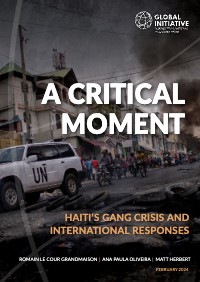
Yon Moman Kritik: Kriz Gang yo nan Ayiti ak Repons Entènasyonal yo
Rezime — Rapò sa a analize sitiyasyon sekirite ki ap vin pi mal nan Ayiti akòz gang kriminèl yo ki vin pi pwisan ak repons entènasyonal yo ki gen ladan sanksyon ONU ak misyon miltinasyonal sekirite yo ki planifye.
Dekouve Enpotan
- Gang kriminèl yo evolye depi aktè san estrikti rive yo vin antreprenè vyolan ki kapab gouvènen teritwa ak kontwòl kriminèl.
- Plis pase 4,789 moun yo te touye nan 2023 ak yon to omisid 40.9 pou 100,000, pi plis pase doub to 2022 la.
- Gang yo kounye a kontwole enfrastrikti enpòtan yo tankou pò komèsyal yo, tèminal pètwòl ak gwo sant popilasyon yo.
- Konsèy Sekirite ONU an otorize yon misyon miltinasyonal sekirite ki pa nan men ONU ki prezante yon chanjman konsèp nan jan yo abòde krim òganize.
- Gwoup ame aktyèl yo pi pwisan nan militè, yo gen pi bon rezo ak yo pi rezistan pase nan entèvensyon anvan yo tankou MINUSTAH.
Deskripsyon Konple
Rapò a dokumente jan sitiyasyon sekirite a ap vin pi mal nan Ayiti nan tout ane 2023 ak kòmanse 2024, ak gang kriminèl yo ki vin pi gwo motè vyolans ak enstabilite. Gang sa yo evolye depi yo te sèlman aktè san estrikti ki te depann sou patwonaj rive yo vin antreprenè vyolan ki kapab gouvènen teritwa yo, yo kontwole enfrastrikti enpòtan yo ak yo mete règ yo sou gwo pòsyon Port-au-Prince ak rejyon riral yo. Transfòmasyon sa a te alimente pa aksè san parèy yo gen nan zam ak ensapsite Leta Ayisyen an pou l te sispann ekspansyon ak pwofesyonalizasyon yo. Pou reponn nan kriz sa a, Konsèy Sekirite ONU an te otorize yon misyon miltinasyonal sekirite ki pa nan men ONU nan oktòb 2023, ak Kenya ki nan tèt la, ansanm ak aplikasyon rejim sanksyon ki vize chèf gang yo, nonm biznis ak politisyen yo. Rapò a mete aksan sou sa ki vle di se yon gwo chanjman konsèp pou ONU an, ki konsantre sou entite kriminèl yo ki vize pwòfi kòm aktè prensipal nan konfli a. Sitiyasyon aktyèl la prezante yon tès ki trè difisil, paske gwoup ame Ayisyen yo kounye a pi pwisan nan militè, yo gen pi bon rezo ak yo pi rezistan pase nan entèvensyon anvan yo tankou MINUSTAH.
Teks Konple Dokiman an
Teks ki soti nan dokiman orijinal la pou endeksasyon.
A CRITICAL MOMENT HAITI’S GANG CRISIS AND INTERNATIONAL RESPONSES ROMAIN LE COUR GRANDMAISON | ANA PAULA OLIVEIRA | MATT HERBERT FEBRUARY 2024 ACKNOWLEDGEMENTS The authors would like to thank the people in Haiti who made this investigation possible. Although for security reasons their names cannot appear in the report, their support and openness has been crucial to this work. The authors would also like to thank Mark Shaw for his comments, the editor and the Global Initiative Against Transnational Organized Crime (GI-TOC)’s Publications team for their support in reviewing and developing the report. ABOUT THE AUTHORS Romain Le Cour Grandmaison is a senior expert at the GI-TOC. His work focuses on criminal organizations, the state and violence in Haiti, Mexico and Central America. He has a PhD in political science from Sorbonne University. Ana Paula Oliveira is a senior analyst in the GI-TOC’s Global Policy team. She provides analysis on a range of international policy issues, including the impact of organized crime on human rights law and policy, human rights responses to transnational organized crime, cybercrime and organized crime violence in the context of illicit economies. Ana Paula has an LL.M. cum laude in international law from the Graduate Institute of International and Development Studies in Geneva. Matt Herbert is the head of research for North Africa and the Sahel at the GI-TOC, overseeing applied field research and analysis on the political economy of organized crime in the two regions. He also co-leads the GI-TOC initiative on the use of targeted sanctions as tools to counter transnational organized crime and corruption. He has a PhD in international relations from the Fletcher School of Law & Diplomacy, Tufts University, with a sub-specialization in security studies, and law and development. © 2024 Global Initiative Against Transnational Organized Crime All rights reserved. No part of this publication may be reproduced or transmitted in any form or by any means without permission in writing from the Global Initiative. Cover photo: Ricardo Arduengo/AFP via Getty Images Cartography: Rudi de Lange Please direct inquiries to: The Global Initiative Against Transnational Organized Crime Avenue de France 23 Geneva, CH-1202 Switzerland www.globalinitiative.net CONTENTS Abbreviations and acronyms �������������������������������������������������������������������������������������������������������������������������������������������������������������� 2 Executive summary���������������������������������������������������������������������������������������������������������������������������������������������������������������������� 3 Methodology�����������������������������������������������������������������������������������������������������������������������������������������������������������������������������������5 Haiti’s gangs: from territorial control to criminal governance ������������������������������������������������������������������������ 6 The professionalization of gangs����������������������������������������������������������������������������������������������������������������������������������������������� 6 Firearms proliferation and tactical training: The new reality ����������������������������������������������������������������������������������������� 12 Gangs, vigilantes and strongmen: The new ecosystem of violence������������������������������������������������������������������������������ 13 The new logics of territorial control and rent extraction �������������������������������������������������������������������������������������������������17 The international response to gangs in Haiti����������������������������������������������������������������������������������������������������������� 22 Sanctions: Developing the regime to buttress the deployment �������������������������������������������������������������������������������������24 The Multinational Security Support mission: A new model of international intervention against organized crime ������������������������������������������������������������������������������������������������������������������������������������������������������������ 29 Potential risks and challenges for the mission�������������������������������������������������������������������������������������������������������������������� 33 Conclusion and recommendations ��������������������������������������������������������������������������������������������������������������������������������� 38 Coordination and planning between the MSS mission, Sanctions Committee and Panel of Experts����������������� 38 Target criminal ecosystems to counter gangs��������������������������������������������������������������������������������������������������������������������� 39 Expedite sanctions designations �������������������������������������������������������������������������������������������������������������������������������������������� 39 Continually map criminal ecosystems ����������������������������������������������������������������������������������������������������������������������������������� 40 Human rights and community at the centre ����������������������������������������������������������������������������������������������������������������������� 40 Fine-tune and repeat messaging �������������������������������������������������������������������������������������������������������������������������������������������� 40 Notes �������������������������������������������������������������������������������������������������������������������������������������������������������������������������������������������������������41 FROM VISION TO ACTION: A DECADE OF ANALYSIS, DISRUPTION AND RESILIENCE The Global Initiative Against Transnational Organized Crime was founded in 2013. Its vision was to mobilize a global strategic approach to tackling organized crime by strengthening political commitment to address the challenge, building the analytical evidence base on organized crime, disrupting criminal economies and developing networks of resilience in affected communities. Ten years on, the threat of organized crime is greater than ever before and it is critical that we continue to take action by building a coordinated global response to meet the challenge. ACRONYMS AND ABBREVIATIONS BINUH United Nations Integrated Office in Haiti BSAP Brigade de Sécurité des Aires Protégées (Protected Areas Security Brigade) EU European Union G9 G9 Fanmi e Alye (G9 Family and Allies), criminal federation of gangs G-Pèp G-People, criminal federation of gangs HNP Haitian National Police MINUJUSTH United Nations Mission for Justice Support in Haiti MINUSTAH United Nations Stabilization Mission in Haiti MSS Multinational Security Support Mission in Haiti UN United Nations UNSC United Nations Security Council UNSG United Nations Secretary General 2 EXECUTIVE SUMMARY Over the course of 2023 and early 2024, security has continued to deteriorate alarmingly in Haiti’s capital, Port-au-Prince, and in rural areas in the centre and south of the country.1 Criminal gangs, the main drivers of this degradation, have grown in strength and capacity, enabling them to supplant in part or in full the control of government forces.2 The gangs’ domination of critical infrastructure, such as commercial and oil port terminals, major roads, and population centres has heightened their influence over Haiti’s economy and political system. The gangs have also imposed governance on major parts of Port-au-Prince, leading both to rising criminal predation and human rights violations, including gender-based violence.3 Moreover, 2023 saw the development of particularly strong vigilante movements while the first weeks of 2024 witnessed the rise of violent political leaders, adding to an already disastrous security situation. As one United Nations (UN) report bluntly noted: ‘The situation is unravelling.’4 The Haitian crisis worsened critically in 2023. UN reports indicate that in 2023, over 4 789 people were murdered, 1 698 injured and 2 490 kidnapped, with a 2023 homicide rate of 40.9 per 100 000, more than double the 2022 rate.5 Besides these figures, the nature of the criminal actors has been profoundly transformed, posing a series of challenges to international intervention. Over the past five years, gangs have undergone a radical evolution, going from rather unstructured actors dependent on resources provided by public or private patronage to violent entrepreneurs who have been able to convert their territorial power into governance capabilities. This shift has been fuelled by the gangs’ unprecedented access to firearms and the Haitian state’s inability to halt their expansion, profession alization and propensity to impose their rule over ever larger territories, as well as by ongoing collusion by elements of the country’s political and economic elites. In October 2023, the United Nations Security Council (UNSC) adopted a resolution authorizing a non-UN multinational security support (MSS) mission to Haiti. After long negotiations, the Kenyan government agreed to lead the deployment, aimed at supporting the Haitian National Police (HNP) in addressing gang violence and re-establishing security,6 although the planned operation is currently being challenged in the Kenyan courts.7 This resolution came after the UNSC agreed a sanctions regime for Haiti in October 2022, and the subsequent imposition of sanctions on key gang leaders, businessmen and politicians. The UN sanctions have been supplemented by unilateral designations issued by Canada, the US, and the European Union (EU). Further UN sanctions were levied on gang leaders in December 2023, as the preparations accelerated for the MSS deployment. 3 Homicide rate 40.9 per 100 000 (more than double the 2022 rate of 18.1 per 100 000) 48 police officers have been killed and 75 injured Detainees in prison 11 822 (rate occupancy of 307%) FIGURE 1 Violence, crime and drivers of insecurity in Haiti, 2023. SOURCE: BINUH report (S/2024/62), 15 January 2024 Homicides 4 789, including 465 women, 93 boys and 48 girls (+119.4% compared to 2022) Kidnappings 2 490 victims (+83% compared to 2022) 146 584 internally displaced persons More than 4.35 million people (more than 40% of the population), are facing acute food insecurity. Intervention by the UN in Haiti is not new, with the embryonic MSS mission representing the third initiative in as many decades. However, the proposed international mission stands out, both for Haiti and more broadly for international responses to organized criminal violence. Historically, the UN has become involved in Haiti in response to political crises, worsening insecurity and repeated natural disasters.8 While the 2004-2017 United Nations Stabilisation Mission in Haiti (MINUSTAH) engaged in counter-gang operations, largely in and around Port-au-Prince, this came after the force had been on the ground for several years and was generally intermittent.9 In contrast, the prospective 2024 intervention will be conducted outside the auspices of the UN and has been motivated by, and focuses on, criminal gangs as the main threat to peace and security. This reflects the substantial change in gangs’ power, structure and capacity for territorial governance since the MINUSTAH era. These entities are nowadays far more economically autonomous and territorially powerful, making them less controllable. As one Haitian entrepreneur described the contemporary evolution of the gangs: ‘We saw a lion being born, we fed it and watched it grow, we tried to domesticate it, but the animal eventually escaped from the cage, and here we are.’10 Nonetheless, the focus by the UNSC on profit-oriented criminal entities as primary conflict actors in their own right, in both the resolutions setting up the sanctions regime and the MSS mission, is a substantial conceptual shift for the UN.11 Given the growth of transnational organized crime, and expansion of instability and violence linked to such crime, situations like the present one in Haiti are likely to become more common. The UN’s current initiatives on Haiti potentially augur a new international approach to how organized crime actors can be tackled both from a security and human rights perspective. Ensuring international tools are effective in mitigating harm caused by gangs in Haiti is therefore vitally important for the people of the country, and for the international community. 4 The situation presents an extremely difficult test. Haitian armed groups today are more militarily powerful, networked, and resilient than those during the MINUSTAH intervention. It is therefore essential that the various international tools be tailored to the rapidly evolving criminal and violence dynamics on the ground, and be implemented in a strategically coordinated fashion. Meetings between Kenyan and Haitian police teams have taken place, as well as trainings, and vetting processes prior to deployment. However, the proposed mission, the UNSC and the Haitian government have yet to present a public plan and strategy for the intervention, either for short-term engagement on the ground or for a long-term political solution.12 This policy report is intended to further efforts to tailor both the MSS mission and the sanctions regime to the current operational challenges in Haiti, support Haitian and international decision-makers in their mission, and provide strategic backing to the country’s civil society. It begins by detailing the current situation on the ground, including gangs and other violent groups’ operations, governance and territorial domination. The next section details the mandate and oper ations of the two primary international tools, the sanctions regime and the MSS mission. The third section flags key issues which need to be considered for both the sanctions regime and the interna tional force, and presents opportunities to align the two more comprehensively, to strengthen public security responses and public policy initiatives so as to resolve the crisis. This report is the first of several planned publications on the political economy of violence in Haiti and the international cooperation that seeks to uproot it. It follows a 2022 Global Initiative Against Transnational Organized Crime (GI-TOC) report on gang evolution and a 2023 GI-TOC report on gender-based violence in the country.13 Methodology The methodology for this report is primarily qualitative, combining fieldwork observation and inter views conducted in Haiti in November 2023, and desk research. It is based on 36 interviews with UN officials, Haitian civil society members, public and private sector actors, politicians, police forces, humanitarian actors, diplomats and other locals, and the wider international community. It also draws on UN Security Council resolutions, reports by UN agencies and the Haiti Panel of Experts, and research conducted by think tanks and academics on gang dynamics and instability. Finally, the study also draws on broader research and analysis conducted by the GI-TOC on organized crime in Haiti, UN action against organized crime, and the use of sanctions to address transnational organized crime. All interviews and fieldwork activities were conducted by GI-TOC teams. For security reasons, the names of the interviewees are not given. 5 HAITI’S GANGS: FROM TERRITORIAL CONTROL TO CRIMINAL GOVERNANCE Gangs in Haiti are a longstanding phenomenon.14 They link to a tradition of non-state armed groups that stretches back to the 1950s, with the development of the Tonton Macoutes by President François (Papa Doc) Duvalier.15 However, the nature of Haiti’s gangs has changed drastically in recent years. Writing during the MINUSTAH era, in 2008, analysts flagged that ‘Haitian gangs proved to be collections of individuals who formed around brutal and charismatic leaders, unlike the hierarchical, tightly organized turf-based institutions found in the United States.’16 This framing of weak, disarticulated gangs is no longer accurate. Although a vast number of Haiti’s gangs remain small organizations, the major ones – those which control substantial territory and are responsible for most current instability – are well-structured, well-armed and operationally competent entities.17 While links to politicians and businesspeople remain, the relationship is more even, with the growing capacity of gangs allowing them to self-fund and put a considerable amount of pressure on the political and economic system. As a result, the international community and MSS planners confront a very different and, in many ways, far more difficult situation than existed under MINUSTAH. This subsection maps out key ground dynamics, delving first into gang evolution, then gang operations, before finally touching on the formal and informal Haitian actors arrayed against gangs. The professionalization of gangs Gangs have grown significantly in size and diversity in comparison to the 2000s and 2010s. As of early 2024, estimates peg the number of gangs in Haiti at around 200,18 and they operate mainly in the metro politan area of Port-au-Prince, including the communes of Port-au-Prince, Delmas, Cité Soleil, Tabarre, Carrefour and Pétion-Ville. Their size ranges substantially, from a dozen men to several thousands. 6 CUBA Caribbean Sea Nord-Ouest Port-De-Paix Nord-Ouest Cap-Haïtien Nord Fort-Liberté HAITI Gonaïves L'Artibonite Nord-Est Hinche Jérémie Grand'Anse Ouest Port-au-Prince Bay HAITI Centre Ouest DOMINICAN REPUBLIC Grand'Anse Les Cayes Sud Nippes Jacmel PORT-AU-PRINCE Sud-Est FIGURE 2 Haiti. Les Cayes Sud N 0 60 km Some gangs that had 50 or 100 active members during the MINUSTAH period now stretch to 1 500 to 2 500 members.19 The most powerful gangs of today did not even exist a decade ago, while new cliques emerge every week. Gang leaders are well known in Haiti. These men combine extensive experience as gang members and access to political and economic networks that provide them with patronage and funding, contacts within the police and justice system, and connections capable of trafficking high-calibre weapons or drugs. In many cases, leaders have served in Haiti’s security forces or in political parties or movements. For example, Jimmy Chérizier (aka Barbecue), head of the G9 Fanmi e Alye (G9 Family and Allies or G-9) coalition, is a former police officer, while Chery Christ-Rois (aka Krisla), head of Ti Bwa Gang, is a former political activist. Increasingly, however, Haiti’s gang leaders have begun to emerge via hierarchic advancement within the gangs themselves, either to control established entities or leveraging their experience to found splinter groups. Leaders such as Johnson André (aka Izo or Izo 5 Segond), head of the Village de Dieu – 5 Segond Gang, or Renel Destina (aka Ti Lapli), who leads the Gran Ravine Gang, have been ‘gang soldiers’ for most of their lives. 7 Port-au-Prince Bay Cité-Soleil Canaan 11 3 11 3 88 Tabarre La Saline 11 88 2 Carrefour Pétion-Ville PORT-AU-PRINCE PORT-AU-PRINCE 22 101 101 Martissant 101 101 FIGURE 3 Port-au-Prince, showing some urban locations discussed in the report. N 0 4.5 km These ‘young veterans’, as one interviewee called them, have learned from mistakes made by their former bosses, and thus run much more sophisticated organizations than their predecessors. They resemble – in their ability to administer territories, extract resources, conduct well-designed mili tary-type operations, and organize, deploy and pay hundreds of men – relatively sophisticated drug cartels, militias, or paramilitary groups, rather than the low-capacity gangs that operated in Haiti in the 2000s and early 2010s. Our contacts indicate that across the board, criminal structures in Haiti are much more hierarchical and strict than before.20 The larger gangs operate with a leadership team and exploit an organized division of labour – from soldiers to financial officers and political advisors – while maintaining com mand and control structures in field areas.21 Further, for large and well-known gangs in Port-au-Prince, recruitment processes have been developed and entail discrete taskings and tests, making it more difficult to join gangs’ ranks, parallel to forced recruitment. Members who have sought to leave gangs, including children, risk being killed.22 8 Gang control: From urban to rural areas Historically, gangs in Haiti have been an urban phenomenon, with most operating in and around Port-au-Prince. This broadly remains the case today. At least 23 major gangs operate in the Port-au Prince metropolitan area (West department), clustered around two main coalitions: the G9 and the G-Pèp (G-People) alliance. Alongside these, another seventy smaller and independent gangs under take opportunistic alliances, both among themselves and with either G9 or G-Pèp.23 Collectively, the gangs exert control or substantial influence over 80% of the city, as well as the zones immediately outside it. To travel in and out of Port-au-Prince, one must take the risk of driving through a criminal checkpoint; the alternative, for the few who can afford it, is to board a small plane. A major development in the geography of violence is the rapid expansion of gangs’ presence and control in peri-urban and rural areas, a phenomenon that started around 2015. However, it has sub stantially accelerated over the last two years. While gang members in rural areas are overwhelmingly local to those regions, they are also allied with or connected to large urban structures based in Port au-Prince. This geographic expansion of major gangs’ influence risks triggering the genre of attacks and gender-based violence that were previously largely confined to Port-au-Prince. The core of Haiti’s rural gang challenge is the Artibonite department, which is located roughly 100 kilometres north of the capital (see Figure 2). There, gangs such as Gran Grif and Kokorat San Ras appeared publicly in 2015, allegedly fuelled by candidates in that year’s legislative elections who sought to instrumentalize them for political success.24 Since then, however, the gangs have become more autonomous and increasingly powerful, with Gran Grif (also known as the Savien gang) expo nentially enlarging its area of control and influence since 2022.25 As of 2023, more than 20 criminal structures, including gangs and vigilante groups, operated in the department.26 The gangs’ expanding presence has led to a sharp increase in violence in Artibonite, including torture, assassinations, extortion, kidnappings for ransom, sexual violence and forced displacement.27 Between January 2022 and October 2023, more than 1 690 people were killed, injured or kidnapped in the department.28 In a three-month stretch, the Artibonite accounted for 27% of all victims of killings, injuries and kidnappings throughout Haiti.29 Violence mainly involved inter-gang competition, including efforts to conquer rivals’ territories, rather than being due to expansion into areas previously free of gang control. G9 Alliance G-Pèp Federation and allies Delmas 6 Gang Baz Krache Dife Baz Pilat Nan Ti Bwa Simon Pelé’s Gang Baz Nan Chabon Was Jérémie Nan Boston Belekou Gang Chen Méchan FIGURE 4 Haiti’s main gang alliances. Nan Brooklyn Gang Village de Dieu/5 Segond Fontamara Kraz Baryè 400 Marozo Grand Ravine Gang Canaan Gang 9 Violence in the Artibonite also emerged along key roads. Gangs have repeatedly targeted travellers on National Road 1, the main south-north route connecting Port-au-Prince with Gonaïves and Cap Haïtien, kidnapping at least 515 people in a three month stretch in Artibonite and the neighbouring commune of Croix-des-Bouquets.30 Incidents of sexual violence and targeted killings have also arisen along the road. Such violence clearly undermines the feasibility of travel between major Haitian cities, potentially posing future risks to commerce and aid delivery should gangs seek to permanently control sections of National Road 1 and other key routes in the Artibonite. While rural gangs generally engage in a similar range of predatory activities as urban ones – including kidnap for ransom and checkpoint robberies – there has been some specific adaptation to the rural environment. Most notably, gangs in the Artibonite have increasingly invaded farmland, threatened farmers and landowners and demanded payment in return for leaving.31 This new tactic has driven substantial rural displacement, and impacted agricultural production in Artibonite, with land under cultivation falling from 5 800 hectares in 2018 to 2 400 hectares in 2022.32 Cultivation likely declined further in 2023. This dynamic has national implications, since Artibonite is key to food supply. Food prices in Port-au-Prince, for example, have sharply increased, while food insecurity, already immense in the country, has continued to worsen.33 Vigilante uprising in rural Haiti The gangs’ presence also provoked the growth of existing vigilante groups and the creation of new ones in parts of Artibonite, triggering heightened violence and confrontations between citizens and gangs akin to that prevalent in Port-au-Prince. In September 2023, the deployment of Izo’s 5 Segond gang members to Mirebalais, 35 kilometres north of the capital, led to clashes between vigilantes and gang members. Thirty were killed, with more than a dozen wounded. At least 800 families in turn fled their homes. Reports indicate several cases where vigilante groups have caught Izo’s soldiers and lynched them or burned them alive.34 The territorial expansion of the Village de Dieu Gang and the G-Pèp coalition has also fed into new forms of violence, along with these groups’ capacities to move armed men by sea, across the bay of Port-au-Prince, to avoid territories controlled by their enemy G9. Moreover, the ability of Village de Dieu to operate at sea poses a major and unaddressed tactical challenge to the international inter vention, which is envisaged as operating largely inland, within the capital. Finally, the ‘ruralization’ of violence does not only concern gangs’ direct presence. Sources in southern departments have indicated that some local schools have been saturated by children sent by their families from Port au-Prince to study away from the capital, amid the relative calm that was still found in this part of the country until recently. Gang alliances: Franchises at the service of territorial expansion A key facet of Haitian gangs’ evolution has been the emergence of rival blocs, notably G9 and G-Pèp. G9 formed first, through the work of Jimmy Chérizier; it is an alliance of nine gangs allegedly linked to the Haitian Tèt Kale Party. G-Pèp was then created by Ti Gabriel, of the Nan Brooklyn Gang, largely in reaction.35 These two blocs include major gangs which are formally linked, medium-sized gangs which are looser affiliates of either of the blocs, and smaller gangs and independent actors who engage opportunistically. It is important to stress that gang alliances remain loose, with tensions and occasional clashes occurring within alliance blocs, as well as against external adversaries. Moreover, 10 Burnt-out car next to the remains of a barricade in Delmas, Port-au-Prince, November 2023. Photo: Romain Le Cour Grandmaison/GI-TOC rivalries between gang leaders do not prevent them from exchanging on WhatsApp groups, according to our interlocutors. The gang alliance system was mainly a dynamic of Port-au-Prince. However, there are some indica tions – as underscored by Izo’s move into Artibonite – that the capital’s gangs are looking to develop similar alliance structures nationally.36 For the gangs, the development of alliances is a fluid phenomenon that serves several purposes. First, in operational terms, the development of alliances reflects the extreme territorialization of gangs, who tend to be rooted in specific neighbourhoods or areas, some of which are small areas. Although their localized roots constitute a strength, constant confrontations and their endless list of enemies prevent most groups from readily operating outside their turf. A gang leader, for example, would generally not risk leaving his stronghold for fear of being targeted by a rival or by the police. As a result, only the most powerful gangs – such as Izo’s or Chérizier’s – are usually able to operate or profiteer outside their fiefdoms. This is when alliances come into play. When gangs go to war, seek to expand their territory or to protect themselves from rivals’ attacks, alliances enable the provision or receipt of quick support, with allied gangs dispatching ‘soldiers’. This was the case during peaks of violence in Carrefour and Mariani, for example, or after the death of Iscard Andrice (Iskar), a prominent G9 leader in November 2023, in Cité-Soleil. Here, at least 166 people were killed in brutal confrontations that lasted for three days, while more than 1 000 were displaced, with local sources reporting that armed reinforcements were mobilized by rival gangs over the course of a week.37 Second, the creation of public alliances feeds an image of power for the gangs and a dynamic of ‘brand ing’ that fuels the creation of new small groups. It is not just a question of clashes between groups, but also of who has the upper hand, G9 or G-Pèp. According to several interviewees who have direct access to the gangs, the alliances function as ‘brands’ that new (often small) groups seek to join, both to receive the potential protection of the ‘gang families’ and to establish their own reputation. Being 11 able to announce that one is affiliated with G9 or G-Pèp enables the newly created group to raise its profile and its attractiveness to potential recruits. In this way, the ‘blocs’ created by G9 and G-Pèp are a powerful communication, recruitment and expan sion tool, enabling them to extend their influence by supporting and integrating new cells. This creates a political dynamic, making the expansion of influence by gang leaders far easier than in the past, with territorial conquest giving way to expansion through franchising. Firearms proliferation and tactical training: The new reality Present-day gangs enjoy a much higher degree of military capacity than those a decade ago, which is reflected in the increasing violence seen in Port-au-Prince, the Artibonite and the south. This has largely been driven by gangs’ ability to acquire high-calibre weapons. Over the past decade, firearms have completely transformed the ecosystem of violence. Ten years ago, according to interviews, it was rare to find semi-automatic weapons in the hands of street soldiers, who in some cases were forced to share handguns between several members. Weapons availability was limited enough that provision of guns was a key form of support by elites to gangs, creating a degree of dependency and control. This has changed, as a variety of weapons trafficking networks – allegedly tied to US, Jamaican, Dominican and Haitian intermediaries, and corrupt authorities and military personnel – have emerged to drive a robust black market in trafficked firearms.38 Larger gangs are readily able to acquire AK-47, AR-15 or IMI Galil assault rifles, with local sources suggesting they have stockpiled them.39 Information from different gang-controlled areas also suggests the presence of .50 calibre rifles and tripod-mounted weapons, while there are rumours of the acquisition of M50 and M60 assault rifles. The increasing availability of weapons has spurred recruitment, in the shape of gangs reportedly prom ising prospective recruits a personal weapon. Finally, local sources have explained how gang members sometimes ask victims of their extortion rackets, especially companies that operate within their territory, to pay them in ammunition or firearms, rather than cash. A sign reading ‘firearms are prohibited’ at the entrance to a hotel in Pétion-Ville, Port-au-Prince, November 2023. Photo: Romain Le Cour Grandmaison / GI-TOC 12 Gangs’ tactical improvements build on weapons acquisition The operational capacity of gangs has also been buttressed by tactical training. Ex-soldiers and police men have been recruited both as fighters and trainers, transforming the ability of gangs to operate. The most powerful gangs now ‘move and fight differently’ to five years ago, one source said. ‘You can tell from the way they carry their rifles, they know how to use them, some are well-trained … [and they display] intimate knowledge of their territories, streets, houses.’40 This increased operational capability has shifted how gangs operate. They are capable of and willing to confront police (including special tactics squads), leading to a growing trend of direct assaults on stations and outposts.41 Recent gang offensives have also involved the use of counterfeit police uni forms and high-calibre weapons capable of destroying armoured vehicles.42 The gangs have also shifted how they secure their territory, hedging more against incursions by heavily armed rivals and the police. Ahead of the potential deployment of the international force, sources contacts indicate that major gangs are stepping up operations to gather information and intelligence. Overall, gangs’ rising capacity – including the proliferation of firearms and development of tactical training – is transforming the nature of confrontations, making them ever more violent. The armed groups can confront the police (and will be able to confront MSS forces) in a way they did not during the MINUSTAH era. However, this does not mean that all gangs hold the same capacity of sustained confrontation. Several interviewees pointed out that in contrast to the generally high capability outlined above, some gangs have difficulty paying, feeding, and arming their soldiers. This fragility, in turn, could mean that the application of heightened strategic pressure by the international mission and HNP could collapse those gangs’ capabilities more rapidly and to a greater degree than commonly perceived. Moreover, several sources close to gang leaders told us that most of the groups were not ready to go into battle against the MSS mission, seeing the international deployment as too powerful a rival, which whom it would be smarter to negotiate rather than fight. However, while this evaluation is also fairly prevalent within international civil society, caution should abound, especially given the determination shown by gangs in their battles against the HNP. Gangs, vigilantes and strongmen: The new ecosystem of violence While the behaviour of Haiti’s gangs is the most visible manifestation of violence, these entities are nevertheless part of a broader violent ecosystem that is continually expanding. Smaller gangs, deportees and freelancers The vast majority of the 200 cells operating in the country are cliques of dozens of men, much less well armed than the major gangs and in some cases unable to pay regular wages to their members. These groups are looking to become bigger, usually under the protection of a major gang, and they are often assigned specific tasks – checkpoint surveillance or kidnappings, for example – in the service of the latter. There are also several ‘freelance’ gangs and groups of individuals that specialize in highly valued skills or services. These include gangs composed of ex-police officers, including from special tactics units, as well as military or security trained personnel. They can provide armed support to both alliances – 13 G9 and G-Pèp – during conflicts, as well as personnel able to operate heavier weapons, offer sharper shooting skills, and aid in the design of tactically complex operations. One example is the Galil Gang, a group which delivers strategic support to other gangs. Present in several Caribbean countries, Galil also provides ‘counsel’ to violent partners, according to interviewees, working as intermediaries to help gain access to specific, hard to penetrate markets, for example specific firearms such as M-4 machine guns or Negev light machine guns.43 Finally, one specific category has gained crucial importance in Haiti’s criminal ecosystem in the past years: the ‘deportees’, gang members and criminals that had been arrested, jailed, and then deported from the United States. Because they bring expertise in the use of firearms, possible contacts in the US and Latin America for drug and weapons trafficking, and experience in bigger gangs or criminal structures, these individuals are extremely valuable for Haitian criminals. Carefully recruited and allegedly better paid than locals, these men work alongside ex-police or military trained personnel in providing tactical training to young gang members, for example. Bwa Kale In the spring of 2023, a major transformation of violence occurred in Port-au-Prince, with the devel opment of a vigilante movement called ‘Bwa Kale’ (peeled wood), mobilizing several hundreds of individuals at key moments of uprising. At the core of Bwa Kale lies the citizens’ will to restore order and security, take justice into their own hands, and punish enemies – gang members or not – through physical violence. The latter includes public lynching and executions, of which more than 600 cases have been registered since April 2023, according to local sources. Although most media outlets have portrayed Bwa Kale as a momentary, spectacular outburst of citizens’ anger against gangs’ harassment and the government’s inability to provide security, this arguably represents only part of the picture. Rather than a proper organization or group, Bwa Kale might be best understood as a renewed set of old practices of community surveillance and patrolling that intersect with neighbourhood ‘brigades’ and ‘baz’ (bases). These terms both refer to a modality in which citizens have organized within their communities – usu ally in contact with state authorities and police forces – via small informal or formal structures, with fluctuating levels of sophistication, focusing on public security, social and religious activities, political rallying, and electoral tasks.44 In Port-au-Prince, dozens of brigades and baz currently operate with strongmen, or a group of them, at their head. These men act as community leaders and crucial brokers, serving as the interface between neighbourhoods and public or private stakeholders. Bwa Kale can also be understood as a fluid ‘mob’ response that can be activated in specific circum stances, such as gang attacks. People can be heard saying that they’re going to ‘make a Bwa Kale’, for example. In addition, ‘Bwa Kale’ graffiti have appeared in dozens of neighbourhoods around the capital.45 Any group of citizens can act under the auspices of Bwa Kale, claiming its right to punish and discipline. This is why lynching have repeatedly been committed over the last year, besides the April and May ‘Bwa Kale moment’ of uprising. Bwa Kale is usually mobilized on a very small territorial scale, operating on a neighbourhood basis. Delimiting the perimeter of action of the vigilantes, through the installation of checkpoints, for exam ple, serves to socially and territorially divide the interior from the exterior; what is safe from what is a 14 menace, while vigilante practices include patrolling – people are armed with sticks, stones, machetes or, increasingly, different types of firearms. Whenever the vigilantes identify a threat, it takes only a few minutes to mobilize the population – mainly through WhatsApp groups or even more spon taneous street alerts – to close the doors or the checkpoints, chase down the threat and, in many cases, summarily punish the suspect. Finally, because of its popularity within the Port-au-Prince population, Bwa Kale has re-sparked the creation of neighbourhood brigades, and the installation of barricades, massive metal doors, and barriers at the entrances to dozens of areas of the capital. These are guarded, or at least monitored day and night. In certain areas, the brigades went as far as to build concrete surveillance outposts. Moreover, Bwa Kale movements have also spread out in Port-au-Prince, for example in the Artibonite department. Without going into the complex history of these vigilante movements here, several local groups have gained substantial power through the provision of security in their area. This is the case around the Port-au-Prince sectors of Laboule 12, Thomassin, Duplan 2 and Fort Jacques, above Pétion-Ville, where different sources said that local vigilante groups played a crucial role in evicting Carlo Petit Homme’s (aka Ti Makak) gang, in April of 2023, and bringing order to the area.46 There are also historic precedents, however, for vigilantes converting their social power into political and violent capital, in so doing transforming into criminal gangs. Baz Pilat for example, active around Carrefour Feuilles, in the south of the capital, has become a major gang-vigilante structure. Its alleged leader, Ezéchiel Alexandre, a former divisional inspector in the HNP, was arrested in June 2022. The gang remains central to ongoing violence in the area. Vigilante movements and their relationships with the police It is important to underscore that in Baz, brigades, Bwa Kale, and other manifestations of vigilantism, the nature of the activities is intimately linked to police forces, both institutionally or personally. In vigilante movements, taking justice into one’s hands is presented as a moral imperative: when the government is not doing its job to combat criminal groups, people must act and protect their com munities. In that sense, the vigilantes seek to fulfil the role that the state fails to play in protecting them from violence, while still calling upon the government to support them politically, financially, and militarily. This is the paradox of self-defence groups, in Haiti and elsewhere: usually professing to emanate from a tradition of self-help, vigilantes at the same time seek to satisfy community demands for more state presence, public accountability and greater police intervention.47 Vigilantes’ tactics for controlling territory enables them to cooperate with the police, particularly to hunt down gang members, while by securing their turf, leaders earn legitimacy in the eyes of local inhabitants. In return, by collaborating with these movements, public authorities and police forces can increase their local acceptance, gather intelligence on the local dynamics of violence, develop a network of allied strongmen, or, at least, guarantee a presence through a proxy partner. The vigilante structures tend to include police officers who support, tolerate and/or participate in the movements, usually on an informal basis. According to our interviewees, this is first linked to an individual logic: police officers live in the same neighbourhoods where vigilante groups operate, which makes them both exposed and involved, as citizens as well as police officers, in community protection. A policeman can therefore perform its public duty, in uniform, during one part of the day, before becoming a vigilante, dressed as a civilian, during another. 15 Secondly, the provision of security by vigilante groups, which is central to vigilantism well beyond Haiti, is rapidly becoming a supplementary task for public forces.48 The latter can delegate surveillance of the territory to these groups, collaborate with them discreetly and informally, and establish links between the vigilantes and the police institution. At one surveillance outpost that we visited, the armed vigilantes were standing a few meters from the neighbourhood police station, illustrating the tacit cohabitation between them. For public authorities, tolerating vigilante movements, or even establishing formal agreements with them might appear efficient in the short term – for example, if it contributes to improving the territorial foothold of the HNP or of the MSS mission. However, in the long run, it tends to further de-legitimize the state as the sole guarantor of order and security, posing threats to political sta bilization and violence reduction. Moreover, while gang activities and violent crimes are a strong driver for the creation of vigilante groups, it is not uncommon for them to gradually become more involved in illicit activities, especially extortion-rackets, and different forms of trafficking, while their leaders tend to accumulate more and more personal power. Avengers, strongmen or political leaders? The new rebels and their militias A final group of actors deserves crucial attention. It concerns strongmen who straddle the line between vigilante leaders and political bosses, accumulating considerable power and articulating it with open calls for popular rebellion against the government of Ariel Henry. In the western and southern communes of Nippes, Aquin and Les Cayes, Jean-Ernest Muscadin, Commissioner of Miragoâne, has been leading for more than two years a large vigilante-style group that he presents as an organ of moral justice and stronger public security in the absence of the state.49 His men, often equipped with automatic weapons, partly regulate life in the municipalities where they operate, in addition to eliminating the gang members they track down, including in disputed terri tories outside Muscadin’s jurisdiction. The Ministry of Justice reportedly blamed the commissioner for extending its mandate in December 2023.50 According to interviews conducted for this study, Muscadin enjoys considerable popularity, both with the population living in these three communes and within the diaspora in the United States. His ability to maintain order, despite videos allegedly showing him executing suspected gang members in broad daylight, has turned him into a key figure in local security and a potential political player to be reckoned with at the national level, although several human rights organizations have called for his impeachment.51 In recent weeks, an even more important figure has reappeared on the Haitian political scene: Guy Philippe. Philippe was police chief in Cap Haïtien during the 1990s, before he was accused of planning a coup against former president Jean-Bertrand Aristide. He was dismissed in 2000, and fled to the Dominican Republic.52 Having received special forces training from the US during his police career, he helped to set up a paramilitary group, the Front Pour la Libération et la Reconstruction Nationales (Front for National Liberation and Reconstruction), aimed at overthrowing the Aristide government.53 That government was toppled in 2004, allegedly with the support of personnel still loyal to Philippe. 54 Despite being elected senator, he was arrested and extradited to the United States in January 2017.55 Charged with money laundering and drug trafficking, he spent six years in prison. Philippe was finally released and deported to Haiti in December 2023.56 In the first weeks of 2024, Philippe has rekindled his profile by organizing several demonstrations across the country, including the capital, the border area with the Dominican Republic and the far west, in Jérémie. These events, held in departments several hundred kilometres apart, underscore 16 his continued capacity for mobilization. Philippe has released a video in which he urges a ‘revolution’ and ‘civil disobedience’ to free Haiti.57 Several of Philippe’s demonstrations were protected by heavily armed men in uniform or plain clothes, many of them members of the Brigade de Sécurité des Aires Protégées (Protected Areas Security Brigade, BSAP). Created in 2006 and falling under the authority of the Ministry of Environment, the BSAP is supposedly tasked with the management of protected environmental areas and ecological sites in Haiti. However, sources have told Haitian media that the government is not able to confirm how many BSAP members are officially registered – our sources range from 2 000 to 6 000 – nor to assess how they are paid and armed.58 Contacts were also unable to detail how agents are currently being recruited, trained or paid.59 Nevertheless, the force clearly has a degree of capacity, with the men appearing with Philippe over the past weeks carrying military gear, and semi-automatic rifles.60 The mobilization of the BSAP, the inability of Haitian politicians to say who controls it, and the con nections to Phillipe are all troubling. They point to a risk that the BSAP could be shifting towards a hybrid-type group – nominally part of the government, but largely operating outside of the control of public officials. The mobilizing power of Guy Philippe, who is said to have been joined in his movement by Commissaire Muscadin, seems particularly strong. Clashes, street closures and occupation of public institutions have been reported, including in the capital, since 12 January 2024. The profile of these men has been grea