

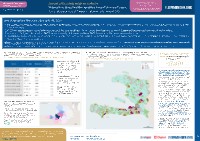
Impact de la crise haïtienne sur la mobilité: Relocalisations de la Zone Métropolitaine de Port-au-Prince
Resume — Analyse des mouvements de population dans et hors de la zone métropolitaine de Port-au-Prince de 2020-2024, montrant un exode important dû aux conditions de crise. La population est tombée sous les 3 millions en avril 2024, plus bas que pendant les restrictions COVID-19.
Constats Cles
- La population de la ZMPP est tombée sous les 3 millions en avril 2024 pour la première fois, plus bas que pendant les restrictions COVID-19.
- Exode net de 17,370 personnes de la ZMPP entre février-avril 2024, principalement vers le département de l'Ouest, Les Cayes, Jacmel et Cap Haitien.
- Depuis 2021, la ZMPP a perdu environ 72,000 personnes à cause de la mobilité interne (déclin annuel de 0.59%).
- Les plus grandes diminutions de population dans la ZMPP ont eu lieu dans les sections Turgeau, Thor, et Bellevue.
- Les modèles de mouvement montrent des flux cycliques d'aller-retour influencés par les restrictions COVID-19 et les épisodes de violence des gangs.
Description Complete
Ce rapport analyse les modèles de mobilité de la population dans la Zone Métropolitaine de Port-au-Prince (ZMPP) d'Haïti de janvier 2020 à avril 2024, utilisant des données anonymes de téléphones mobiles. L'étude révèle des changements démographiques significatifs causés par les conditions de crise persistantes incluant la violence des gangs et l'instabilité.
L'analyse montre qu'entre février et avril 2024, il y a eu un exode net de 17,370 personnes de la ZMPP, avec comme principales destinations d'autres parties du département de l'Ouest (Kenscoff, Gressier, Léogâne), Les Cayes, Jacmel, et Cap Haitien. À l'intérieur de la ZMPP, les plus grandes diminutions de population ont eu lieu dans les sections de Turgeau, Thor, et Bellevue, tandis que des augmentations ont été observées dans les sections St Martin et Morne l'Hôpital.
Le rapport documente que pour la première fois, la population de la ZMPP est tombée sous les 3 millions en avril 2024, atteignant 2,998,020 personnes - plus bas que pendant les restrictions COVID-19 de 2020 quand environ 50,000 personnes avaient quitté pour les zones rurales. Depuis 2021, la ZMPP a perdu environ 72,000 personnes à cause de la mobilité interne, représentant un déclin annuel de 0.59%.
L'étude révèle des modèles cycliques de mouvement avec des périodes alternées d'afflux et d'exode nets depuis 2020, influencées par les restrictions COVID-19, les épisodes de violence des gangs, et les blocages routiers. Les données indiquent que les flux de relocalisation sont probablement sous-estimés, suggérant que le déplacement réel de population pourrait être significativement plus élevé que les chiffres rapportés.
Texte Integral du Document
Texte extrait du document original pour l'indexation.
Protracted Crisis report Active Crisis report Long term monitoring Impact of the Haiti crisis on mobility Relocations from the Metropolitan Area of Port-au-Prince. Protracted crisis report Study period: 01 January 2020 - 30 April 2024 Published: 03 May 2024 Part 1 | Focus on the last 3 months: February 2024 to April 2024 Key observations (February 2024 to April 2024) ¶w The population of the Metropolitan Area of Port au Prince (ZMPP) dropped to under 3 million in April 2024. This is lower than during the 2020 COVID-19 restrictions, when about 50,000 people had left the ZMPP for more rural areas £w 17,370 more people moved out of the ZMPP than into from February to April 2024. Main destinations: West department (Kenscoff, Gressier and Léogâne), Les Cayes, Jacmel and Cap Haitienw ´w Since January 2024, relocations out of the ZMPP have been increasing while relocations into the ZMPP from the rest of the country have been decreasing w Decreases in population within the ZMPP are in 1re Section Turgeau (Port au Prince), 10e Section Thor (Carrefour) and 3e Section Bellevue (Tabarre), but we observe increases in 1re Section St Martin (Delmas) and 2e Section Morne l'Hôpital (Port au Prince). Data used: monthly estimates of population per communal section (admin3) and estimates of population relocating between communal sections each month (change in dominant monthly location) - derived from anonymous mobile phone data, weighted using survey data and based on baseline population estimates in Haiti (methods: see ‘about the data’ on https://haiti.mobility-dashboard.org ). Disclaimer: The magnitude of most relocation flows we report are likely underestimates (and e.g. the population of the ZMPP may have decreased by more than 17,370 people since February), we will revise them by September 2024 but relative trends over time will remain unchanged. The 10 largest net outflows from the Metropolitan Area of Port-au-Prince (ZMPP) from February to April 2024 were to these communal sections Net outflows from ZMPP = outflows from ZMPP - inflows to ZMPP (for each communal section) From February to April 2024, more people left the ZMPP to move into these communal sections than left these sections to move into the ZMPP. More people moved out of the ZMPP than into, from February to April 2024. The main destinations (net relocation outflows) are West department (Kenscoff, Gressier and Léogâne), Les Cayes, Jacmel and Cap Haitien. Net relocation outflows from the ZMPP = outflows from ZMPP minus inflows to ZMPP Change in the number of ZMPP residents from February to April 2024 (low estimate) -17,370 The map shows that, between February and April 2024, more people moved out of the ZMPP than into. This resulted in a decrease of 17,370 people These relocation flows have in the estimated population of the ZMPP (the map increased the population of these sections and decreased that of the ZMPP. Overall, from February to April 2024, more people (17,370) moved out of the ZMPP than moved in. shows net outflows (negative net flows) from the ZMPP to each communal section). Our data show that for each communal section, more people arrived from the ZMPP than moved there (there were no net inflows to the ZMPP from any communal section for this time period). For most communal sections, the number of people moving in from the ZMPP, and moving out of those sections to the ZMPP, is similar (the numbers of inflows and outflows to/from the ZMPP are similar), so the netflows from these communal sections to the ZMPP are close to 0 (light blue on the map). Change in the number of residents in the However, we note that for 100+ communal ZMPP, per communal section, from January to April 2024. sections, more people moved into these sections from the ZMPP, than moved to the ZMPP from these sections (there are net outflows from the The change in residents stem from relocation flows in and out of the ZMPP as well as relocation flows within the ZMPP. ZMPP to the sections displayed in green, brown and purple on the map). The main destinations are to other parts of West (Kenscoff, Léogâne, and Largest decreases: 1re Section Turgeau ( people), 10e Section Thor ( ) -18,510 -5,050 and 3e Section Bellevue ( ). -4,130 Largest increases: 1re Section St Martin Gressier), and to the Greater South (Les Cayes and Jacmel (see purple areas). There are other notable net outflows (displayed in Cap Haitien green, brown and purple) to and other ( ) and 2e Section Morne l'Hôpital towns ( Gonaives, St Marc, Jérémie, Hinche, +4,500 ( ) +3,080 These mobility estimates come from anonymous mobile phone data. These are not key informant estimates or field observations. If you are unfamiliar with this data source, please read our documentation which can be found at www.flowgeek.org info@flowminder.org @Flowminder Mirebalais border points ) and also to the (Ouanaminthe and Belladere; Anse à Pitres to a lesser extent, but not to the Jimani border point). 1 | 3 www.flowminder.org haiti.mobility dashboard.org Protracted Crisis report Long term monitoring Impact of the Haiti crisis on mobility Relocations from the Metropolitan Area of Port-au-Prince. Part 2 | Overview of the last 4 years: Population changes and mobility since 2020 Published: 03 May 2024 Reporting period: 01 January 2020 - 30 April 2024 4+ years trend in urban population due to internal mobility. The ZMPP population has, for the first time, dropped to under 3 million in April 2024 (even lower than during the 2020 COVID 19 restrictions). Population in Les Cayes has increased, and is stable in Cap Haitien. *Estimates of monthly residents are based on the change in dominant location where subscribers are present for each calendar month to the next (monthly relocations). Number of subscribers relocating are weighted to obtain a number of people, but natural growth and international migrations are not taken into account. Our estimates relocations are currently underestimates, and the ZMPP has likely lost more people since 2020 than indicated here. Since 2021, the ZMPP population has decreased by around 72,000 people due to internal mobility (this is likely an underestimate), in contrast, the population of Les Cayes has increased by nearly 2% a year since 2021, partly due to people moving in from the ZMPP. Key observations (2020 to 2024) ¸É The population of the Metropolitan Area of Port-au-Prince (ZMPP) has generally declined since January 2021 (by 71,970 people; 0.59% a year) due to internal mobility. À É However, we ve observed frequent back and forth movements between the ZMPP and the rest of the country since 2020 (+/- 1% of population), due to COVID-19 restrictions and then episodes of gang violenceÉ É For the first time, in April 2024, the ZMPP population has dropped to under 3 million (2,998,020 people) - this is fewer people than during the 2020 COVID-19 restrictions. Disclaimer: Please see first page: the magnitude of most relocation flows we report here are underestimates (e.g. more than 71,970 people have likely left the ZMPP for other regions within Haiti since 2021). We will revise our estimates, but this will not affect the observation that the ZMPP population is lower in April 2024 than in April 2020 at the time of COVID-19 restrictions, which can serve as a comparison point. 4+ years trend in relocations in and out of the ZMPP Back and forth movements between the ZMPP and the rest of the country since February 2020. Recently (January - April 2024), more people are leaving than arriving There has been an alternation of net outflows and net inflows in the past 4+ years from/to the ZMPP (net flow alternatively positive then negative), meaning that on some occasions more people left than moved in (e.g. during the COVID-19 restrictions we observe a peak of outflows from the ZMP), and vice versa (e.g. immediately after the lift of COVID-19 restrictions people came back (peak of inflows). When the netflow to the ZMPP is negative, the population of the ZMPP decreases. In July-September 2023, more people left the ZMPP than arrived ( , including -9,980 in September alone). Then, in -16,280 October-November 2023, more people ( ) moved into the ZMPP (perhaps coming back), while both the number of +2,470 people moving out and the number of people moving in decreased (perhaps a consequence of road blockades). However, similar decreases in mobility has been observed previously (e.g. April - June 2023)). More recently, between February and April 2024, we observe again more people leaving than moving into the ZMPP ( ) - this is because the number of people leaving the ZMPP is increasing again, while the number of people moving -17,370 in (or coming back) hasn't stopped decreasing since September 2023. Protracted Crisis report Long term monitoring Published: 03 May 2024 Reporting period: 01 January 2020 - 30 April 2024 About this work Impact of the Haiti crisis on mobility Relocations from the Metropolitan Area of Port-au-Prince. Part 3 | About this work: Background & considerations Data privacy & governance Flowminder s Population Mobility Data for Disaster Management project aims to improve the availability and use of mobile operator data (Call Detail Records, CDR data)-derived population-scaled estimates on population mobility, density and/or displacement data among humanitarian actors, with a particular focus on Haiti. Through this project, Flowminder will enable access to, and use of reliable and user-friendly information by humanitarian organisations for disaster preparedness and response, while strengthening its CDR processing and analysis software, FlowKit, to better support humanitarian sector data needs. Authors & funders This report was authored by the Flowminder Foundation. This work is made possible by the generous support of the American People through the United States Agency for International Development (USAID). The contents are the responsibility of the Flowminder Foundation and do not necessarily reflect the views of USAID or the United States Government. This project is led by the Flowminder Foundation. Acknowledgements This study was made possible thanks to the anonymised (aggregated) mobile phone usage data provided by Digicel Haiti. We welcome feedback to help us improve future reports and requests for specific types of analysis. Please email info@flowminder.org with any feedback and suggestions, or if you have any specific analytical requirements we can support This report and its contents may only be shared with attribution to the Flowminder Foundation. Adaptation is permitted as long as the changes are indicated and the Flowminder Foundation is cited. Use of the report and its contents is limited to humanitarian and development purposes. No personal data, such as an individual s identity, demographics, location, contacts or movements, is made available to the government or any other third party at any time. All results produced by Flowminder are aggregated results (for example, subscriber density in a given municipality), which means that they do not contain any information about individual subscribers. This data is fully anonymised. This approach complies with the European Unions General Data Protection Regulation (EU GDPR2016/679). Data is processed on a server installed behind the mobile network operator s firewall in Haiti, and no personal data leaves the operator s premises. Data considerations The estimates shown are our best current assessment of movements. However, there are a number of uncertainties. The information should be interpreted together with other available evidence. For more information about our methods, please read our Haiti Mobility Data Indicators documentation on residents and relocation . here Data sources Pseudonymised mobile phone usage data from Digicel Haiti Data products: Flowminder Previous report(s) Our most recent previous report on displacements in Haiti was published on 14 March 2024: Gang violence in downtown Port-au-Prince | Mobility situation report: Haiti (29 February - 12 March 2024) https://www.flowminder.org/resources/publications-reports/haiti-gang-violence-in-downtown-port-au-prince Disclaimer of Warranties and Limitation of Liability: To the extent possible, Flowminder offers this report and its contents as-is and mobility-situation-report-29-february-12-march-2024 as-available, and make no representations or warranties of any kind concerning this report and its contents, whether express, implied, statutory, or other. This includes, without limitation, warranties of title, merchantability, fitness for a particular purpose, non-infringement, absence of latent or other defects, accuracy, or the presence or absence of errors, whether or not known or discoverable. To the extent possible, in no event will Flowminder be liable on any legal theory (including, without limitation, negligence) or otherwise for any direct, special, indirect, incidental, consequential, punitive, exemplary, or other losses, costs, expenses, or damages arising out of the use of the report or its contents, even if Flowminder has been advised of the possibility of such losses, costs, expenses, or damages. The disclaimer of warranties and limitation of liability provided above shall be interpreted in a manner that, to the extent possible, most closely approximates an absolute disclaimer and waiver of all liability. The following citation is required when using the data and information included in this report: Flowminder Foundation, May 2024. Impact of the Haiti crisis on mobility: Relocations from the Metropolitan Area of Port-au-Prince (01 January 2020 - 30 April 2024) info@flowminder.org @Flowminder www.flowminder.org www.haiti.mobility-dashboard.org www.flowgeek.org 3 | 3