

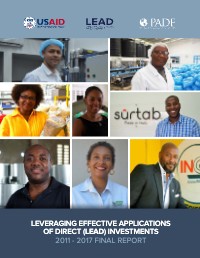
Rapò final pwojè Leveraging Effective Applications of Direct (LEAD) Investments 2011-2017
Rezime — Pwojè LEAD la te sipòte PME ayisyen yo ak kapital ak asistans teknik pandan y ap angaje dyaspora a pou ankouraje devlopman ekonomik nan depi 2011 rive 2017. Pwojè a te kreye plis pase 18,000 travay ak li te jenere $33 milyon nan lavant nan twa korido jewografik yo.
Dekouve Enpotan
- Te kreye plis pase 18,000 travay ak li te jenere plis pase $33 milyon nan lavant nan 45 antrepriz yo te sipòte.
- Te mobilize plis pase $10 milyon nan fon pwòp prive yo, byen biznis yo ak fon dèt nan mwayen modèl subvansyon kontrèpati a.
- Te reyisi ak modèl Konkou Plan Biznis la nan twa korido jewografik yo (Pòtoprens, Sen Mak, Okap).
- Te demontre ke PME yo ak kapital ak asistans teknik ki apropye yo ka kreye efe ki ka transfòme ekonomi Ayiti a.
- Te angaje gwoup dyaspora ayisyen yo ak siksè pou ogmante enpak devlopman transfert lajan yo ak patisipasyon ekonomik.
Deskripsyon Konple
Pwojè Leveraging Effective Applications of Direct (LEAD) Investments te yon pwogram sis ane USAID te finanse (2011-2017) Pan American Development Foundation (PADF) te realze pou sipòte repriz ekonomik Ayiti apre tranbleman de tè a. Pwojè a te konsantre sou de eleman prensipal yo: sipòte ti ak mwayen antrepriz yo (PME) ak kapital ak asistans teknik, ak angaje dyaspora ayisyen an pou ogmante enpak devlopman transfert lajan yo.
Pwojè a te fonksyone nan twa korido jewografik - Pòtoprens, Sen Mak ak Okap - lè l sèvi ak yon modèl Konkou Plan Biznis pou idantifye PME ki gen bon potansyèl. Nan mwayen subvansyon kontrèpati yo ki te konbine ak asistans teknik, LEAD te sipòte 45 antrepriz nan divès sektè yo. Apwòch pwojè a te vize debloke kapital envestisman prive ak ankouraje patisipasyon enstitisyon finansye yo nan aktivite kwasans ekonomik yo.
LEAD te reyalize rezilta enpòtan yo, li te kreye plis pase 18,000 travay ak li te jenere plis pase $33 milyon nan lavant pandan y ap mobilize plis pase $10 milyon nan fon pwòp prive yo, byen biznis yo ak fon dèt yo. Pwojè a te travay anpil tou ak gwoup dyaspora yo pou ankouraje patisipasyon nan ekonomi Ayiti a nan divès inisyativ tankou roadshow yo, fon devlopman sosyal yo ak pwogram amelyorasyon transfert lajan yo.
Sik LEAD la te demontre ke sipòte PME yo ak bon konbinezon kapital ak asistans teknik la ka kreye efe ki ka transfòme ekonomi ayisyen an, li etabli gwoup antrepriz prive yo nan chèn valè kle yo ak sant endistriyèl yo ki ankouraje pwoduksyon domestik ak amelyore konpetitivite a.
Teks Konple Dokiman an
Teks ki soti nan dokiman orijinal la pou endeksasyon.
LEVERAGING EFFECTIVE APPLICATIONS OF DIRECT (LEAD) INVESTMENTS 2011 - 2017 FINAL REPORT LEVERAGING EFFECTIVE APPLICATIONS OF DIRECT (LEAD) INVESTMENTS FINAL REPORT JULY 25, 2011 – DECEMBER 30, 2017 COOPERATIVE AGREEMENT NO. 521-A-00-11-000010-00 Prepared by Pan American Development Foundation (PADF) Submitted: APRIL 15, 2018 THIS PUBLICATION WAS PRODUCED BY THE PAN AMERICAN DEVELOPMENT FOUNDATION (PADF) FOR REVIEW BY THE UNITED STATES AGENCY FOR INTERNATIONAL DEVELOPMENT (USAID) DISCLAIMER The contents of this report are the sole responsibility of the Pan American Development Foundation and do not necessarily reflect the views of the United States Agency for International Development or the United States Government. Dear Friends, The Leveraging Effective Application of Direct Investments (LEAD) project was conceived at a critical juncture in Haiti’s development. The premise was that supporting promising small- and medium-sized enterprises (SMEs) with capital and technical assistance, and tapping into critical diaspora resources would create jobs, stimulate economic growth, unlock private capital and send a strong signal to key actors that Haitian businesses could play a vital role in the country’s recovery after the devastating earthquake of 2010. Beginning in 2011 and running through 2017, the LEAD project ran several iterations of its renowned Business Plan Competition to identify and support those SMEs which showed the most promise to create jobs, increase domestic production, and would continue to grow in years to come. To encourage decentralization of the economy, the project focused on the Saint Marc and Cap Haitian corridors alongside Port-au-Prince. The project also worked with various diaspora groups to promote diaspora engagement, in the Haitian economy. Today, we are proud to shine the spotlight on our enterprises, social development fund projects, and partnerships with diaspora groups. These successful entrepreneurs have created over 18,000 jobs and generated more than $33 million in sales while leveraging the project’s capital contributions with private equity, business assets, and debt funds of over $10million. By supporting SMEs and promoting impactful diaspora engagement the project has meaningfully contributed to Haiti’s recovery and economic growth. The 45 businesses represent a breadth of sectors and geographic regions, which is a testament to the fact that the future of Haiti’s growth rests on a strong and diverse base of SMEs. The LEAD model, which provides the right combination of capital and technical assistance, can spur the creation of entire clusters of private enterprise in key value-chains and industrial hubs. This in turn will create more jobs, boost domestic production, enhance Haiti’s competitiveness in the global economy, and generate exports. In short, if more enterprises can be supported using the LEAD model then there will be a transformative effect on the Haitian economy. Much of LEAD's success has been due to the tireless efforts of partner organizations and key stakeholders. I would like to thank the Government of Haiti, particularly the Ministries of Finance, Commerce & Industry, and Haitians Living Abroad and the Center for Facilitation of Investments for their support and collaboration and the belief in the project, and its entrepreneurs. Our many private sector partners including AMCHAM-Haiti, and the Chambers of Commerce of the North and North East have my gratitude for their support. My sincere thanks also go to organizations such as FAVACA, CSL, Zafen, Yunus Social Business, EGI and SOFIHDES for helping us deliver timely and exceptional technical assistance to our entrepreneurs. Our enterprises also benefited greatly from the network of exceptional Business Development Service providers throughout Haiti, who worked tirelessly to help address business challenges. I remain confident that the strengthened SME ecosystem will nurture future enterprises for many years to come. The Haitian Diaspora’s commitment to Haiti is unwavering. Their deep love for Haiti and their passion for its development was evident across the multiple activities we engaged in together during the course of LEAD. I would like to thank in particular the teams at GRAHN-USA, HHTARG, HRA, NAAHP, EDEM Foundation, and the Society for Haitian Research Inc. for their commitment to LEAD. Diaspora capital, know-how and passion remains a powerful force in support of the economic and social development of Haiti. I would also like to extend my deepest gratitude to the many volunteers drawn from the echelons of the business and public sectors in Haiti, who believed in the project from its conception and generously provided their time by reviewing business plans, sharing their sector expertise, serving on jury panels, mentoring entrepreneurs, and participating in our events. Members of the Board of Directors of PADF from Haiti provided advice on successfully engaging the Haitian private sector. Your pro-bono support was invaluable and I cannot thank you enough for your contribution to the project. LEAD received exceptional support from the USAID Haiti mission. I would like to thank the LEAD AOR Mr. Isaac Michel and the team within the Economic Growth office in particular for their guidance, knowledge of the economy and marketplace, and their continued support. I would like to extend my deepest gratitude to the LEAD team; your dedication, professionalism, passion, enthusiasm and ethics were remarkable and I am proud of everything we’ve accomplished together. My thanks also go to the PADF staff in both Haiti and Washington D.C. for their unwavering support. Finally, I want to bring the attention back to the LEAD project participants – entrepreneurs, private sector stakeholders, and diaspora members. What they all share in common is the ability to see opportunity amidst challenge, and a can-do spirit that turns dreams into reality. I am proud to know them and I invite you to join us as we celebrate their success and imagine a bright future for this beautiful country and its amazing people. Sincerely, Nadia Cherrouk Chief of Party, LEAD & Country Director, PADF-Haiti Acronyms ADIH AMCHAM ASFAPPR BDS BPC CAP CCIH CCIPN CCIPNE CECI CFI CSL CSR DCF DCI EDEM EGI EMPR ERRM EXCITE FAVACA FDI FTE GOH GRAHN GWU HABNET HACCP HELP HHTARG HERO HIN HOPE HRA HTA Association des Industries d’Haïti American Chamber of Commerce Association Fanm Plantez Préval Renal Business Development Services Business Plan Competition Cap-Haitian Chambre de Commerce d’Industrie Haïti Chambre de Commerce d‘Industrie et des Profes sions du Nord Chambre de Commerce d‘Industrie et des Profes sions du Nord Est Centre d’Etude et de Coopération International Centre de Facilitation des Investissements Centre Spécialisé de Leadership Corporate Social Responsibility Diaspora Challenge Fund Diaspora Challenge Initiative Space for the Development and Emancipation of the Masses / Espace de Développement pour l’Emancipation des Masses Economic Growth Institute Environmental Management Performance Report Economic Recovery and Road Map, Government of Haiti Entrepreneurship, X-Factor, Credibility, Innovation, Transparency, Exit in View Florida Association for Volunteer Action in the Caribbean and the Americas, Inc. Fonds de Developpement Industriel Full-time equivalent Gouvernement of Haiti Groupe de Réflexion et d’Action pour une Haïti Nouvelle George Washington University Haitian-American Business Network Hazard Analysis and Critical Control Point Haiti Economic Lift Program Haitian Hometown Association Resource Group Haiti Economic Recovery and Opportunity Act Haiti Investment Navigator Haiti Hemispheric Opportunity through Partnership Encouragement Act Haiti Renewal Alliance Hometown Associations IDB IPTT IFC IS IT LMS LOP MCI M&E MEAL MEF MIF MHAVE NAAHP NUPAS OCAT OPIC OSHA PAP PADF PIRS PMP PPP RDI REP SDF SE SHR SM SME SOFIHDES T.A. UEMPR USAID WB YSB Inter-American Development Bank Indicator Performance Tracking Table International Finance Corporation (part of the World Bank) Informational Systems Information Technology LEAD Management System Life of Program/Project Ministry of Commerce / Ministère du Commerce Monitoring & Evaluation Monitoring Evaluation Accountability Learning Ministry of Finance / Ministères des Finances Multilateral Investment Fund Ministry of Haitians Living Abroad / Ministère des Haitians Vivant à l’Etranger National Alliance for the Advancement of Haitian Professionals Non US Organization Pre Award Survey Organizational Capacity Assessment Tool Overseas Private Investment Corporation Occupational Safety and Health Administration Port-au-Prince, Haiti Pan American Development Foundation Performance Indicator Reference Sheet Performance Measurement Plan Public-Private Partnerships Remittance Development Impact initiatives Remittance Enhancement Program Social Development Fund Social Enterprise Society for Haitian Research Saint-Marc Small and Medium Enterprises Société Financière Haïtienne de Développement S.A Technical Assistance Umbrella Environmental Management Perfor mance Report U.S. Agency for International Development World Bank Yunus Social Business, formerly Grameen Creative Lab Table of contents 1 Executive summary 7 Component 1 8 SME Ecosystem 11 Business Plan Competition 14 Lessons Learned 15 Sectors 17 Cluster Effect 18 Women & Entrepreneurship 19 Social Enterprises 19 Technical Assistance 25 Results Component 1 27 Component 2 28 Diaspora Success 29 Roadshows 31 Whitepaper 33 Social Development Fund 35 Diaspora Challenge Initiative 37 Remittance Paper 37 Portal 38 Lessons Learned 39 Cross-Cutting Activities 40 Grants Management 41 Monitoring & Evaluation 42 Environmental Management 43 Communications 45 Entrepreneurs Spotlights 47 Official Visits to Grantees 49 Major LEAD Organized Events 52 Expos and Award Ceremonies 55 LEAD Key Diaspora Events EXECUTIVE SUMMARY Over a six-year period (July 2011 to December 2017), the Leveraging Effective Application of Direct Investments (LEAD) program provided access to capital and technical assistance to Haitian small- and medium-sized enterprises, strengthened the eco-system for private sector development in Haiti, and engaged the Haitian Diaspora to increase the development impact of remittance flows. 3 geographic CORRIDORS 1 LEAD 6year PROGRAM $16.96 million FUNDING Small- and medium-sized enterprises (SMEs) play a major role in most economies, particularly in developing countries. Per data collected by the World Bank Group1, formal SMEs contribute up to 60 percent of total employment and up to 40 percent of national income (GDP) in emerging economies. These numbers are even higher when informal SMEs are included. Overall, small firms have lower productivity growth compared to large firms2 . Throughout the world, the single biggest constraint to growth for SMEs is access to finance - SMEs are less likely to be able to secure bank loans than large firms; instead, they rely on internal or “personal” funds to launch and initially run their enterprises3. Another constraint to growth for this sector is access to business development services resources that can help enterprises address important issues that limit their access to capital or ability to grow. These resources are often needed to address common SME needs such as improved financial management systems, installation of sound accounting systems, business plan drafting and revision, market and feasibility studies, and support to improve general operations. In Haiti, the impact of such global factors that limit SME growth is compounded by country-specific constraints. Haiti is ranked as a low-income country with a population of 10.8 million and a GNI per capita of US$ 780. Haiti ranks 181 out of a possible 190 on the Global Doing Business Index (DB) published by the World Bank. Haiti also has a Distance to Frontier (DTF) measure of 38.24. An economy’s DTF is reflected on a scale from 0 to 100, where 0 represents the lowest performance and 100 represents the frontier. Haiti’s DTF compares unfavorably with the regional average for Latin America & the Caribbean of 58.66 and is considerably less than that of geographical neighbor Dominican Republic’s DTF of 60.93.4 Haiti’s poor ranking is a direct reflection of the extraordinary challenges faced by SMEs in the country including significant challenges in starting a business (DB rank of 189 out of 190), unreliable access to power (DB rank of 138 out of 190), difficulties in registering property (DB rank of 180 out of 190), getting access to credit (DB rank of 177 out of 190) and protecting minority investors (DB rank of 188 out of 190). These policy, infrastructure, legal and capital constraints are compounded by the fact that Haiti remains highly prone to natural disasters due to its geographical position that is subject to catastrophic hurricanes and earthquakes. Haiti ranked #15 in the world on the Global Climate Risk Index, reflective of the devastating impacts of the earthquake of 2010 and Hurricane Matthew in 2016. The LEAD project, conceived as part of the post-earthquake U.S. Government’s Haiti strategy, focused on supporting economic growth in the three development corridors of Port-au-Prince, Saint Marc and Cap Haitian with a two-pronged approach: 1) create jobs and increase sales through sustainable business and social enterprise development, and 2) utilize innovative mechanisms to engage the Haitian Diaspora and increase the development impact of remittances. LEAD utilized a Business Plan Competition (BPC) to identify promising Haitian SMEs and social enterprises in the three corridors. The project’s “matching grant” model of investment unlocked private investment capital and encouraged the active participation of key financial institutions in economic growth activity. Grant capital was complemented by technical assistance to support and strengthen the SMEs. Finally, recognizing that remittances would play a key role in supporting the Haitian economy, the project actively engaged the Haitian Diaspora to increase the development impact of diaspora activities and capital. 1 World Bank Group, SME Finance: Improving SMEs’ access to finance and finding innovative solutions to unlock sources of capital. 2 Ayyagari, Demirgüç-Kunt and Maksimovic (2014) 3 World Bank Group, http://www.doingbusiness.org/data/exploreeconomies/haiti 4 Insert reference to World Bank Doing Business Index, Distance to Frontier 5 David Eckstein, Vera Künzel and Laura Schäfer, 2018, GLOBAL CLIMATE RISK INDEX 2018 Who Suffers Most From Extreme Weather Events? Weather related Loss Events in 2016 and 1997 to 2016. PADF 2 Business Plan Competition: LEAD completed four editions of its renowned BPC that attracted nearly 500 applicants from the three corridors. Each edition of the BPC involved multiple stages, including review by sector experts, due diligence visits by financial representatives, and presentations to an independent jury. 45 winning entrepreneurs were selected across all four editions. A total of $6.7 million in LEAD grant capital leveraged over $10 million in private matching funds/investments. These 45 enterprises have collectively created 18,123 jobs, generated $33 million in sales, and represent various productive sectors such as agribusiness, manufacturing, water and sanitation, food services, technology, textiles, tourism and hospitality, and recycling. Promoting Decentralization: LEAD promoted decentralization of the Haitian economy by promoting the BPC heavily in Saint Marc and Cap Haitian, organizing special technical assistance activities for enterprises in those corridors, and supporting the development of the relatively underdeveloped SME ecosystem in these areas. The emphasis on these corridors resulted in a geographic diversity in LEAD’s portfolio with six enterprises from Saint-Marc, and 12 enterprises from Cap-Haitian receiving support. 4% Grants by corridor 58% 682 38% 10,570 6,871 11% Port-au-Prince Corridor Saint-Marc Corridor Cap-Haitian Corridor 18,123 jobs 62% $ 2,988,801 9% $ 33 million in sales 82% $ 27,143,394 27% $ 2,954,367 9% Women and Entrepreneurship: LEAD worked to address the specific economic constraints faced by women entrepreneurs by tailoring its outreach activities and technical assistance to their articulated needs. As a result, women entrepreneurs make up 45 % of the total portfolio and received grant capital of $3 million which unlocked private investment capital of $5.3 million. Of the 18,123 jobs created, 8,190 jobs are held by women. LEAD delivered a total of 3,541 hours of training or technical assistance to women. Social Enterprises: LEAD partnered with key local institutions such as Yunus Social Business Haiti, Zafen and Economic Growth Initiative, to address social enterprises which would provide both an economic and social benefit to the Haitian economy. These partner institutions have supported a total of 7 social enterprises. 3 LEAD Technical Assistance: LEAD had an integrated approach to delivering technical assistance, providing support to the entire SME ecosystem as well as targeted, firm-level assistance. Throughout the BPC, LEAD offered support to entrepreneurs to develop their business plans and improve their presentation skills. LEAD also organized roundtables with local Business Development Service (BDS) providers to improve their capacity to meet the business needs of Haitian SMEs. To strengthen the SME ecosystem, LEAD partnered with financial institutions to create linkages between the financial sectors and entrepreneurs, and increase knowledge of available credit and equity sources of capital. LEAD also organized sector-wide training sessions that addressed common needs of multiple enterprises on key topics such as manufacturing standards, health and safety, financial management etc. Finally, LEAD completed an in-depth assessment of each of the 45 enterprises in its portfolio and provided access to consultants to address critical business needs of each firm. Overall, LEAD delivered a total of 10,775 of hours of targeted and sector-wide technical assistance. Diaspora Engagement: The Haitian Diaspora supports the country’s economy through remittances, philanthropic initiatives and investments. Remittances from the diaspora have been rising steadily for 20 years, with data from 2016 showing Haiti received US$ 2.36 billion or over 20% of its GDP from remittances. In April 2017, the Central Bank of Haiti suggested that by 2020 remittances could rise to US$ 2.7 billion or 29% of GDP6. Looking to harness the impact of diaspora activities on the Haitian economy, LEAD engaged the Haitian Diaspora via multiple activities. First, diaspora entrepreneurs looking to establish or grow businesses in Haiti were encouraged to participate in the BPC. As a result 12 of the 45 winners of the BPC are from the diaspora. Secondly, LEAD organized multiple outreach activities with diaspora groups to promote the success of diaspora entrepreneurs. LEAD partnered with the Haitian Hometown Association Resource Group (HHTARG) to support the development of a whitepaper titled “Haitian Diaspora Engagement & Investment in Haiti: New Findings and Recommendations.” LEAD also launched the Social Development Fund, an innovative mechanism that adapted the BPC to fund seven community-based projects (out of 207 applications) that could sustainably generate revenue and meet social needs with the support of diaspora capital. Finally, LEAD also partnered with the National Association for the Advancement of Haitian Professionals (NAAHP) and its partners to launch the Diaspora Challenge Initiative. This competitive exercise canvassed the Haitian Diaspora to identify their best ideas and projects to promote economic and social development in Haiti. Via its various activities, LEAD supported 13 outreach activities and informed 133,663 diaspora members of economic development opportunities in Haiti. 2012-2013YEAR 2 2013-2014YEAR 3 2014-2015YEAR 4 2015-2016YEAR 5 2016-2017YEAR 6 OCT-DEC 2017 # GRANTS YEAR 1 AWARDED 4 9 20 14 0 0 GRANT AWARDED IN USD $757,763 $1,488.006 $2,807,83 $1,742,46 SALES GENERATED $2,206,898 $5,079,656 $6,172,495 $6,374,891 $12,342,924 $909,697 JOBS CREATED 5,831 1,262 2,448 2,837 1,810 3,935 Haiti’s private sector consists mainly of small enterprises. There are around 900,000 micro-, small- and medium-sized enterprises, 60,000 of which are small and medium-sized enterprises—small firms (with between 10 and 49 employees), and mid-size companies (with 50-250 staff).7 6 Data released by BRH at the “Haiti - remittances, impacts on the national economy” conference organized in Port-au-Prince by the Economic & Social Development Council (CDES) http://www.haitilibre.com/en/news-20563-haiti-economy-impacts-of-remittances-from-diaspora-on-the-national economy.html 7 IFC Enterprise Finance Gap Database - Raw Data, 2010-2011. https://finances.worldbank.org/Other/IFC-Enterprise-Finance-Gap-Database-Raw-Data/2ppx-k958 COMPONENT 1 LEAD completed four editions of its Business Plan Competition (BPC) to identify the most promising, investment-worthy enterprises across key productive sectors within the three growth corridors of Port-au Prince, Saint Marc and Cap Haitian. As the SME eco-system in Haiti had been nascent before the earthquake, and particularly fragile post quake, LEAD organized its activities to strengthen the eco-system around SMEs so that those enterprises that won the BPC would have access to the resources needed to sustain growth after the project was completed. LEAD also delivered technical assistance at both the firm level, and across sector needs, to help the SMEs in its portfolio meet their business objectives. 7 LEAD SME Ecosystem Haiti’s economy is primarily informal.8 The fact that most of the firms operate at informal levels limits the accessibility to business support services, financial services, and seed capital. It was estimated that 82% of all enterprises are engaged in basic commercial activities, buying and selling products with very limited added value due to the low levels of industry and product transformation that takes place in Haiti.9 Guided in part by the Haiti Economic Recovery & Roadmap (ERRM) published in 2010, PADF studied the chart noted below that lays out the “Survival Cycle” illustrated in the middle of the figure, which affects economic growth in Haiti. Breaking the Survival Cycle, Fostering a Culture of Entrepreneurship10 Survival Cycle Recognizing that LEAD had the potential to play a pivotal role in breaking this cycle through its private sector investment strategy that simultaneous investment in human and social capital is also required if business investment is to be successful. The PADF team designed a technical approach grounded around this theory and enshrined in the acronym EXCITE which when expanded provides the founding principles of LEAD: 8 Entrepreneurship, Development and Economic Policy in Haiti. Marroquin, 2015. 9 Private Sector Assessment Report, 2014, Inter-American Development Bank 10 Haiti Economic Recovery & Roadmap (ERRM), Presidential Commission on Competitiveness Groupe de Travail sur la Compétitivité (GC), 2010. PADF 8 E ENTREPRENEURSHIP: LEAD oriented all its activities to support entrepreneurship and enterprises in Haiti. X X-FACTOR: LEAD recognized that success in entrepreneurship would require the X-factor, an entrepreneur’s desire to succeed against all obstacles that we could nurture and support. C CREDIBILITY: LEAD benefited from PADF’s sterling reputation, and its activities were managed to build trust and demonstrate results to all stakeholders. I INCLUSIVENESS: LEAD made special efforts to include all segments of Haitian and diaspora society in its activities. T TRANSPARENCY: LEAD activities were managed competitively, providing accounting and transparency to all stakeholders. E EXIT IN VIEW: LEAD activities were designed to promote sustainability, leaving behind a strong cadre of entrepreneurs, an engaged diaspora, and a strengthened SME ecosystem in Haiti. To support sustainable growth for Haitian SMEs, LEAD determined that funding for entrepreneurs (particularly in priority growth areas such as productive sectors) would be accompanied by: 1. A training and support program (capacity-building, mentoring) to build human capital; 2. Connections to key actors in the ecosystem including business development service providers and chambers of commerce; and 3. Access to capital via financial institutions for long-term support. Recognizing that in a post-quake context, many Haitian SMEs had been decapitalized and that service providers were often sole proprietorships who had been similarly affected, LEAD considered it important that strengthening the entire ecosystem was an integral part of providing financial and technical support to SMEs. LEAD thus adopted an integrated approach by focusing on developing linkages and supporting the SME ecosystem, concurrent with multiple editions of its BPC. The cost of credit in Haiti is very high, especially in the microfinance sector. Commercial banks typically charge annual interest rates of 8 - 15%, while micro-finance institutions (MFIs) charge 2-4% per month (24-48% per year) and pawnbrokers and moneylenders charge up to 20% per month (240% per year).11 The lack of a credit bureau makes it difficult for financial institutions to assess risk and monitor over indebtedness. Due in part to the general economic environment, financial institutions are unwilling to make uncalculated risks and thus act conservatively when granting credit. Therefore, only a small proportion of liquid assets are loaned. LEAD specifically developed relationships with financial institutions so as to help SMEs improve their financial management services, strengthen their business plans, and be able to access long-term credit from commercial banks. Integrating representatives of financial institutions into LEAD activities helped create awareness of SME achievements. LEAD established linkages with major chambers of commerce, key business development service providers in the three corridors, Government of Haiti actors (Ministry of Finance, Ministry of Commerce & Industry, Ministry of Haitians Living Abroad, and Center for the Facilitation of Investments) and major financial institutions such as SOFIHDES, SOGEBANK, UNIBANK. These linkages also extended to support social enterprise (SEs) via partnerships with organizations focused on strengthening SEs such as Yunus Social Business (YSB Haiti), Economic Growth Initiative (EGI) and ZAFEN. 11 2010 Annual report, Banque de la République d’Haïti, Microfinance industry census in Haiti 2010-2011, SMG for USAID/HIFIVE, September 2012 and Statistical annex of the 2012 annual report of the Banque de la République d’Haïti 9 LEAD The linkages with the SME & SE ecosystem promoted consistent and formal dialogue between entrepreneurs and other stakeholders. For instance, LEAD embedded representatives from the ecosystem within the BPC to serve as members of the jury, selection committee members, and for due diligence exercises. This infused local sector expertise into the selection process while building general awareness of the potential of LEAD SMEs to innovate and generate growth. LEAD also organized multiple roundtable sessions with Business Development Service (BDS) providers in the corridors, both to build their own capacity to service the needs of SMEs as well as raise awareness of the needs being expressed by LEAD SMEs. LEAD’s technical assistance model made it a priority to meet SME BDS needs from local providers wherever possible. LEAD events, including two editions of its business expo (including B2B matchmaking sessions), “power breakfast” networking events, trainings, and general info sessions, were inclusive of all relevant stakeholders in the ecosystem. These events created multiple opportunities for peer-to-peer networking and generated linkages both within the LEAD portfolio and with external actors. Examples of such linkages include supply chain partnerships between enterprise in the agribusiness sector of LEAD portfolio, as well as cross-sector distribution partnerships amongst LEAD enterprises. Similarly, enterprises within sectors such as recycling, tourism and hospitality often accessed similar services from BDS providers, and direct referrals from LEAD enterprises helped build new clients for these providers. LEAD also worked with Chambers of Commerce in all its corridors, as these are natural entry points for local SMEs to access ecosystem stakeholders. LEAD encouraged and supported specific chambers in strengthening their own business operations, organizing events, and hosting info sessions from local financial institutions on credit & banking products relevant to SME needs. LEAD also partnered with the Government of Haiti (GoH) ministries that provide support to SMEs including the Ministry of Finance, Ministry of Commerce & Industry, Ministry for Haitians Living Abroad for diaspora engagement, and Center for Facilitation of Investments (CFI). These partnerships resulted in 5 LEAD enterprises receiving access to government programs (funded by the Inter-American Development Bank) designed to provide financing to Haitian SMEs. LEAD also coordinated closely with ongoing private sector development projects happening in Haiti and the region. The project staff collaborated closely with USAID-funded LEVE project, ensuring that technical assistance were made judiciously. LEAD also worked closely with Caribbean Compete, a project supported by Department for International Development (DFID) and the Inter-American Development Bank, regarding the overlap amongst SMEs supported in Haiti. Similarly, LEAD shared information about enterprises in its portfolio that were looking for expansion support with representatives of multilateral agencies such as the Multilateral Investment Fund, Inter-American Development Bank, and the World Bank. LEAD staff organized and led quarterly meetings with donors and representatives of the private sector working group post Hurricane Matthew to promote greater coordination. For SEs, LEAD supported the efforts of YSB-Haiti, EGI and ZAFEN by providing them with grant capital to develop their institutional capacity and increase the number of SEs supported by these organizations. LEAD’s efforts at strengthening the SME ecosystem will contribute greatly to the long-term sustainability of delivering support to Haitian SMEs after project closes. This is reflective of PADF’s central development philosophy for sustainability as this approach leverages available local sources and seeks their buy-in. PADF 10 Business Plan Competition LEAD’s Business Plan Competition (BPC) was the primary mechanism to identify promising, investment-worthy enterprises with the greatest potential for job creation and revenue growth. The guiding principles for the BPC were competitiveness, transparency, and accountability which in turn generated trust among the SME ecosystem that the activity produced reliable results. LEAD vigorously promoted the BPC throughout the three growth corridors and to a diaspora audience in order to attract qualified applicants. Each new edition of the BPC received more applicants than the prior editions, as the success of the project and the winning enterprises helped generate interest and trust in the process. Special efforts were made to promote the competition to women entrepreneurs to encourage their participation. LEAD sought applications from entrepreneurs (either Haitian, diaspora, or foreign) who wished to operate in the three growth corridors to: • Expand or diversify an existing business; or • Start a new business12 12 Start-ups were considered when the business acumen of the entrepreneur could be verified by past business success, as well as the quality of strategic partners to achieve results in a timely manner. 11 LEAD Each iteration of the BPC included multiple stages of review culminating in a presentation in front of a jury. Enterprises were awarded grants between $50,000 to $200,000 which they matched with private capital (either equity or debt). All enterprises in the LEAD portfolio were provided technical assistance to help them achieve their business 500 APPLICANTS SELECTION PROCESS 01 objectives. The combined infusion of capital and business expertise helped create sustainable enterprises that would support long-term economic growth in Haiti. Enterprises (both start-ups and established enterprises) submitted their business plans via an online platform designed for the project, an innovative approach to BPCs in Haiti. LEAD provided technical assistance to help SMEs prepare their business plans, undergo due diligence and financial evaluation, and finally present in front of a jury. The stages of the BPC included review committees comprised of external sector experts, banking and financial institution representatives and LEAD technical experts. Similarly, jury panels for each edition of the BPC included business leaders, representative of financial institutions, government agencies, partner institutions and other key stakeholders. This was a rigorous, competitive, and transparent process which included review committees composed of external sector experts, representatives of financial institutions, partner organizations, as well as the LEAD technical team. Through the competitive process, entrepreneurs received rigorous, detailed feedback and assistance to help them identify their capital needs, finalize their proposed business plan, include strategic partners where needed, and practice their “business pitches”. Financial due diligence exercises also helped entrepreneurs improve their financial management practices. Via the support of its partners such as SOFIHDES and CSL, LEAD provided applicants with: 1. Practical training in critical areas such as business planning, accounting, human resources, marketing, management, and other related themes. 2. Guidance in developing a bankable business plan. 3. Individual consultations with business development experts to address the specific concerns of their enterprise. 4. Networking opportunities with financial institutions CALL FOR APPLICATIONS 02 INITIAL REVIEW (CONCEPT NOTE STAGE) 03 BUSINESS PLAN SUBMISSION 04 DETAILED REVIEW (W/SECTOR EXPERTS) 05 DUE DILIGENCE & FINANCIAL REVIEW 06 TOP APPLICANTS SELECTED 07 JURY PRESENTATIONS 08 WINNERS SELECTED 09 BUSINESS PLAN COMPETITION WINNERS ANNOUNCED and other entrepreneurs. 45ENTERPRISES PADF 12 “I have been working part-time at CASTMI for several months. This job allows me to pay my school, to buy my books and clothes” — Orenord Nelson, machine operator at CASTMI water plant. “I like the work I’ve been doing for over 5 years at Ayiti Linge, it has allowed me to take care of my family" — Christelle, operator at Ayiti Linge 13 LEAD “The LEAD project has been a leader for us. We were able to finance the training for our employees which is critical for the maintenance of our equipment and to increase our commercial service. It also helped us to renew our spare parts inventory. LEAD arrived at a time when we were desperate, we were even considering closing. Although we had a good product it was unusual to the Haitian market therefore hard to sell. This accompaniment has helped put us back on track and today ALS is doing much better and has grown its clientele considerably. Bravo LEAD! You have been a real Leader" — Dominique Carvonis Ayiti Linge Services (ALS). Owner testimony Lessons Learned ⊲ The first edition of the BPC required applicants to submit paper applications/business plans. For subsequent editions, LEAD switched to an electronic platform where applicants submitted their business plans online. This was based on feedback from both applicants and selection committee members that an electronic platform would ensure more uniform submissions and ease the process. ⊲ Recognizing that many entrepreneurs requested and needed technical assistance to help complete their business plans, LEAD provided technical assistance from the very first stage of the process. ⊲ Environmental monitoring and due diligence became mandatory steps of the BPC process by the second edition. ⊲ For the fourth and most popular edition of the BPC, the program established an efficient, two-part application process: 1) submit a concept note and 2) submit the business plan application for those concept notes selected. ⊲ Scoring sheets (with weighted values) were provided to reviewers and jury members to ensure that all reviewers were uniformly considering the key objectives of the program. PADF 14 Sectors 15 LEAD FOOD INDUSTRIES Haiti is renowned for its delightful cuisine. LEAD supported 5 entrepreneurs who run diverse businesses in the food service industry including bakery, patisseries, and a fruit salad store. Developing innovative, consumer focused business operations has helped these companies create successful niches for themselves in the sector. These 5 enterprises have generated $ 2.8 million in sales revenue. TEXTILES While the apparel sector is a key to Haiti’s economic growth, LEAD supports 3 enterprises who are smaller in size but are primarily focused on the domestic market, delivering high quality products such as uniforms and consumer wear for the mass market. These companies have generated $1.1 million in additional sales. RECYCLING Post-earthquake Haiti saw a huge increase in plastics and other contaminants that make parts of the sea and low-lying areas impossible to navigate. LEAD supports 4 enterprises in this sector – three of the enterprises are engaged in recycling plastics while the fourth company works on recycling diesel. This sector has contributed heavily to the overall economic impact of LEAD, including revenue flows of $6.6 million. This sector has also contributed the second most number of jobs created to LEAD's results. Enterprises in this key sector have received strong technical assistance which has enabled them to become premium suppliers to companies like Timberland. TOURISM & HOSPITALITY Haiti’s location, its music, dance, culture and cuisine have often been touted as reasons to dramatically increase its market share of tourism happening in the Caribbean islands. LEAD’s portfolio includes eco-lodges and service companies including dry cleaning. These companies have generated over a $1 million in sales. MANUFACTURING Manufacturing is one of the most important sectors in LEAD’s portfolio, not least because of its high impact on the local economy. LEAD’s 4 manufacturing enterprises include the manufacture and sales of toilet paper, construction frames and bricks, and household chemicals. LEAD’s manufacturing sector accounted for $6.5 million in sales revenue and is the third most important sector in terms of jobs created. Two LEAD enterprises in the manufacturing sector have won prestigious awards in the locally run Digicel Business Awards – Entrepreneur of the Year competition. WATER TREATMENT In the wake of the cholera crisis in Haiti, Haitians are extremely motivated to make changes to their drinking water supply and this sector is open to innovations. LEAD supports 4 enterprises in this sector who are running successful businesses that has led to formal supply chain actor partnerships. This sector has seen an increase in sales of nearly $2.4 million over the project. ALTERNATIVE ENERGY Haiti’s dependence on fossil fuels to meet its energy needs has a deep negative impact on its balance of trade and leaves it vulnerable to market fluctuations. Household level reliance on charcoal has been linked to health issues that disproportionately affect women, as well as having a negative environmental impact. LEAD supports 3 enterprises in this sector that are focused on charcoal alternatives or reducing charcoal consumption. These enterprises have generated $1.7 million in sales revenue. TECHNOLOGY LEAD supports a local tablet manufacturer, SURTAB, which has generated over $4.7 million in sales revenue. The company has put Haiti on the technology map by producing affordable, high quality tablets which have wide applications across sectors like education, agriculture, manufacturing, construction and health. AGRI-BUSINESS Haiti is blessed with a variety of micro climates and grows a variety of high quality crops. A key growth sector that LEAD identified within the agri-business sector was value-chain processors who transformed local produce into high value goods for local consumption or export. For example, LEAD enterprises transform cacao to chocolate, convert raw rice into milled parboiled rice, sisal leaves into ropes, extract juice from local fruits, and produce condiments. Another area of growth is to grow crops at scale, transforming production at smallholder farms to more profitable, large scale operations. Crops which benefited from such investments include peppers and papaya. Overall, there are 13 enterprises in LEAD’s portfolio that are in this sector. Together they generated over $6 million in sales revenue. This is also LEAD’s top sector in terms of job creation. PADF 16 Cluster Effect The 45 LEAD impact on the metrics of success Additional jobs by gender supported enterprises have so far created 18,000+ new jobs and generated over $33 million in sales, a testament to the success of the model of identifying viable SMEs and infusing them with capital and technical assistance. If the project were to scale and support 500 SMEs, one can project that the benefits to the Haitian economy would be tremendous. It would be equally impactful to achieve scale across particular sectors such as agribusiness, manufacturing, recycling and water treatment. By investing in multiple enterprises within a growth sector, the project could increase its impact through the cluster effect. To understand this potential impact, we look to the economics of clusters - a key economic concept developed by Dr. Michael Porter and a principle guiding the design of private sector development projects in Haiti. A cluster is defined as “geographic concentrations of interconnected companies and institutions in a particular field. Clusters encompass an array of linked industries and other entities important to competition.” 13 In the case of LEAD, certain sectors noted above (Agribusiness, Recycling and Manufacturing) naturally had a greater immediate measured by the project including 12,000 jobs created and revenues generated. This suggests that these particular firms and the sectors they occupy offer key 10,000 growth opportunities for the Haitian economy, as there may be additional economies of scale to be achieved. To achieve the full benefits of a cluster, a critical mass 8,000 of anchor firms and their related industries (input suppliers, value chain actors, distribution networks, workforce development, and government institutions/enabling 6,000 factors) must be identified and strengthened so that the entire sector could benefit. LEAD offers the examples of certain sectors as 4,000 potential sites of such anchor firms and related actors capable of and ready to absorb additional capital, and needing additional technical support. Continued investment in 2,000 a LEAD-model to support cluster development could help generate high economic value for the country. 0 LEAD recognized that women and girls in Haiti are disproportionately burdened by factors such as greater obstacles to attend schools, increased health challenges, significant disadvantages in the labor market, and low participation rates in the public sphere. Therefore, one of the guiding principles adopted by LEAD was to promote investment opportunities that would enhance women’s entrepreneurship. 45%FEMALE 55%MALE 9,933 8,190 Male Female “I face the same challenges as any entrepreneur in Haiti – we need better infrastructure and improvements to the financial ecosystem.” — Marie Alice Lemaire. Panou, Owner testimony. 13 Clusters and the New Economics of Competition, Michael E. Porter, 1998 17 LEAD Women & Entrepreneurship To encourage participation of women in the BPC, LEAD specifically organized outreach sessions to women entrepreneur groups, as well as provided support to the Chamber of Commerce of Women Entrepreneurs. Via its various activities, LEAD supported 13 outreach activities and informed 133,663 diaspora members of economic development opportunities in Haiti. LEAD also accounted for traditional gender roles in the Haitian economy and made investments in value-chains that employed women (particularly agriculture, and distribution of fast moving consumer goods) and enterprises that made efforts to recruit women (e.g. – SURTAB, a tablet manufacturer has a workforce primarily consisting of women because of their natural skills for this profession). LEAD also encouraged its enterprises to seek women to fill non-traditional roles such as in the construction and manufacturing sectors. Within sectors, and at the firm-level, LEAD supported enterprises to identify strong women candidates as they invested in workforce development LEAD to boost productivity. Such investments led to firms appointing women in managerial positions (e.g. – CASTMI, a water manufacturer, invested in a young woman to operate its plant in Cap Haitian. This employee, with LEAD assistance, won a prestigious IVLP fellowship to improve her management skills). Finally, LEAD supported women entrepreneurs by addressing their needs for access to capital and providing them with tailored business consultants so that they could grow their businesses. Two of LEAD’s women entrepreneurs (SWITCH S.A. and Glory Industries S.A.) were selected to represent Haiti in the Global Entrepreneurship Summit in 2016 following an extremely competitive worldwide process. “I work harder everyday to prove that I belong here. Being a woman entrepreneur in Haiti is not easy but I see it as an opportunity to inspire others.” — Gueldy Saint Fleur, INGSA. Co-owner testimony. PADF 18 Social Enterprises Social Enterprises (SEs) are defined as enterprises whose social impact is as critical to their success as profitability. To support investments in SEs, LEAD partnered with three key partners to strengthen their capacity to identify and invest in promising SEs in the three growth corridors. Yunus Social Business (YSB-Haiti) YSB-Haiti, affiliated with Yunus Worldwide, was founded by Mohammed Yunus and supports SEs which deliver an important social benefit and reinvest all profits in the enterprise. This model encourages SEs to invest in their workers and the communities they serve. LEAD provided YSB with a grant in order to improve its management capacity and to on lend to SEs in its portfolio. LEAD also made direct investments in multiple SEs supported by YSB – ESN (poultry producer), CPBM (a community-based bakery), Snack Fresh Center (vegetable processor), Kreyol Essence (castor oil products), Palmis Eneji (clean energy consumer goods), and NARIZIFWI S.A. (baby food manufacturer). Economic Growth Initiative (EGI) LEAD provided support to EGI, an organization focused on providing business skills training and business resources to underserved small and growing businesses serving vulnerable communities. LEAD provided a grant to EGI to provide training on business plan development, seed capital, and operate business related services (accounting training, access to legal support, and office equipment). EGI delivered a total of 930 hours of assistance and training to entrepreneurs. ZAFEN LEAD provided ZAFEN, a division of FONKOZE (a leading microfinance institution) a grant to identify promising SEs in the growth corridors (particularly Saint Marc and Cap Haitian) and provide these enterprises with support services. SEs that received such support were eligible to be placed on ZAFEN’s online platform (supported by KIVA) to receive loan capital. Technical Assistance Training and technical assistance play a critical role in improving access to finance for SMEs. Organizations that provide training, technical assistance and business development services can help “de-risk” enterprises to make them more attractive to investors. Building the capacity of SMEs enhances their attractiveness and competitiveness. LEAD simultaneously worked with both enterprises and Business Development Service (BDS) providers to address the needs in capacity building of the participating enterprises. The project offered technical assistance and capacity-building support to all their enterprises and partner organizations to support entrepreneurs to implement their business plans and reach their employment, revenue, and other strategic goals. LEAD drew upon a large pool of Business Development Services (BDS) providers, both local and international, to provide one-on-one assistance, tailored to the needs of each enterprise. LEAD