
Haiti Poverty & Equity Brief (2025-04)
Summary — Haiti faces deteriorating poverty conditions with 29.2% living on less than $2.15 per day and nowcasts projecting poverty rates to reach 37.6% by 2025 due to ongoing gang violence and economic contraction.
Key Findings
- Haiti has the highest poverty rates in Latin America and Caribbean region with 29.2% living on less than $2.15 per day.
- Economy contracted for six consecutive years (2019-2024) with real GDP per capita 12.3% lower than 2012.
- Poverty rates projected to worsen by 2025, reaching 37.6% at $2.15 per day due to gang violence and instability.
- Rural poverty (74.4%) significantly exceeds urban poverty (40.1%) with education strongly correlated to poverty levels.
- Half the population faces acute food insecurity with limited access to basic services like electricity (40.4%) and sanitation.
Full Description
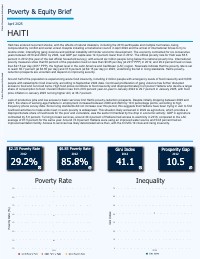
Haiti continues to struggle with severe poverty challenges compounded by recurrent natural disasters, political instability, and escalating gang violence. The economy has contracted for six consecutive years between 2019 and 2024, with real GDP per capita falling 12.3% below 2012 levels. The official poverty rate stood at 58.5% in 2012, with 29.2% of the population living on less than $2.15 per day, the highest rate in Latin America and the Caribbean region.
Nowcast projections indicate a worsening situation, with poverty rates expected to reach 66.7% at $3.65 per day and 37.6% at $2.15 per day by 2025. Approximately half the population experiences acute food insecurity, including 2 million people with emergency-level food insecurity. High inflation rates of 29.7% overall and 36.7% for food prices in January 2025 further exacerbate living conditions.
Rural populations face significantly higher poverty rates at 74.4% compared to 40.1% in urban areas. Educational attainment strongly correlates with poverty levels, with 70.7% of those without education living in poverty versus only 12.7% of those with tertiary education. Access to basic services remains critically limited, with only 40.4% having electricity access, 74.9% using improved water sources, and 54.8% having improved sanitation facilities.
The multidimensional poverty analysis reveals that 68.8% lack access to limited-standard sanitation and 64.3% have no electricity access. With continued security challenges and limited productive employment opportunities, Haiti's poverty reduction prospects remain highly uncertain and dependent on establishing stability and security.
Full Document Text
Extracted text from the original document for search indexing.
Public Disclosure Authorized Poverty & Equity Brief April 2025 HAITI Public Disclosure Authorized Haiti has endured recurrent shocks, with the effects of natural disasters, including the 2010 earthquake and multiple hurricanes, being compounded by conflict and social unrest. Despite installing a transitional council in April 2024 and the arrival of international forces to try to restore order, intensifying gang violence and political instability still hinder economic development. The economy contracted for six consecutive years between 2019 and 2024: by 2024, real GDP per capita was 12.3 percent lower than in 2012. The official poverty rate for Haiti was 58.5 percent in 2012 (the year of the last official household survey), with around six million people living below the national poverty line. International poverty measures show that 58 percent of the population lived on less than $3.65 per day (at 2017 PPP) in 2012, and 29.2 percent lived on less than $2.15 per day (2017 PPP), the highest level in the Latin America and Caribbean (LAC) region. Nowcasts indicate that the poverty rate is set to reach 66.7 percent (at $3.65 per day) and 37.6 percent (at $2.15 per day) in 2025, underlining the fall in living standards. Haiti’s poverty reduction prospects are uncertain and depend on improving security. Public Disclosure Authorized Around half of the population is experiencing acute food insecurity, including 2 million people with emergency levels of food insecurity and 6,000 people with catastrophic food insecurity, according to September 2024 data. Continued proliferation of gang violence has further disrupted access to food and non-food items. High food prices contribute to food insecurity and disproportionately hurt poorer Haitians who devote a larger share of consumption to food. Overall inflation rose from 20.9 percent year-on-year in January 2024 to 29.7 percent in January 2025, with food price inflation in January 2025 running higher still, at 36.7 percent. Lack of productive jobs and low access to basic services limit Haiti’s poverty-reduction prospects. Despite initially dropping between 2020 and 2021, the share of working-age Haitians in employment increased between 2020 and 2023 by 10.6 percentage points, according to high frequency phone survey data. Since living standards did not increase over this period, this suggests that Haitians have been trying in vain to find livelihood activities to make ends meet; in-work poverty is widespread. This situation likely worsened in 2024 as agriculture, which provides a Public Disclosure Authorized disproportionate share of livelihoods for the poor and vulnerable, was the sector hit hardest by the drop in economic activity: GDP in agriculture contracted by 5.6 percent. Turning to basic services, around 40.4 percent of Haitians had access to electricity in 2016, compared to the LAC average of 97.5 percent for the same year. Around 74.9 percent Haitians were using an improved water source and 54.8 percent had an improved sanitation facility. Access to services has likely deteriorated since then, with the COVID-19 crisis and rising insecurity. $2.15 Poverty Rate $6.85 Poverty Rate Gini Index Prosperity Gap 2012 2012 2012 2012 29.2% 85.8% 41.1 10.5 e (%) Rat erty v Poverty Rate Inequality 90 70 60 80 50 70 x e 40 60 d Gini In 30 50 o P 40 30 20 2012 20 10 0 2012 Poverty at Different Lines Poverty Line Number of Poor (Thousands) Rate (%) Year National Poverty Line 6,019.2 58.5 2012 International Poverty Line ($2.15/day) 2,939.6 29.2 2012 Lower Middle Income Class Poverty Line ($3.65/day) 5,843.3 58.0 2012 Upper Middle Income Class Poverty Line ($6.85/day) 8,640.0 85.8 2012 Multidimensional Poverty Measure 46.8 2012 Group and Multidimensional Poverty Poverty by Group Poverty Rate (%) Urban population 40.1 Rural population 74.4 Males 58.9 Females 57.2 4 0 to 14 years old 66.4 15 to 64 years old 53.2 65 and older 55.3 Without education (16+) 70.7 Primary education (16+) 60.3 Secondary education (16+) 44.7 Tertiary/post-secondary education (16+) 12.7 Note: Multidimensional Poverty Components (% of Pop.) Daily income less than US$2.15 per person 29.2 At least one school-aged child is not enrolled in school 9.0 No adult has completed primary education 23.1 No access to limited-standard drinking water 33.5 No access to limited-standard sanitation 68.8 No access to electricity 64.3 N/A denotes a missing/removed value, while N/A* refers to a value which was removed due to having fewer than 30 observations. The rates in the Poverty by Group table above are shown at the $3.65 lower-middle income line. Data for the Poverty by Group table is derived from a 2012 survey and data for the Multidimensional Poverty Components table is derived from a 2012 survey. Poverty Data & Methodology The last national household survey suitable for monetary poverty measurement, the Enquête sur les Conditions de Vie des Ménages Apres le Séisme (ECVMAS), was conducted in 2012. More recent estimates of poverty are constructed using nowcasts. These nowcasts take the 2012 ECVMAS data, combine them with macroeconomic data on economic growth and population growth, construct up-to-date estimates of household consumption levels, and calculate poverty accordingly. Collecting a new household survey with detailed information on consumption is unlikely to be feasible in Haiti in the coming years. Yet other methods, including phone surveys, mobile phone data, and geospatial data may help address Haiti’s data gaps. Poverty in Haiti is measured using the cost-of-basic-needs methodology, applied to the 2012 ECVMAS. Per-capita household expenditure is used as the welfare aggregate and includes both food and non-food expenditures. The poverty line reflects a minimum threshold of 2,300 calories per person per day and is based on a food basket of 26 food items. The national overall poverty line is close to the $3.65 (2017 PPP) international poverty line, being just 0.9 percent higher. The national extreme poverty line is 12.7 percent lower than the $2.15 (2017 PPP) international poverty line. Harmonization The numbers presented in the brief are based on the regional data harmonization effort known as the Socio-economic Database for Latin America and the Caribbean (SEDLAC) - a joint effort of the World Bank and CEDLAS from the National University of La Plata (Argentina). SEDLAC includes 18 countries and more than 300 household surveys since the 80s. Several Caribbean countries have not been included in the SEDLAC project due to lack of data. Since an income-based welfare aggregate is widely used in the region for official poverty estimates, income-based microdata is used for the Global Monitoring Database (GMD) and Global Poverty Monitoring. SEDLAC covers demographics, income, employment, and education. Terms of use of the data adhere to agreements with the original data producers. Latin America & the Caribbean Poverty Economist: Jonathan W. Lain