
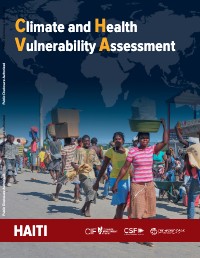
Climate and Health Vulnerability Assessment: Haiti
Summary — This assessment examines climate-related health risks in Haiti and evaluates the health system's adaptive capacity to address climate change impacts. It provides recommendations to enhance health system resilience to climate-related threats.
Key Findings
- Climate change poses significant health risks to Haiti through floods, hurricanes, droughts, rising temperatures, and extreme weather events.
- Key health threats include waterborne diseases, vector-borne diseases (malaria and dengue), nutrition risks, heat-related mortality, and mental health impacts.
- Haiti's health system has limited adaptive capacity with gaps in governance, workforce, financing, and service delivery.
- Malaria and dengue transmission areas are projected to expand under climate change scenarios.
- The country faces increasing food insecurity and malnutrition risks due to climate impacts on agriculture.
Full Description
This comprehensive Climate and Health Vulnerability Assessment for Haiti analyzes the country's exposure to climate-related health risks and evaluates the adaptive capacity of its health system. The assessment examines various climate hazards including floods, hurricanes, landslides, droughts, rising temperatures, and wildfires that pose significant threats to public health.
The document identifies key health risks stemming from climate change, including nutrition risks, waterborne and water-related diseases, vector-borne diseases like malaria and dengue, heat-related morbidity and mortality, air quality health risks, and mental health impacts. It provides detailed analysis of disease patterns and projections for future climate scenarios.
The assessment evaluates Haiti's health system capacity across six building blocks: leadership and governance, health workforce, health information systems, essential medical products and technologies, health service delivery, and financing. It identifies significant gaps in the system's ability to respond to climate-related health threats.
Based on the analysis, the document provides specific recommendations to enhance health system resilience, including strengthening governance structures, improving health financing mechanisms, enhancing service delivery capacity, building health workforce capabilities, and developing robust health information systems for climate-health surveillance.
Full Document Text
Extracted text from the original document for search indexing.
Public Disclosure Authorized Climate and Health Vulnerability Assessment Public Disclosure Authorized Public Disclosure Authorized Public Disclosure Authorized HAITI © 2024 International Bank for Reconstruction and Development/The World Bank 1818 H Street NW Washington DC 20433 Telephone: 202-473-1000 Internet: www.worldbank.org The findings, interpretations, and conclusions expressed in this work do not necessarily reflect the views of the World Bank, its Board of Executive Directors, or the governments they represent. The World Bank does not guarantee the accuracy of the data included in this work. The boundaries, colors, denominations, and other information shown on any map in this work do not imply any judgment on the part of the World Bank concerning the legal status of any territory, or the endorsement or acceptance of such boundaries. Rights and Permissions The material in this work is subject to copyright. The World Bank encourages the dissemination of its knowledge; thus this work may be reproduced, in whole or in part, for noncommercial purposes, as long as full attribution to this work is given. Any queries on rights and licenses, including subsidiary rights, should be addressed to World Bank Publications, The World Bank Group, 1818 H Street NW, Washington, DC 20433, USA; fax: 202-522-2625; e-mail: pubrights@worldbank.org. Cover image: Dajaban Haiti - July 15, 2011: Haitian woman carries a bucket of goods on her head while men carry a poultry crate and sack of grains at Haitian Dominican Republic border market. HAITI Climate and Health Vulnerability Assessment March 2024 CLIMATE INVESTMENT FUNDS CONTENTS ACKNOWLEDGMENTS .................................................................................................................vii LIST OF ABBREVIATIONS ...........................................................................................................viii EXECUTIVE SUMMARY.................................................................................................................. 1 INTRODUCTION ............................................................................................................................. 3 Country Context .................................................................................................................................................... 3 Aims of assessment and conceptual framework............................................................................................ 3 CLIMATOLOGY.................................................................................................................................7 Haiti’s Geography.................................................................................................................................................. 7 Observed and Projected Climate and Sea-Level Rises (SLRs) ...................................................................8 Climate-related Hazards.................................................................................................................................... 10 Floods........................................................................................................................................................................10 Hurricanes................................................................................................................................................................12 Landslides ................................................................................................................................................................13 Droughts...................................................................................................................................................................14 Rising Temperatures .............................................................................................................................................15 Wildfires....................................................................................................................................................................16 CLIMATE-RELATED HEALTH RISKS ............................................................................................19 Nutrition risks ......................................................................................................................................................22 Waterborne and water-related diseases .......................................................................................................25 Vector-Borne Diseases (VBDs) ........................................................................................................................27 Malaria......................................................................................................................................................................27 Dengue ....................................................................................................................................................................30 Heat-Related Morbidity and Mortality ............................................................................................................32 Air Quality Health Risks .....................................................................................................................................33 Mental Health and Well-being..........................................................................................................................34 ADAPTIVE CAPACITY ..................................................................................................................39 Health system overview ....................................................................................................................................39 Leadership and Governance ............................................................................................................................40 Health workforce.................................................................................................................................................42 Health information and disease surveillance systems................................................................................44 Essential medical products and technologies ..............................................................................................45 Health Service Delivery ....................................................................................................................................46 Financing...............................................................................................................................................................48 iv | Climate and Health Vulnerability Assessment: Haiti RECOMMENDATIONS TO ENHANCE HEALTH SYSTEM RESILIENCE TO CLIMATE CHANGE .........................................................................................................................................51 Leadership and Governance ............................................................................................................................52 Health financing...................................................................................................................................................52 Service Delivery...................................................................................................................................................52 Health workforce.................................................................................................................................................53 Health Information Systems..............................................................................................................................53 ANNEXES ......................................................................................................................................55 Annex A. Methods for estimating mosquito suitability in Haiti, under RCP8.5 .....................................55 Annex B. Assumptions on the course of future global climate change .................................................55 REFERENCES ................................................................................................................................ 57 LIST OF FIGURES Figure 1. World Health Organization (WHO) operational framework for climate-resilient healthcare systems........................................................................................................................................................5 Figure 2. Administrative boundaries of Haiti’s departments...............................................................................5 Figure 3. Projected average monthly temperatures and precipitation levels in Haiti..................................8 Figure 4. Total population living below 1 m above the sea level in Haiti, by department...........................10 Figure 5. Hurricane Matthew’s trajectory in the Caribbean Basin....................................................................12 Figure 6. Risk of landslide hazard.............................................................................................................................14 Figure 7. Hazard climate drought zones..................................................................................................................15 Figure 8. Top 10 causes of total number of deaths in 2019 and percentage change, 2009–2019, all ages combined....................................................................................................................................................... 20 Figure 9. Top 10 risks contributing to the total number of DALYs in 2019 and percent change, 2009–2019 — all ages combined.............................................................................................................................21 Figure 10. Stages of the food system that drive healthy and sustainable diets...........................................23 Figure 11. Acute food insecurity, Sept 2021 (Rural + Urban) .............................................................................24 Figure 12. Enteric infections deaths per 100,000 in the LAC region...............................................................26 Figure 13. Geographic and temporal distribution of malaria vectors..............................................................29 Figure 14. Spatial and temporal distribution of dengue vectors .......................................................................31 Figure 15. WHO’s health system building blocks .................................................................................................40 Figure 16. WHO’s Operational framework for building climate-resilient health systems ...........................51 Contents | v LIST OF TABLES Table 1. Projections on precipitation extremes for the 2030s and the 2050s, based on a high-emissions scenario of RCP8.5..........................................................................................................................11 Table 2. Heat index days (> 35°C) anomaly projections, under high-emissions scenario RCP8.5..........16 Table 3. Flood and storm events in Haiti from 1991 to 2020.............................................................................21 Table 4. Child stunting, wasting, and mortality rates, by department............................................................24 Table 5. Number of malaria cases in Haiti in 2014, by geographic department .........................................28 Table 6. Current and projected suitable areas for malaria vectors, by department ..................................29 Table 7. Vulnerable populations and areas suitable for malaria vectors.......................................................30 Table 8. Regional and global comparisons of deaths attributable to outdoor air pollution, household air pollution, and fine particulate matter in Haiti, 2016.................................................................34 Table 9. Summary of the Climate Change Risks on Health Outcomes .........................................................36 Table 10. Key policies and action plans in Haiti that consider climate change challenges......................40 Table 11. Number of healthcare facilities, by type, across provinces ............................................................ 47 Table 12. Summary of the health system adaptive capacity gaps for Haiti ..................................................50 vi | Climate and Health Vulnerability Assessment: Haiti ACKNOWLEDGMENTS This Climate and Health Vulnerability Assessment (CHVA) for Haiti was produced by the Health- Climate, Environment and Disasters (HCED) program in the Health, Nutrition and Population (HNP) Global Practice of the World Bank, which is led by Tamer Rabie. It is authored by April Frake, Christopher Boyer, Mikhael Iglesias, Claire Bayntun, Stephen Dorey, and Tamer Rabie. The authors sincerely appreciate the valuable contributions provided by Ana Lucrecia Rivera-Rivera, Muloongo Simuzingili, and Loreta Rufo. This work also benefited from the administrative support of Fatima-Ezzahra Mansouri, the editorial work of Kah Ying Choo, and the production of Sarah Jene Hollis. The authors are also highly grateful to the HNP management for their strong support of the HCED program and this product and would like to extend their thanks to Juan Pablo Uribe and Monique Vledder. The authors are thankful to the Africa Climate Resilient Investment Facility (AFRI-RES) Trust Fund, Climate Investment Funds (CIF) and the Climate Support Facility (CSF) for funding this work. Acknowledgments | vii LIST OF ABBREVIATIONS AAP Ambient Air Pollution AIDS Acquired Immunodeficiency Syndrome AR6 Assessment Report 6 [of the IPCC] CCKP Climate Change Knowledge Portal [of World Bank] CFP Ciguatera Fish Poisoning CHVA Climate and Health Vulnerability Assessment CHE Current Health Expenditure CHEVT Climate and Health Economic Valuation Tool CMIP5 Coupled Model Intercomparison Project Phase 5 COPD Chronic Obstructive Pulmonary Disease COVID-19 Coronavirus 2019 CRU Climatic Research Unit [University of East Anglia, UK] CVD Cardiovascular Disease DALYs Disability Adjusted Life Years DCC Direction des Changements Climatique DRM Disaster Risk Management EU European Union FCV Fragility, Conflict, and Violence GBS Guillain-Barré Syndrome GCCA Global Climate Change Alliance GCM General Circulation Model GDP Gross Domestic Product GHG Greenhouse Gas [emissions] GWP Global Warming Potential HAP Household Air Pollution HFG Health Finance and Governance HIS Health Information System(s) HIV Human Immunodeficiency Virus HNAP Haiti National Adaptation Plan HNP Health, Nutrition and Population HRH Human Resources for Health HSS Health Systems Strengthening ICU Intensive Care Unit IHME Institute for Health Metrics and Evaluation IHR International Health Regulation INDC Intended Nationally Determined Contribution(s) IPC Integrated Food Security Phase Classification IPCC Intergovernmental Panel on Climate Change LAC Latin America and the Caribbean LULC Land Use and Land Cover MDE Ministère de L’Environnement MSPP Ministère de la Santé Publique et la Population NAP National Adaptation Plan NAPA National Adaptation Plan of Action NCD Noncommunicable Disease viii | Climate and Health Vulnerability Assessment: Haiti NDC Nationally Determined Contribution(s) NOAA National Oceanic and Atmospheric Administration NGO Nongovernmental Organization OFATMA Office d’Assurance Accident du Travail, Maladie et Maternité ONA Office National d’Assurance Vieillesse OOP Out-of-Pocket (spending on health) PAHO Pan American Health Organization PES Essential Service Package PHC Primary Health Care PIH Partners in Health PM2.5 Fine Particulate Matter PSDH Strategic Development Plan of Haiti PSP Paralytic Shellfish Poisoning PTG Post-Traumatic Growth RCP Representative Concentration Pathway SIDS Small Island Developing State SLCP Short-Lived Climate Pollutant SLR Sea-Level Rise SOPs Standard Operating Procedures SPEI Standardized Precipitation Evapotranspiration Index SPCR Strategic Program for Climate Resilience SDGs Sustainable Development Goals STMM Short-Term Medical Mission UHC Universal Health Coverage USAID United States Agency for International Development VBD Vector-Borne Disease WaSH Water, Sanitation, and Hygiene WBD Waterborne Disease WHO World Health Organization List of Abbreviations | ix EXECUTIVE SUMMARY Haiti is highly vulnerable to the impacts of climate change due to its geographic location, low economic development, and limited resources. The country’s geograph ical location — characterized by its presence on the Atlantic hurricane belt and on a low-lying coastal plain — makes it particularly susceptible to sea- level rises (SLRs), rising temperatures, hurricanes, and heavy rainfalls — all of which are projected to become more frequent and intense due to global warming. Over the past 30 years, Haiti has experienced 34 flooding events, 35 significant storms, and 31 hurricanes including Hurricane Matthew in 2016. Haiti also experiences periodic droughts that have impacted its agricultural production and exacerbated food insecurity. Climatic hazards are also exacerbating Haiti’s vulnerability to fragility, conflicts, and violence (FCV), further stressing the need for immediate action. Climate-related hazards — such as hurricanes, droughts, and floods — have destroyed crops, disrupted food production, and led to food insecurity and malnutrition. This can contribute to further social unrest and conflicts, especially among vulnerable communities. Severe weather events impacting the country have also caused significant damage to infrastructure, homes, and communities, forcing people to flee their homes and seek refuge elsewhere. Climate hazards in Haiti have also disrupted economic activity and caused significant losses to agriculture, fisheries, and other livelihoods, thereby exacerbating poverty and unemployment, and likely contributing to social instability and conflict. These factors highlight the importance of addressing the underlying vulnerabilities that make Haiti susceptible to FCV and of taking effective measures to mitigate and adapt to the impacts of climate change. Climate-related health risks in Haiti are significant; they are projected to increase the disease burden of the country. Identified climate-related health risks include (1) increased injuries and fatalities due to extreme weather events, (2) increased heat-related morbidity and mortality, (3) increased nutritional risks, (4) increases in water-related diseases, (5) increases in vector-borne diseases (VBDs), (6) exacerbation of respiratory risks, and (7) decline of physical / mental health and well-being. While the government of Haiti is committed to addressing climate change through multiple national plans, further efforts are required to strengthen the adaptive capacity of the country’s health system to address its growing needs. Notably, the country still lacks adequate funding for climate-health programming and infrastructure, as well as adequate integration of climate-informed interventions such as early-warning monitoring systems. 1 Five key recommendations are proposed in this CHVA to improve the health system’s adaptive capacity to growing climate-related health risks: 1. Incorporate climate change into health plans and strategies, thus creating a governance and policy landscape that would contribute to strengthening the country’s health system resiliency. 2. Provide budget lines to channel funding for implementing climate-health interventions. 3. Strengthen health service delivery amid extreme weather events and prioritize support for frontline communities. 4. Expand information systems that are already in place, such as Haiti Data, thus enabling the collection and analysis of climate and health data. 5. Develop building codes that are aimed at strengthening the existing health facilities’ resiliency to climate hazards. 2 | Climate and Health Vulnerability Assessment: Haiti SECTION I. INTRODUCTION COUNTRY CONTEXT 1. Haiti is highly vulnerable to the impacts of climate change — due to its geographic location, low economic development, and limited resources. Haiti’s geographical location — characterized by its presence on the Atlantic hurricane belt and a low-lying coastal plain — makes the country particularly susceptible to sea-level rises (SLRs), rising temperatures, hurricanes, and heavy rainfalls, which are projected to become more frequent and intense due to global warming. Over the past 30 years, Haiti has experienced 34 flooding events, 35 significant storms, and 31 hurricanes including Hurricane Matthew in 2016. Haiti is also affected by periodic droughts that have impacted its agricultural production and exacerbated food insecurity. 2. Climatic hazards are also exacerbating Haiti’s vulnerability to fragility, conflict, and violence (FCV), further magnifying the need for immediate action. Climate-related hazards, such as hurricanes, droughts, and floods, have destroyed crops, disrupted food production, and led to food insecurity and malnutrition. This can contribute to further social unrest and conflicts, especially among vulnerable communities. Severe weather events impacting the country have also caused significant damage to infrastructure, homes, and communities, forcing people to flee their homes and seek refuge elsewhere. Climate hazards in Haiti have also disrupted economic activity and caused significant losses to agriculture, fisheries, and other livelihoods, thereby exacerbating poverty and unemployment, and likely contributing to social instability and conflicts. These factors highlight the importance of addressing the underlying vulnerabilities that make Haiti susceptible to FCV and of taking effective measures to mitigate and adapt to the impacts of climate change. AIMS OF ASSESSMENT AND CONCEPTUAL FRAMEWORK 3. The objective of this Climate and Health Vulnerability Assessment (CHVA) is to assist decision-makers with planning effective adaptation measures to deal with climate related health risks. Where available, these measures are also provided at the subnational level to assist regional health planners. The recommendations of this CHVA are primarily aimed at the health sector; however, related sectors influencing health risks that stem from climate changes, such as DRM, are also included. The target audience includes, but is not limited to, the country’s Ministry of Health, Ministry of Environment, and any other ministry involved in addressing climate-related health risks, as well as nongovernmental organiza tions (NGOs) that are involved in supporting projects and programs for the health system in Haiti. 4. Adaptation priorities need to run alongside fundamental and urgent action to mitigate 3 climate change. It is important to stress how complex the climate challenge is and how hard it is to predict with accuracy how severe climate exposures facing populations will become. There are many factors that could slightly slow or significantly speed up the rates of change, including positive feedback effects and, most worrying of all, cascading climatological tipping points. For this reason, mitigating existing greenhouse gas emissions (GHGs), as well as developing and implementing measures to protect human development from the changing climate, is of paramount importance. 5. Investing in adaptation strategies to proactively address the effects of climate change on health outcomes is critical. This assessment is focused on the climate risks to health and health systems, the adaptive capacities in place to deal with these risks, and the recommendations to meet identified gaps. The primary focus of this assessment is, therefore, on climate adaptation and resilience measures. However, as the Assessment Report Six (AR6)1 of the Intergovernmental Panel on Climate Change (IPCC) makes clear, “Global surface temperature will continue to increase until at least the mid-century under all emissions scenarios considered.” Mitigation is no longer a sufficient strategy, regardless of the pace of the response of governments and communities around the world. Adaptation is now as critical a part of climate action as mitigation. Therefore, although this report is focused on adaptation measures, it also includes recommendations on reducing the healthcare sector’s carbon footprint. 6. The World Health Organization’s (WHO) operational framework for building climate-re silient health systems is adopted to analyze the adaptive capacity to adequately deal with current and future identified risks. Based on this framework (Figure 1), the assessment is structured around the six health systems strengthening (HSS) building blocks. These six categories offer a structure for organizing the assessment of capacities and gaps — now and into the future. The framework then moves on to consider WHO’s operational framework to develop the Recommendations section. 7. This assessment follows a stepwise linear approach. The first step characterizes the climatology in Haiti — highlighting the observed and future climate exposures relevant to health. The second step examines climate-related health risks, including identifying vulnerable populations. The final step assesses the adaptive capacity of the health system — identifying gaps for the management of current and future climate-re lated health risks. Together, these steps inform a series of recommendations for reducing climate-related health vulnerability in Haiti. The assessment is based on a review of the published literature, as well as national and international quantitative and qualitative data. 8. The assessment incorporates subnational considerations for health-related climate action. Within the context of this assessment, 10 administrative departments of Haiti were considered: Artibonite, Centre, Grand’Anse, Nippes, Nord, Nord-Est, Nord-Ouest, Ouest, Sud-Est, and Sud (Figure 2). 4 | Climate and Health Vulnerability Assessment: Haiti FIGURE 1. World Health Organization (WHO) operational framework for climate-resilient healthcare systems CLIMATE RESILIENCE Climate & Health Financing Leadership & Governance Leadership & Governance Financing Health Workforce Health Workforce Vulnerability, Capacity & Adaptation Assessment Early Integrated Risk Emergency Preparedness & Management Service BUILDING BLOCKS OF HEALTH SYSTEMS Health Information Systems Warn ni g Monitor ni g & Climate Programs Informed Health Delivery Essential Medical Products & Technologies Health & Climate Research Management of Climate Resilient Environmental stainable u Detriments & S chnologies of Health & Infrastructure e T Source: World Health Organization, 2015, Operational Framework for Building Climate Resilient Health Systems. FIGURE 2. Administrative boundaries of Haiti’s departments Source: World Bank Cartography Unit. Introduction | 5 SECTION II. CLIMATOLOGY 9. This section describes observed climatic changes and projected climate trends, highlighting priority climate-related exposures that should be considered in relation to human health risks. Climate information is taken from the World Bank Group’s Climate Change Knowledge Portal (CCKP), where historical, observed data is derived from the Climatic Research Unit, University of East Anglia (CRU). Observed changes in mean annual temperatures, mean maximum temperatures, mean minimum temperatures, and precipitation levels from the CCKP are derived from the CRU TS version 4.05 gridded dataset for the 1901–2020 period. Model-based climate projection data is derived from the Coupled Model Intercomparison Project Phase 5 (CMIP5) collection. CMIP5 is a standard framework for the analysis of coupled atmosphere-ocean general circulation models (GCMs), providing estimates of future temperature and precipitation scenarios. Projected changes are explored under the IPCC representative concentration pathway (RCP) 8.5a for the short term (2030s; 2020–2039) and the medium term (2050s; 2040–2059). HAITI’S GEOGRAPHY 10. Haiti is predominantly situated on the western portion of the island of Hispaniola in the Caribbean Sea, with smaller islands surrounding the country, including Île-à Vache, Gonâve, Grosse Caye, Les Cayemites, Navassa, and Tortuga Island. The mainland consists of mountains, plains, and valleys, which influence the climate conditions across the country. The mountainous northern region and the Northern Plain along the northern border with the Dominican Republic range in elevation from 600 to 1,100 meters (m). The central region consists of the Central Plateau that spans 85 kilometers (km) from the southeast a Information is provided for RCP4.5 in Annex B of this report. to northwest, with a width of 30 km. To the southwest of the Central Plateau are the Montagnes Noires, with elevations of up to approximately 600 m. The southern region consists of the Plaine du Cul-de-Sac and the mountainous southern peninsula. The Plaine du Cul-de-Sac is a natural depression that is 12 km wide; it extends for 32 km from the border with the Dominican Republic to the coast of the Baie de Port-au-Prince. The mountains of the southern peninsula extend from the Massif de la Selle in the east to the Massif de la Hotte in the west. The range’s highest peak — the Morne de la Selle — is the highest point in Haiti, rising to an altitude of 2,715 m. The Massif de la Hotte varies in elevation from 1,270 m to 2,255 m. 7 Moreover, numerous rivers and streams traverse the plains and mountainous areas. The largest drainage system in the country is that of the Artibonite River. Rising from the foothills of the Massif du Nord as the Libón River, the river crosses the border into the Dominican Republic and then forms part of the border before re-entering Haiti as the Artibonite River. The 400-km Artibonite River is only one meter deep during the dry season, and it may even dry up completely in certain spots. During the wet season, it is more than three meters deep and subject to flooding. OBSERVED AND PROJECTED CLIMATE AND SEA-LEVEL RISES (SLRS) 11. Haiti has a hot and humid tropical climate that can be separated into six climate zones. The country is predominantly tropical savannah (55 percent), tropical rainforest (25 percent), and tropical monsoon (14 percent). These areas are characterized by high temperatures and precipitation rates. The wet season is long, particularly in the northern and southern FIGURE 3. regions of the island, with two pronounced peaks occurring between March and November. The remainder is arid (2.5 percent) — temperate without a dry season and with a hot summer (2.2 percent), or temperate with a dry winter and warm summer (1.7 percent). The north wind brings fog and drizzle, inter rupting Haiti’s dry season from November to January. However, from February to May, the weather is very wet. Northeast trade winds bring rains during the wet season. Monthly temperatures typically range from 19°C to 28°C in the winter and from 23°C to 33°C during the summer months (Figure 3). Northern and windward slopes in the mountainous regions receive up to three times more precipitation than the leeward side; annual precipitation in the mountains averages 1,200 millimeters (mm). In contrast, the annual precipitation in the lowlands is as low as 550 mm; the Plaine du Gonaïves and the eastern part of the Plaine du Cul-de-Sac are the driest regions in the country. Projected average monthly temperatures and precipitation levels in Haiti 120 mm 30 ˚C 29 ˚C 100 mm 28 ˚C 27 ˚C 80 mm 26 ˚C 25 ˚C 60 mm 24 ˚C 40 mm 23 ˚C 22 ˚C 20 mm 21 ˚C 20 ˚C 0 mmJan Dec Feb Mar Apr May Jun Jul Aug Sep Oct Nov Historical Ref. Period, 1986-2005 2020-2039 2040-2059 Historical Ref. Period, 1986-2005 2020-2039 2040-2059 Source: World Bank Climate Change Knowledge Portal 8 | Climate and Health Vulnerability Assessment: Haiti 12. There is already evidence of the climate changing in Haiti: as Section III of this report will show, this situation is leading to significant human health impacts. Annual mean temperatures have steadily increased over the past half century. Since 1960, mean temperatures have risen by 0.45°C. Much of this warming has occurred between June and November. Temperatures across Haiti are fairly uniform: the variation in the subnational annual temperature is only approximately 2°C on average. The southwestern departments of Nippes, Grand’Anse, and Sud experience the warmest temperatures throughout the year, while the eastern departments of Centre and Sud-Est experience the coolest. 13. Precipitation is asymmetrical, due to the orientation of Haiti’s mountain chains and the rain-bearing northeast trade winds. On a national scale, variations in the average annual rainfall since the early 1900s have varied by less than 2 mm, with a rising trend recorded over time. Overall, Artibonite (1144 mm), Nord-Ouest (1198 mm), and Nord-Est (1220 mm) receive the least amount of average annual rainfall, while Sud (1955 mm) and Grand’Anse (1806 mm) receive the most. The heaviest rainfall has historically occurred in May for most departments, except for Grand’Anse, Nippes, and Sud-Est; they receive the most rainfall in October, with the Nord experiencing the heaviest rainfall in November. 14. The average national temperature will increase by 0.88°C in the 2020–2039 period and by 1.7°C in the 2040–2059 period, resulting in average temperatures of 26.35°C and 27.17°C, respectively. The month of September will have significant temperature increases for the two time periods, that is, 1.04°C and 1.81°C, respectively. Sub-nationally, the Nord-Est department will experience the highest increase (0.92°C by 2020–2039 and 1.76°C by 2040–2059). The maximum temperature is projected to reach an average of around 30°C (for both time periods), with the highest average maximum temperatures experienced in the Artibonite (31.27°C) and Nord (31.17°C) departments by 2020–2039. Moreover, the increases in the number of tropical nights (that is, where temperatures > 20°C), at the national level, are also expected to be 31.54 by 2020–2039 and 51.81 by 2040–2059. 15. Precipitation is expected to increase to 632.74 mm/year (+26.27 mm) by the 2020–2039 period, but it will decrease to 588.49 mm/year (–17.97 mm) by the 2040–2059 period. The month of October will experience the greatest increase of precipitation (+8.26 mm), while the greatest decrease (–7.7 mm) will take place in September during the 2020–2039 period. However, by the 2040–2059 period, there will be a decrease in precipitation of 18.95 mm in May. The department of Grand’Anse will experience the highest precipitation increase for the 2020–2039 period. However, all the departments will experience a decrease for the 2040–2059 period. 16. Over the past century, the rate of SLRs has roughly tripled in response to the increase in the global temperature of 0.8°C. SLRs pose a significant threat to islands across the globe, including Hispaniola. Since the 1950s, the mean SLR in the Caribbean region has been approximately 1.8 mm/year. Historic sea-level data recorded from Haiti are sparse: published tide tables from the National Oceanic and Atmospheric Administration (NOAA) for the Port-au-Prince date back to only 2019. The IPCC AR6 in 20212 reported that the mean global sea surface rose by 0.20 m between 1901 and 2018 — constituting an average SLR Climatology | 9 FIGURE 4. Total population living below 1 m above the sea level in Haiti, by department Source: Climate Central Risk Finder. 2021. Total population below 1m in Haiti by department. https://riskfinder.climatecentral. org/country/haiti?comparisonType=department&forecastType=BK_RCP85_p50&impact=Population_Worldpop15&level=1&pro tection=unprotected&unit=m of 1.3 mm/year between 1901 and 1971 and 1.9 mm/year during the 1971–2006 period. 17. Available information suggests that SLR trends in the Caribbean have been broadly similar to global trends over this same period.3 In Haiti, it is expected that SLRs will increase by 0.21 m (0.17–0.24 m) by the 2030s and by 0.35 m (0.30–0.40 m) by the 2050s.4 Considering the country’s topography, the Artibonite and Ouest departments have a great part of their land below 1 m above the sea level, where around 165,000 Haitians live (see Figure 4). CLIMATE-RELATED HAZARDS 18. Haiti is vulnerable to several extreme climate-related events that will be exacerbated by ongoing climate change. The most common are floods and hurricanes; but they also include landslides, droughts, and extreme temperatures. The impacts of these hazards are further compounded by anthropogenic causes, including deforesta tion, coastal degradation, and urbanization. FLOODS 19. Floods are the leading factor of vulnerability in Haiti and throughout history. Since 1991, the country has experienced 34 flood events (25 riverine floods, eight flash foods, and one coastal flood),5 with the most populated cities — all nestled in valleys along the coast — most affected. Widespread deforestation in the upper reaches of these valleys, coupled with the lack of drainage infrastructure, has created an environment that is conducive to flooding. When it rains, the steep, often barren, hills surrounding them flush rainwater toward the urban areas. Riverine floods have impacted more than 502,910 people, leaving 3,024 lives lost and estimated damages of USD2,157,000,6 since 1991. Almost all of Haiti’s 30 major watersheds are of concern, because of intense seasonal rainfall, storm surges in the coastal zones, and a deforestedb and eroded landscape. Given b Haiti is one of the most deforested countries in the world, with forest cover estimated at just 1.5 percent. 10 | Climate and Health Vulnerability Assessment: Haiti the near-complete absence of embankments and levees, this cycle then intensifies the next round of flooding, leading to the destruction of crops, farmlands, and agricultural infrastruc ture, as well as losses of livestock and human lives. On the other hand, coastal and flash floods account for approximately 85 percent of flooding cases. Flash floods have also resulted in adverse consequences since 1991 — 120,112 people affected, 98 lives lost, and damages estimated at USD1,439,000.7 20. There is high confidence that storm surges will increase in tandem with the mean SLRs, thus leading to more coastal flood hazard8 Haiti’s coastal flood hazard is classified as “medium,” that is, more than a 20 percent chance of potentially damaging coastal flood waves occurring in the next 10 years.9 Its riverine and urban flood hazards are classified as “high,” which means that potentially damaging and life-threatening river floods and urban floods are expected to occur at least once in the next 10 years. Although the surface flood hazard in urban and rural areas is not included in this hazard classification, it may also be possible in the coming years. 21. Extreme precipitation magnitudes are projected to increase over the 2030s and 2050s. The average largest 1-day precipi ta¬tion level will increase slightly to 43.15 mm (+1.76 mm) on an annual average by the 2030s (compared to the 1986–2005 period) TABLE 1. and remain similar in the 2050s, at the national level. During the 2030s, the largest increase, with more risks of flooding, will be in October during the wet season (April to October). As for the 2050s, there will be a slight decrease in the average largest 1-day precipitation level (42.35 mm) (see Table 1). Sub-nationally, the greatest increases will be taking place in the Sud-Est and Ouest departments (+5.59 mm and +5.05 mm for the 2030s, along with +7.24 mm and +7.03 mm for the 2050s, respectively). On the other hand, projections of the 5-day cumulative precipitation, where areas can become saturated over several days, present a different flood risk. There will be an average increase of 9.68 mm for the 2030s nationally, especially during the rainy months, with the Grand’Anse department experiencing the greatest increase (+20.2 mm). In the case of the 2050s, there will be a slight decrease nationally (–2.33 mm), with Nord-Ouest expe riencing the greatest decrease (–6.69 mm), while Grand’Anse will experience increases in its average 5-day cumulative rainfall (9.57 mm, anomaly). Lastly, while average largest 1-day precip itation (in mm) will increase, the number of consecutive wet days will decrease for the 2030s and 2050s (–0.86 mm and –6.62, respectively). Also, the rainy days are going to be more scattered throughout the seasons. Projections on precipitation extremes for the 2030s and the 2050s, based on a high-emissions scenario of RCP8.5 2020–2039 2040–2059 Avg largest 5-day cumulative (mm) 116.65 104.64 43.15 71.46 Avg largest 1-day (mm) 42.35 Consecutive wet days 65.7 Source: World Bank Climate Change Knowledge Portal Climatology | 11 HURRICANES 22. Haiti lies in the Caribbean hurricane corridor; thus, it is regularly affected by storm surges (see Figure 5). The country is mainly subject to tropical waves, which tend to be influenced by the intertropical convergence zone and carried from east to west by trade winds. These climate events can lead to tropical cyclogenesis and produce cyclonic systems characterized by excessive rainfall and strong winds, resulting in the formation of storms: convective storms, tropical storms, or hurricanes.10 Haiti’s storm season goes from June through November, affecting mostly the West and South departments. Hurricanes constitute the second-most frequent disaster type, representing 40 percent of the country’s total disasters.11 Hurricanes are also highly hazardous, with an approximately 20 percent chance of damaging wind speeds.12 From 1991 to 2020, Haiti experienced a total of 35 storms — 31 hurricanes, three tropical storms, and one FIGURE 5. Hurricane Matthew’s trajectory in the Caribbean Basin convective storm. In 2021, Haiti was ranked third among the countries most affected by extreme weather events in the world.13 23. In 2016, Hurricane Matthew made landfall in Haiti, and subsequently, became one of the most destructive hurricanes for Haiti. The country was subjected to days of intense precipitation, with the total exceeding 30 inches in some locales.14 Due to its steep, deforested terrain, Haiti was vulnerable to floods and at risk of mudslides.15 The intense precipitation resulted in extensive flooding, infrastruc ture damage, crop losses, and significant mortality.16,17 The hurricane also led to 600 deaths, with 2.1 million people impacted,18 including over 50,000 internally displaced.19 Sub-nationally, the hurricane caused consid erable damage to the southern peninsula and the northwestern parts of the country.20 In particular, the Grand’Anse and Sud — both of which were located in the southwestern tip of Hispaniola — were the most affected. Source: Knapp, K. R., M. C. Kruk, D. H. Levinson, H. J. Diamond, and C. J. Neumann, 2010: The International Best Track Archive for Climate Stewardship (IBTrACS): Unifying tropical cyclone best track data. Bulletin of the American Meteor. Society, 91, 363-376. doi:10.1175/2009BAMS2755.1 12 | Climate and Health Vulnerability Assessment: Haiti 24. Severe hurricanes are projected to increase in frequency and severity. Haiti’s geograph ical location along the hurricane corridor will worsen the country’s vulnerability under climate change scenarios. By 2050, rainfall from hurricanes is expected to increase by 20–30 percent near the center, and by 10 percent in the outer circle of the hurricane (200 km or larger). Wind speeds from hurricanes will also increase by 2–11 percent.21 Although the frequency of Atlantic storms is projected to decrease, the most severe hurricanes from the Atlantic that will make an incursion into the Caribbean will increase its frequency by 80 percent by the end of the century.22 Cities such as Port-au-Prince and Gonaïves are 2–4 times more vulnerable to tropical storms than any other city in the country.23 Increases in hurricane frequency and overall storm intensity will worsen flood and storm surge risks in the country.24 LANDSLIDES 25.High deforestation rates, coupled with changing rainfall patterns, make landslides commonplace and particularly dangerous in steep sloping lands.25 On many Caribbean islands, frequent heavy rains, the mountainous topography, and the volcanic geology combine to create high-hazard conditions for landslides (see Figure 6). On some slopes, landslides are common even when rainfall is only mild. The relationship between landslides and climate change is complex. While changes in rainfall and temperature may lead to more landslides, the increasing frequency of droughts, as projected in Haiti, may decrease the likelihood of these events.26 In Haiti, landslides are common along all river valleys, where years of deforestation have left the upper reaches of the western basins bare. 26. Landslides are among the climate change related hazards that Haiti experiences. Even though landslides are the least frequent disaster in the country (1 percent of the reported natural disaster distribution),27 Haiti’s geographic location, which places it in the path of the Atlantic hurricanes, combined with the steep topography of its western region from which all major river systems flow to the coast, makes the country particularly vulnerable to landslides, especially between June and December. Taking into consideration the slope, the slope orientation, the water flows in the land, as well as hillside and geological factors, it is observed that most of Haiti has a moderate level of landslide susceptibility. At the subnational level, the highest levels of landslide susceptibility are in the zones where the mountains are located, especially in the southern and southeastern parts of Haiti, due to the slope factor.28 Port-au-Prince is one of the cities with the highest landslide risk (“very high”), especially its southern part. Also, in Léogâne — a city located in the western part of Port-au-Prince, the landslide risk is rated as “high” and “very high” (see Figure 6). In terms of potential damage, highways are highly susceptible to landslides, especially in the southern part of the country. For example, the highway that connects Port-au-Prince and Léogâne, along with the highway that starts in Port-au-Prince and continues to the eastern part of the country, are two of the riskiest roads in the country29 (see Figure 6). 27. Projections about extreme precipitation events suggest that they would be the main trigger for future landslides. Increases in the average largest 1-day precipitation level for the 2030s indicate that landslides could occur concomitantly. Projections for the 2050s underline a decrease in rainfall, Climatology | 13 FIGURE 6. Risk of landslide hazard Source: Global Facility for Disaster Reduction and Recovery. 2021. Climate Risk and Adaptation Country Profile: Haiti. https://www.gfdrr.org/en/publication/climate-risk-and-adaptation-country-profile-haiti. which could reduce the risk of landslide. At the same time, the increased frequency and intensity of hurricanes could impact Haiti’s steep topography, resulting in more landslides. DROUGHTS 28. Haiti is susceptible to droughts due to rising temperatures related to climate change, deforestation, and limited water management infrastructures. Haiti is affected by the El Niño-Southern Oscillation — a climatic pattern that generates large-scale anomalies that increases surface temperatures in the Pacific Ocean. This climate phenomenon delays the start of the cyclone seasons, as well as increases the dry season. Departments in the North-West, Artibonite, North-East, and Central have experienced repeated droughts (see Figure 7).30 From 1991 to 2020, the country went through five drought periods due to irregular and insufficient rainfall, resulting in crop failures, food shortages, and therefore, famine.31 These events tend to appear during the dry season (generally from December to April), exacerbated by the influence of the El Niño Southern Oscillation. The five drought events have affected 8,855,521 people.32 29.As rainfall will decrease for the 2050s, droughts are expected to become more extreme.33 The annual Standardized Precipi tation Evapotranspiration Index (SPEI) drought index measures drought severity according to its intensity and duration. Negative SPEI values indicate a negative water balance, whereby the −2 value equates to “severe drought.” The annual SPEI drought index values for Haiti will be −0.42 for the 2030s and −0.68 for the 14 | Climate and Health Vulnerability Assessment: Haiti FIGURE 7. Hazard climate drought zones Source: HaitiData.org. https://haitidata.org/layers/geonode_data:geonode:hti_hazardclimate_droughtzone_polygon_052010. 2050s.34 Although proje